Beauty and Mystery in Butterflyland
eggs, butterfly and butterflies
BEAUTY AND MYSTERY IN BUTTERFLYLAND a joy to be a child or a butterfly on a happy day of sunshine and merry winds! While a bee is all busyness because there is so much to do putting away honey for the winter, the butterflies haven't a care in the world.
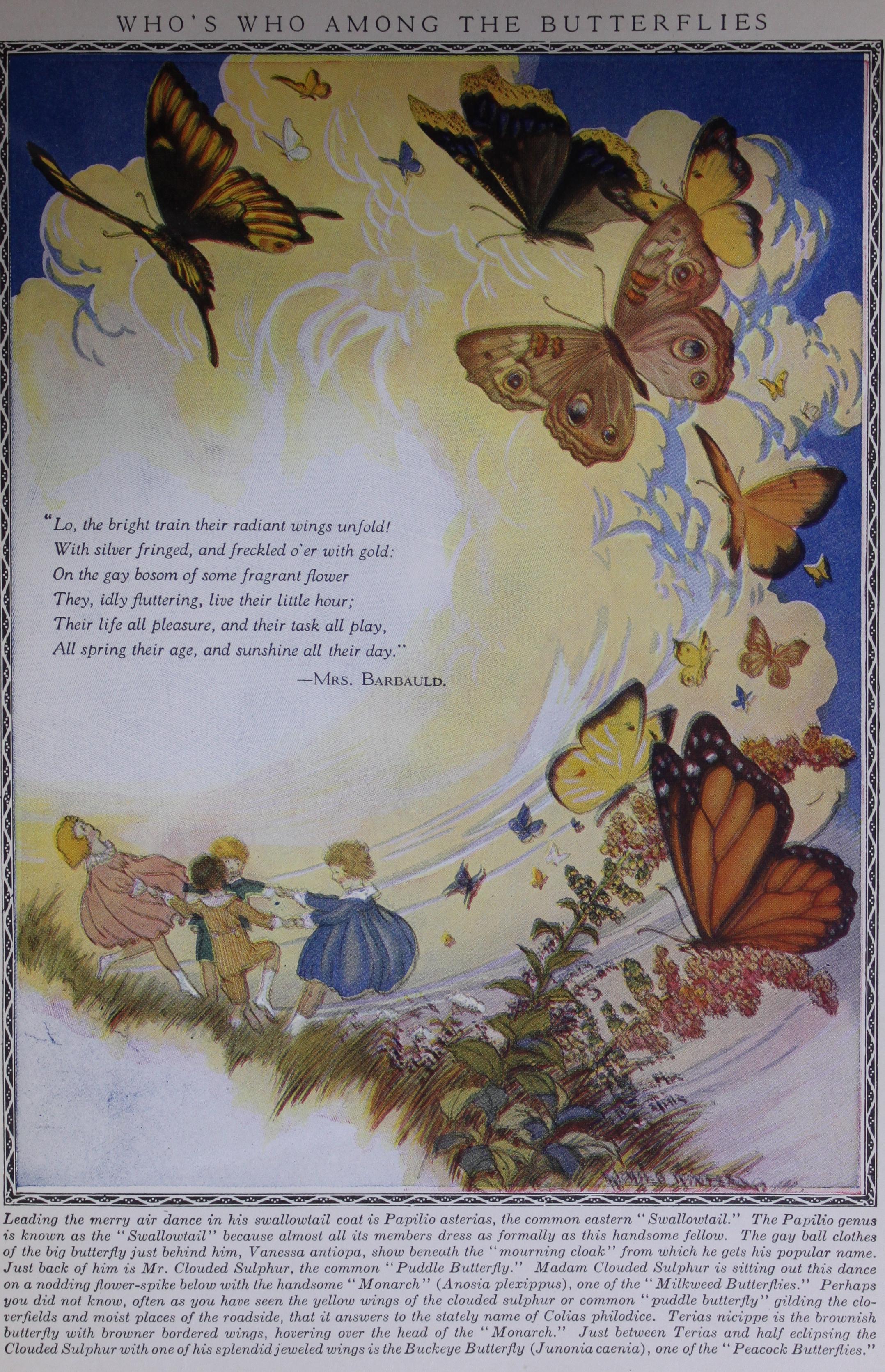
Nobody to look after but themselves, living on an occasional sip of nectar, they spend the livelong day flitting and drifting about like this in the golden air.
It is the "wondrous sculptured dust," the scales on their wings, that break up the rays of sunlight falling upon them and produce all the beautiful colors and shadings of butterflies and moths. But a long time before they get their wings—as time is measured in Butterflyland—these winged creatures of the sun are beautiful. If they celebrated Easter in Butterflyland, they wouldn't have to bother about coloring their Easter eggs; for the eggs of both butterflies and moths are not only remarkable for variety of form—they are round, oval, flat, barrel-shaped and bottle-shaped but, in addition to the white eggs., there are lovely shades of green or brown.
But in hunting for these eggs, you may have to look sharp, for here, as elsewhere in Nature, Art is combined with Utility; that is to say, the eggs are usually of the color of the leaves to which they are attached, and this helps conceal them from enemies.
So you see the butterfly doesn't dress up just to "show off." Not only have the eggs this protective coloring, but the larvae too are frequently protected by their similarity in color to the surrounding foliage. One theory is that the coloring of the leaves colors the cater pillar. But how a gaudy butterfly, like the Kallima of India, ever got put together so that the moment he settles on a twig and folds his gay wings he looks like an old withered leaf—that nobody knows! Possibly you may be the very boy or girl to find out some day.
Many Nature secrets quite as mysterious have been solved by men of science who began by amusing them selves with Nature's puzzle pages just as you are doing this very minute.