Buenos Aires
city, miles, world, largest, free and argentina
BUENOS AIRES a'rez), ARGENTINA. If you follow the golden highways of the world's commerce, you will find yourself before long sailing up the wide mouth of the Rio de la Plata, from the east coast of South America, and docking 165 miles from the sea in the harbor of Buenos Aires, the capital of the Republic of Argentina, and one of the wonder cities of the world. Around you will be moored or anchored scores of steamers, flying the flags of all nations. And spread out on the south bank of the river, more than 30 miles broad at this point, you will see a great modern metropolis, 16 miles long and 12 miles wide, where a few decades ago there was only an old fashioned unpaved cattle town.
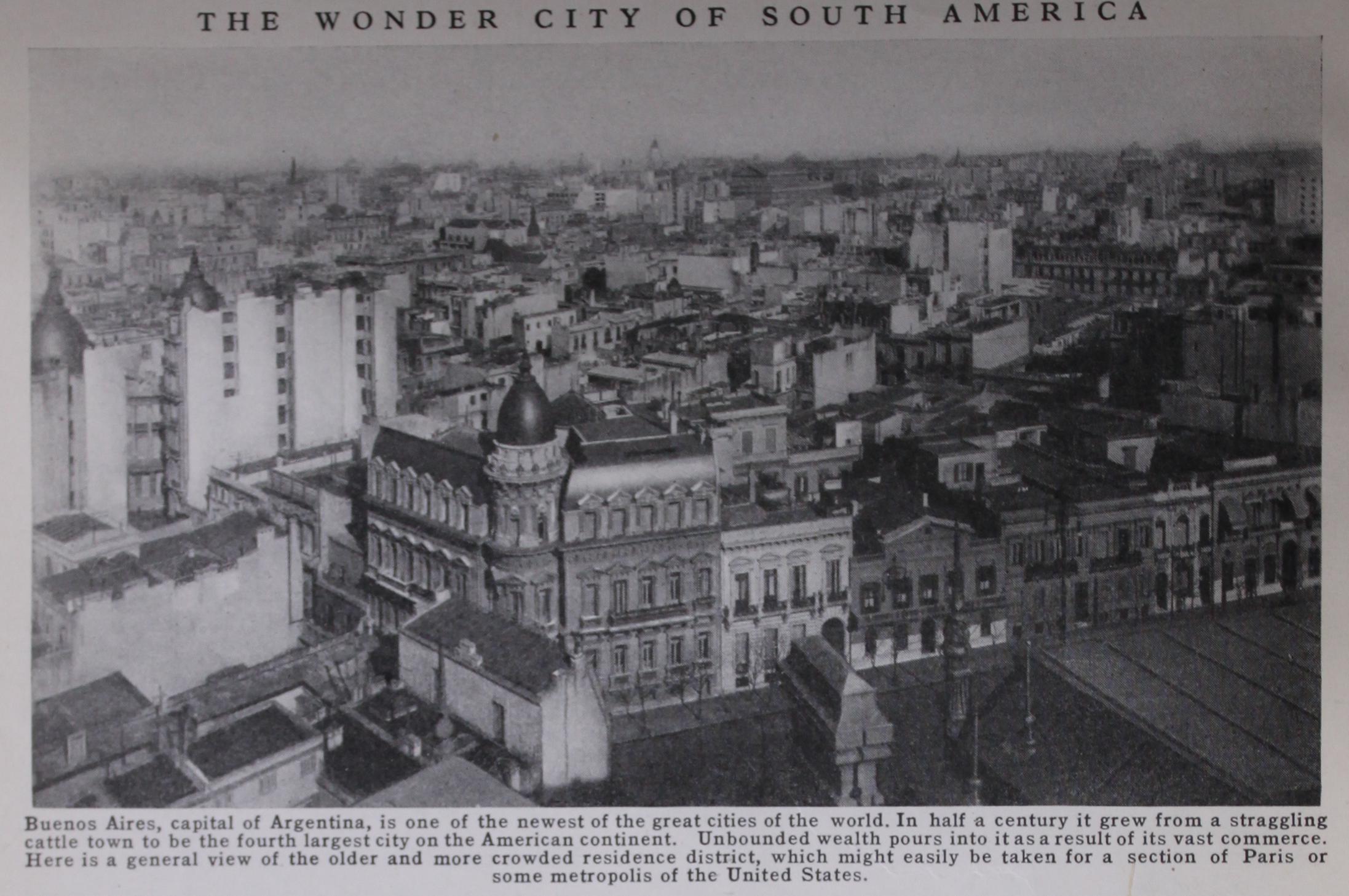
Buenos Aires today is the largest city in the south ern hemisphere, and the fourth largest on the American continents, ranking next to Philadelphia. Wealth and progress are the results here of the busy com mercial spirit of the New World. The vast harbor system, constructed at a cost of $50,000,000, has opened the shallow river channels to the largest ships.
hinge warehouses line the six miles of wharves, includ ing the" Central Fruit Market," the largest warehouse in the world, occupying an area equal to nine New York City blocks. Through these storehouses pass more foreign goods than any other American gateway outside of New York City.
Beyond the wharves lies the city in all the magnifi cence of imposing new buildings, broad streets, beau tiful parks, and handsomesquares. The thoroughfares are alive with automobiles, street-cars, trucks, and all the signs of thriving industry. On the sidewalks before the glittering shop windows every language of the globe may be heard. On the news stands, beside papers in Spanish, will be found publications in Eng lish, French, Italian, Scandinavian, Russian, Hebrew, and Arabic. Indeed, the newspapers of Buenos Aires, as much as anything else, are gauges of the city's progress. The two largest, La Nacion and La Prom, have the most extensive telegraph services in the world; and La Prettsa is a most unusual institution.
Its handsome building is dedicated to social service, and contains a library, free eveninr; schools in • com merce and music, offices for free r Medical treatment, free legal aid, and free chemical laboratory, etc.
A rapidly extending subway system burrows be neath the business district. The water system and sewers, built at a cost of $45,000,000, are unexcelled; with other sanitary measures they have rid the city completely of its former cholera and yellow fever.
Buenos Aires has many fine schools and technical colleges, and an excellent university with more than 4,500 students. The people are great lovers of drama and of music, and each year some of the greatest singers and actors in the world appear in the numer ous and gorgeous theaters.
The great Plaza de Mayo is the center of the official life of the city. Here are the Casa Rosada (the Pink House) where the president of the republic lives, the 18th century cathedral of classic design, the National Bank of Argentina, and the immense House of Con gress, built in 1906 at a cost of $6,000,000.
Buenos Aires draws its wealth from the vast cattle and farming lands of Argentina, which pour their products over the 22,000 miles of railways into this central point. The city contains one-fifth of the pop ulation of the republic.. Its mayor is appointed by the president, and so has the power of the federal government behind him. This commercial and polit ical centralization has brought prosperity and at &acted foreign immigration and capital to the city, and it promises to maintain Buenos Aires as one of the most important trade centers of the world.
Population, about 1,640,000.