John Caldwell 1782-1850 Calhoun
south, war, life, slavery, carolina, tariff, webster and public
CALHOUN, JOHN CALDWELL (1782-1850). More tragical than any tragedy ever conceived by the imagination of man, says an eminent historian, is the record of this powerful and distinguished champion of nullification, secession, and negro slavery. Born in the same year with Daniel Webster and dying two years before that great statesman, Calhoun at the height of his career stood at the opposite pole of politics from Webster—the defender of the South, as Webster was of the North, of States' Rights as Webster was of National Sovereignty. Successively member of Congress at the time of the War of 1812, secretary of war under President Monroe, vice-presi dent with John Quincy Adams and again with Andrew Jackson, secretary of state under President Tyler, and for many years senator from South Carolina, in his 40 years of public life Calhoun did more than any other man to form the views of the South on constitutional questions, and to instil in it that conviction that slavery was a posi tive good, which in the end produced the Civil War.
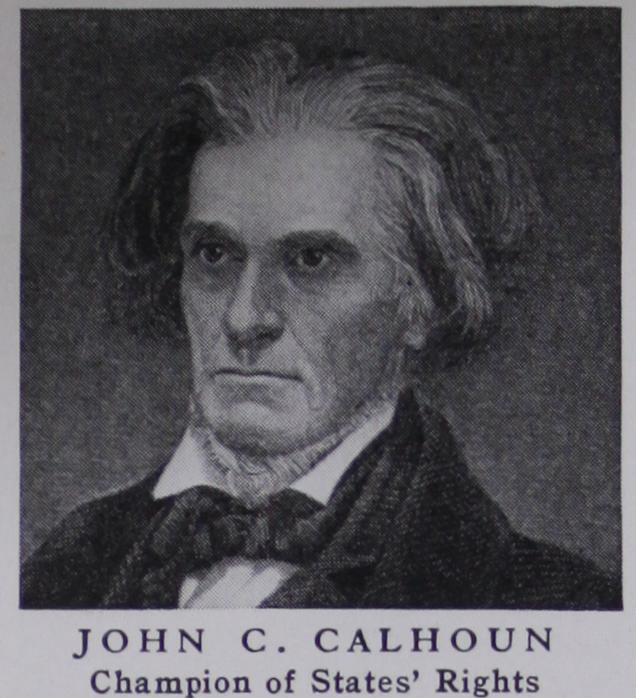
Calhoun was a son of the South Carolina hills. Born of Scotch parents on a frontier farm near , Abbeville, he was left fatherless when very young and received very little early education. He was a lonely thoughtful boy, given to meditation and quiet ways. It is said that he seldom laughed, never cracked a joke in his life, and had no sense of humor.
In 1800 he entered Yale College as a member of the Junior class. He was graduated two years later with highest honors, then studied and practiced law, and after a brief term in the state legislature was elected, in 1811, to the United States Congress.
Here, with young Henry Clay, he came almost immediately into prominence as a leader of the "Mfrs Hawks," a group of brilliant patriotic young men who were urging war with England. When their combined eloquence finally persuaded Congress and the Presi dent to declare war in 1812, Calhoun advocated vigorous measures. When the war was over he con tinued to urge the use of wide national powers. In a speech advocating government roads he said : "The extent of our country exposes us to the greatest of all calamities next to the loss of liberty—disunion.
Let us bind the republic together with a perfect system of roads and canals." At this time Calhoun also favored a protective tariff, a national bank, a strong army and navy.
But during the next 12 years a change took place in Calhoun's views, and the tragedy of his public life began. The ardent nationalist became the no less ardent champion of States' Rights. In 1828 the cotton-growing states of the South, especially South Carolina, were furious at what they bitterly called the "tariff of abominations," a tariff which they claimed levied tribute on the South for the benefit of manufacturing New England. Flags were flown
at half-mast; threats were made to disobey the law and even to withdraw from the Union.' Calhoun took up the defense of the South and wrote a papei called the 'South Carolina Exposition', in which he urged that the protective tariff of 1828 was uncon stitutional and that, in such a case, the state, or states, had the constitutional right to refuse obedience to the law and declare it null and void within their limits. Four years later South Carolina tried to put Calhoun's idea of nullification into practice; but the stern attitude of President Jackson, combined with a compromise tariff put forth by Henry Clay, prevented an armed clash. From that time on Calhoun and Jackson were bitter enemies.
It was impossible to espouse the cause of the South and not uphold the institution of slavery. Accord ingly, as the years passed by, Calhoun from merely tolerating slavery became its strongest defender.
On one occasion he said, "I hold that in the present state of civilization, the relation now existing between the two races in the slave-holding states is, instead of an evil, a good—a positive good." In order to extend slave territory, Calhoun when secretary of state under Tyler negotiated a treaty for the annexa tion of Texas, although he greatly deplored the war with Mexico which almost immediately followed.
To the end of his life Calhoun was untiring in defense of his beloved South. In the debate on the Compromise of 1850 he made his last public appear ance. So ill that he had to be carried into the Senate Chamber, and so weak that his speech had to be read by a colleague, his address seemed "a message of despair." As he sat there wrapped in flannels and "alive only in the great deep eyes which still flashed beneath his heavy brows" he looked, indeed, an apostle of a dead or dying cause. Within less than a month he passed away. Almost his last words were, "The South—the poor South; God knows what will become of her now." Daniel Webster, one of his chief political opponents during the 40 years of his public life, said of him what no historian would deny: "He was a man of undoubted genius and commanding talent. He had that indispensable basis of high character—unspotted integrity and unimpeachable honor." But his great abilities were used to bolster up an institution which was both morally and polit ically wrong—the institution of human slavery.