Cannon
gun, guns, metal, powder, fuse, tube and shell
forts of Liege at the beginning of the war. One hit from the French monster in 1918 on Fort Malmaison —the strongest fort ever built—paralyzed the whole so that the gun will be thicker at the breech than at the muzzle. Some guns are wound between the sleeves with miles upon miles of strong tough wire.
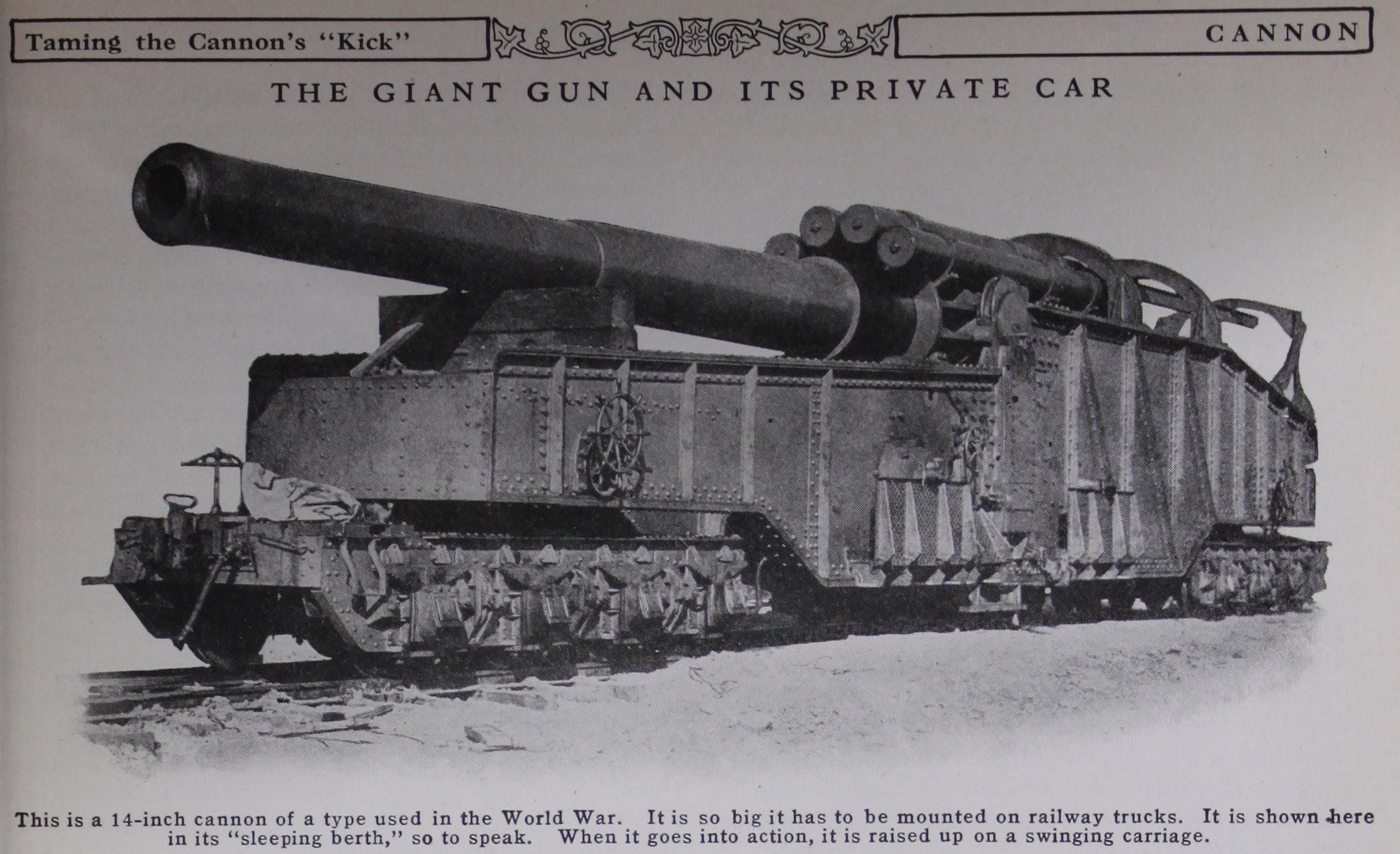
The most delicate operation in gun-making is cut ting the grooves of the rifting, which must be accurate within a thousandth of an inch. The breech mech anism, which has to withstand pressures of 20 to 30 tons per square inch, also requires the most skilful attention. Gun carriages and mountings are no less difficult and expensive to make than the gun itself, for all sorts of delicate mechanism is needed for softening the tremendous "kick" of firing, for swing ing the monster weapons over hair-breadth scales when sighting at the target, and for scores of other purposes. The intricate turret mountings of battle ships and the wonderful " disappearing" carriages for forts are among the devices which make a, battery of big guns cost millions of dollars.
Yet, after all this expense and trouble, the active life of a big gun is about three seconds! Under the best conditions, it can be fired only 150 to 200 times before it has to go back to the factory for a new lining.
If you add up the tiny fractions of time that each one of the shells actually spends in traveling from the breech to the muzzle, you will find the total period during which the gun is employed in actual firing is certainly not more than three seconds. Erosion caused by the tremendous pressure of the explosive gases and the great friction set up by metal against metal at high speed is the cause of this rapid wearing out of the barrel. The shells are also exceedingly expensive, a single charge costing as much as $1,500.
"The Cannon's Opening Roar" Cannon were first used in European warfare in the 14th century, perhaps at the battle of Crecy between Another projectile of special construction is the shrapnel shell. In its simplest form it contains a light charge of powder in the base, and the remaining space is filled with 250 to 300 small leaden bullets.
A
time fuse at the point leads back to the powder charge. In this form, the shrapnel is like a small gun itself, fired from a larger gun. At the proper moment during its flight the powder in the base explodes and drives the bullets forward out of the shell-case with increased velocity. The whirlingmotion of the shell scatters them like water from a garden sprinkler. The time fuse is an ingenious device which can be set so it will explode the shell at any range from 25 feet in front of the gun's muzzle to 5,000 yards or more. This fuse is started by the shock of firing. If it should fail, there is a percussion fuse which will do the work the instant the shell strikes the ground. Shrapnel is the most effective artillery weapon against charging infantry.
Why
Big Guns Are "Built Up" In former days cannon were made of one solid piece of cast or forged metal, but the enormous charges of powder used in modern guns would burst such cannon like paper. A special method of con struction called "building up" is used to get the necessary strength and expanding power. A thin inside tube or lining is first bored out and forged by the blows of a powerful steam-hammer. Then a second tube or "sleeve" is prepared, which is slightly 9 too small when cold to fit over the outside of the first tube, but when heated red-hot it expands enough to slide snugly into place. When cooled off again, it grips the inner lining tube like a vise. A second, a third, and even a fourth sleeve may be put on in the same way, each a little shorter than the one before, the French and the English in 1346. Beginning as small metal tubes fastened to rude supports, they rapidly grew in size until such huge weapons as the " Dulle Griete," or "great bombard of Ghent," ap peared, which was made over 16 feet long, weighing 13 tons, and fired a 25-inch granite ball of 700 pounds.
By the middle of the 16th century, artillery mounted on wheels had come to be an important part of all armies. The earliest big guns were mostly breech-loaders, but no effective means was found of stopping leaks of powder gas, so muzzle-loaders soon took the lead. Stone shot gave way to cast-iron, brass, and lead balls. Bundles of bullets, bolts, frag ments of metal, etc., were fired in close-range work against infantry or cavalry. Chain-shot, consisting of two metal balls fastened together with a short length of chain, came into use in naval engagements.