Central America
republics, miles, costa and region
In the last 25 years education has helped the masses in the more advanced republics, but the percentage of illiteracy except in Costa Rica is still large.
In Volcanoes She Leads the World! It is said that Central America has more volcanoes in proportion to its size than any other country.
They range along the Pacific shore and spread to the Caribbean only where the land contracts into a narrow neck. Volcanic eruptions and earthquakes are very common in this region. In 1917-19 both Guatemala City and San Salvador were destroyed, and there is scarcely a city between Mexico and Colombia but has suffered from earthquakes or volcanic eruptions. The volcanoes are, however, a blessing as well as a curse to the region, for their lava enriches the soil beyond the power of the most costly fertilizers.
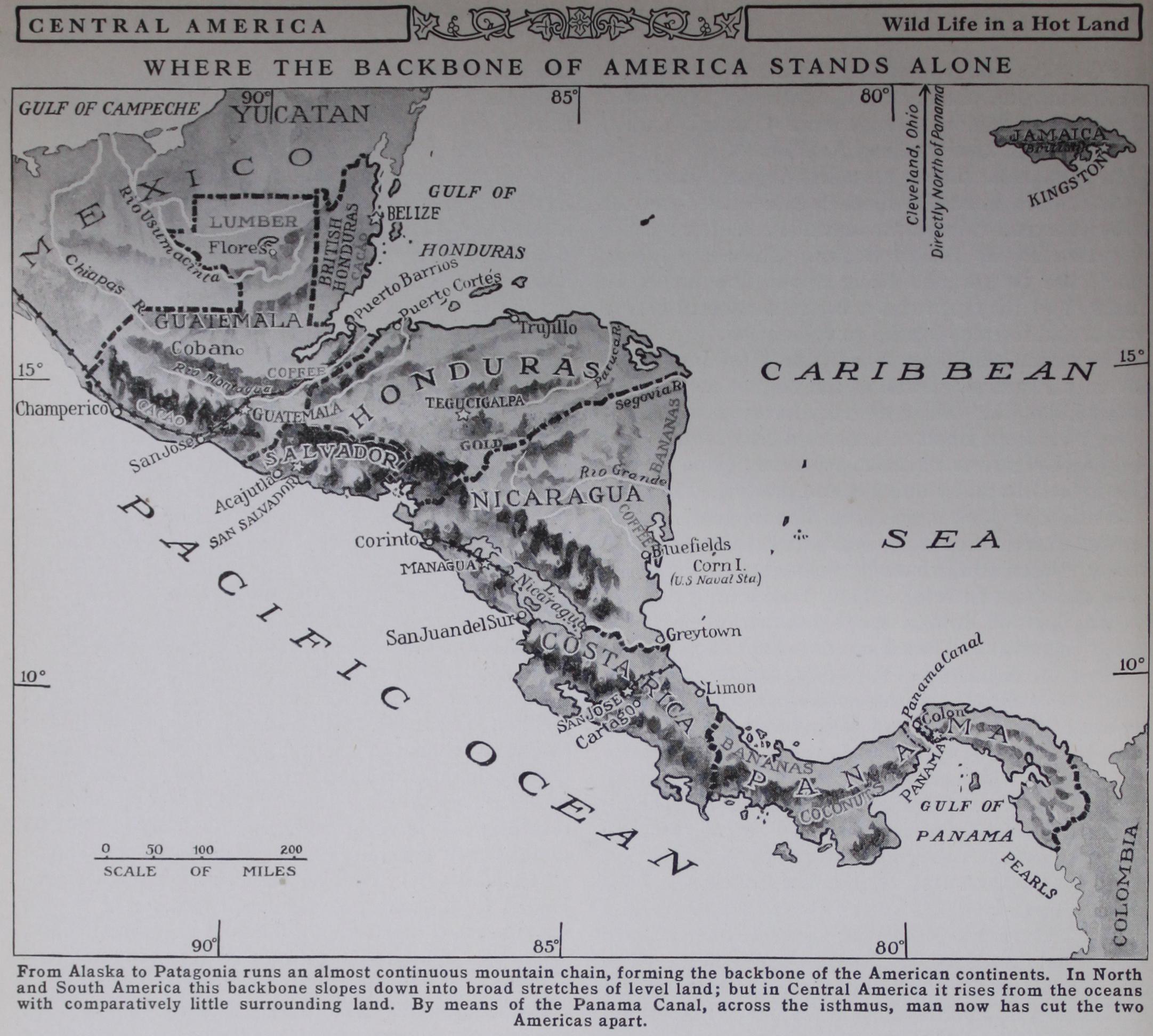
The eastern slope is covered by a vast jungle, which until recently was inhabited only by a few groups of uncivilized Indians along the shore and a few settlements of woodcutters who traded in ma hogany and other valuable woods. Huge trees 20 feet in diameter, with thick vines wound about their trunks, hide their tops in an impenetrable mass of green hundreds of feet above. Bushes with brilliant foliage fill every vacant spot. Alligators swarm the rivers, reptiles exist in almost endless variety, and insect and bird life is even more abundant. Ants may sometimes be seen marching in a column three or four miles long, and Costa Rica alone has twice as many species of birds as all Europe. The atmos phere is moist and hot and very unhealthful. Yet into this region an American corporation ventured, clearing and planting great banana farms, and building a net of railways to carry the perishable fruit to the ports, from which it is shipped in fast steamers to the United States and Europe.
Uncle Sam's Business with the Five Republics The five republics, only 150 miles distant from the Gulf ports, are one of the most promising fields for the expansion of American commerce and the invest ment of American capital. At the present time the United States' easily occupies the leading place in their foreign trade, supplying the greater part of the imported foodstuffs, hardware, and machinery, and a very considerable part of the textiles.
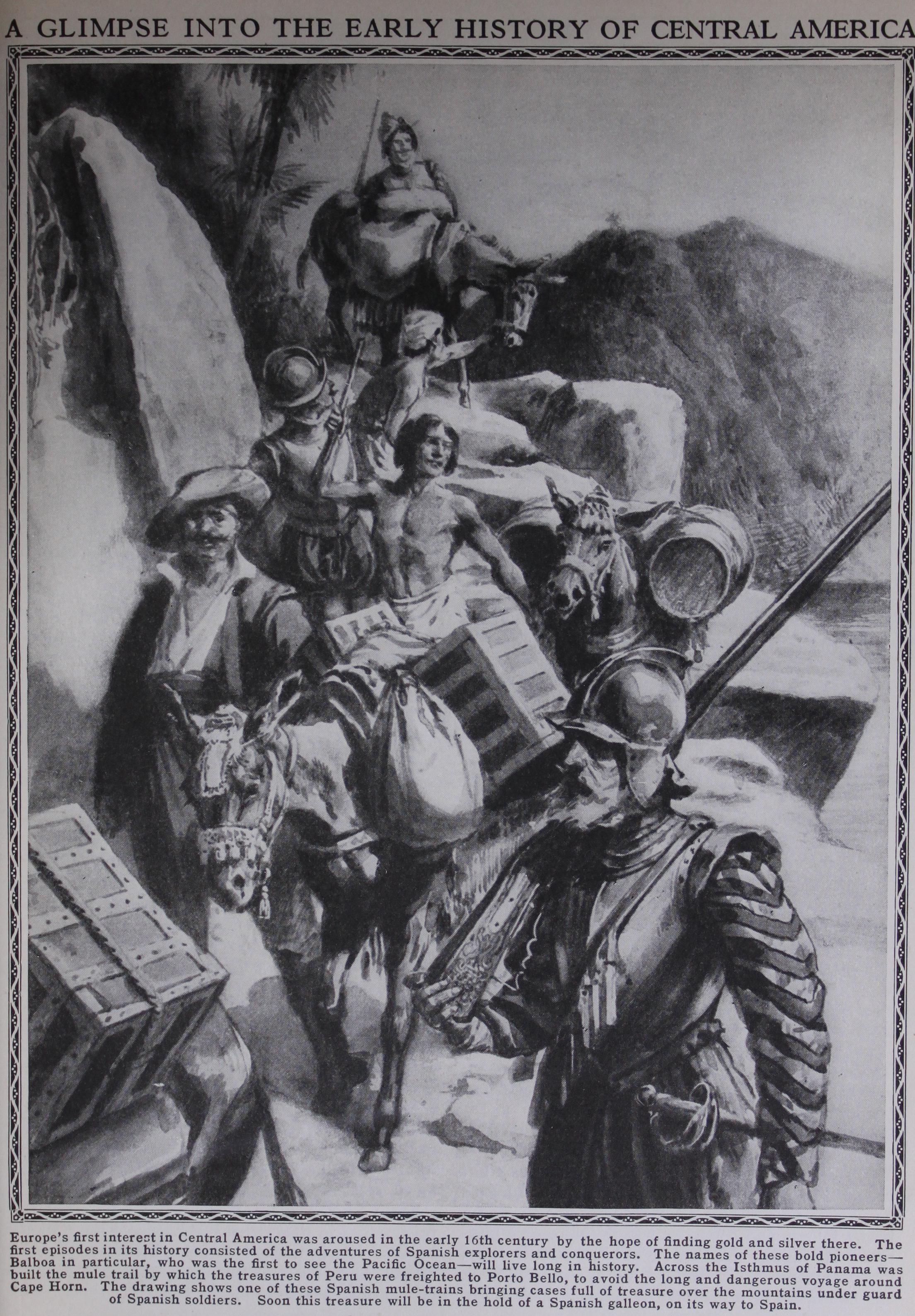
Central America was discovered by Columbus in 1502. Costa Rica was conquered by the Spaniards after 1513, and the rest of the country was subjugated between 1522 and 1525 by Hernando Cortez after his conquest of Mexico. Great Britain colonized British Honduras in the 18th century and exercised a protectorate over the Mosquito coast until 1860. The rest of Central America remained a Spanish dependency bearing the name Guatemala (with the exception of Panama, which belonged to New Granada) until the revolution of 1821, which established the present independent republics, with governments similar in form to that of the United States. Area, about 213,000 square miles; population, about 5,500,000.