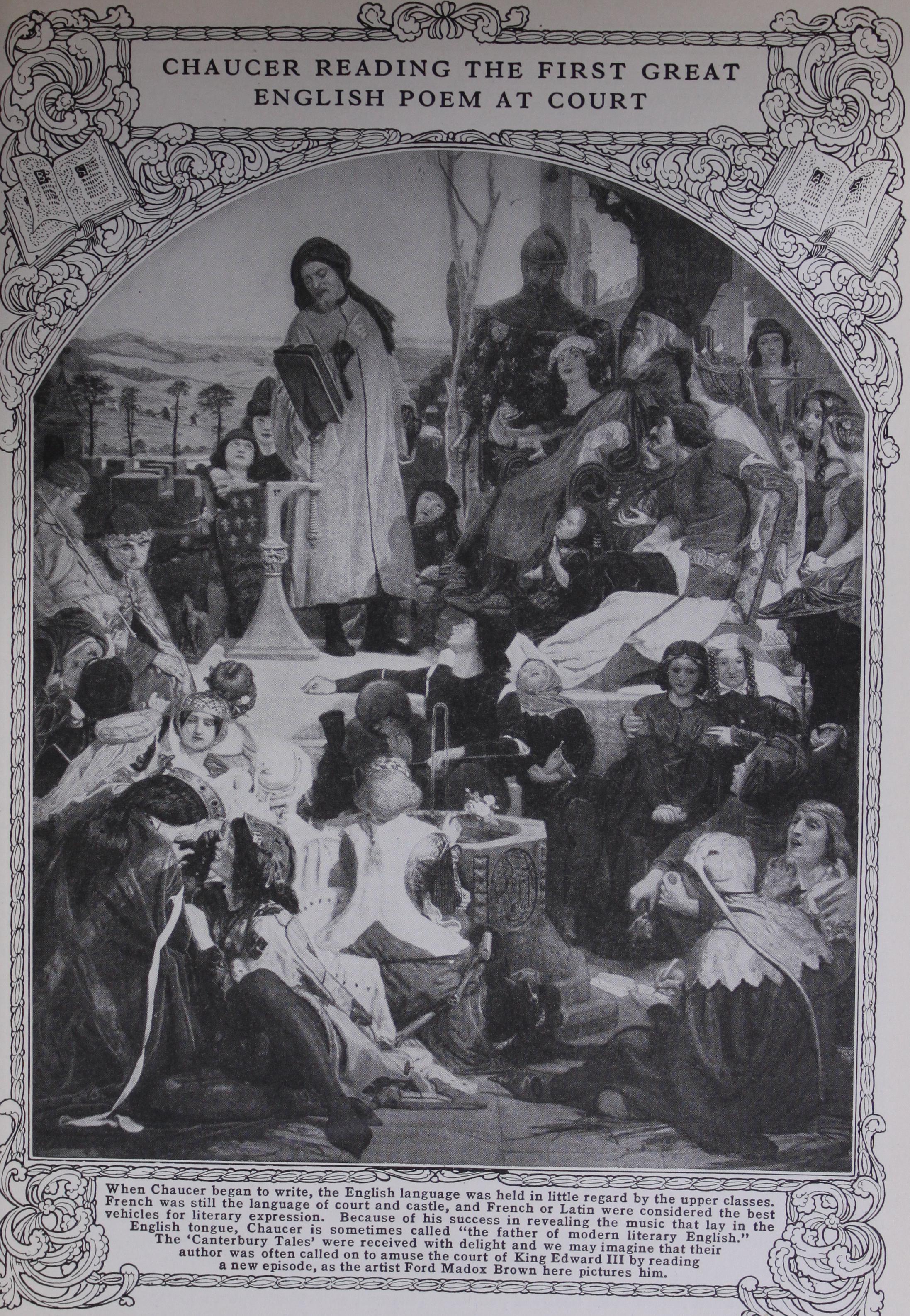
Geoffrey Chaucer
english, language, french, tales, wrote and brought
Gracious, ready of wit, cheerful and genial, he made friends wherever he went. He was a keen observer and made the best of his rich experience. The devel opment of his genius owed much to French influence.
He translated the French Roman de la Rose', a typical medieval love story, and in his own earliest poems imitated French models. One of his missions brought him to Italy, which was then Europe's great center of art and learning. Possibly in this sunny land he may have met Petrarch, the poet and human ist, and Boccaccio, the writer of gay tales; at any rate he became acquainted with their writings, and his own work was greatly influenced by them.
In his later years Chaucer's fortunes declined, but he did not lose his cheerful disposition. Half in fun, he wrote a Complaint to his Purse !' A pension from the king quickly followed, but he did not live long to enjoy it, for death came within a year. He was buried in Westminster Abbey, and was the first to find a resting place in the famous Poets' Corner.
The Poet of the Springtime We naturally think of Chaucer as a springtime poet, for he loves to sing of the joyous season when the birds make melody and all nature awakes.

When April hath his sweetest showers brought To pierce the heart of March and banish drought. And when the little birds make melody, That sleep the whole night long with open eye, So nature rouses instinct into song.
And as springtime suggests the beginning of new life, so Chaucer stands at the beginning of English poetry. Edmund Spenser called him the "well of English undefyled"; and Tennyson, "the morning star of song." He helped to fix the English lan guage and verse-forms in channels which they have ever since followed. To him and to Wyclif, as much as to any others, we owe the form of the language which we speak today. Before Chaucer there was no standard English language. There were three dialects Northern, Midland, and Southern—and of these he chose the Midland for his immortal work. " He found English a dialect and left it a language." While using a consider able number of Norman French words, and thus giving grace and smooth ness and variety to the rude speech of the people, he still kept close to the language of common life. James Russell Lowell puts it this way: "In him we see the first result of the Norman yeast upon the home-baked Saxon loaf.
The flour had been honest, the paste well kneaded, but the inspiring leaven was wanting till the Norman brought it over. Chaucer works still in the solid material of his race, but with what airy lightness has he not infused it?" (See English Language.) In more than one sense Chaucer is " the father of English poetry." His great imagination, his insight and sympathy, and his whole-souled humor have been an inspiration to five centuries of poets.
In the quotations in this article the ancient spellings and words have been modernized, for many of Chaucer's words look very queer to our eyes. He wrote more than 500 years ago, and a language is bound to change a great deal in that time. It is well to begin to read the 'Canterbury Tales' in some good modern version, such as Mrs. H. R. Haweis"Chau cer for Children'. But it will not be long before you will want to read the tales just as Chaucer wrote them, and you will find that with a little pains you will have no trouble in under standing them.
Besides the 'Canterbury Tales', Chaucer's chief works are: 'The Romance of the Rose' translated from the French; 'The Book of the Duchess' ; 'Troilus and Cressida'; 'The Parlia ment of Fowls (Birds)'; 'The House of Fame' ; 'The Legend of Good Women'.