Checkers
game, black and square
CHECKERS. Battles between " checker men" have interested young and old ever since the first crude game of draughts was played by the Egyptians —probably as early as 1600 B.C. Later the Greeks and Romans enjoyed the game, and more recently there have been French, German, Polish, Dutch, Scotch, and English games of "draughts," the latter being the game called " checkers" in America.
The game is played with small round pieces of wood or bone, arranged in lines of battle on a square board, divided into 64 alternating squares of black and white or black and red. Two players using a set of 12 "men" each direct the combat, which con sists in an orderly advance and retreat across the battlefield. The men of one player are colored white (or red), the other black. The object of the game is to capture your opponent's men and remove them from the board.
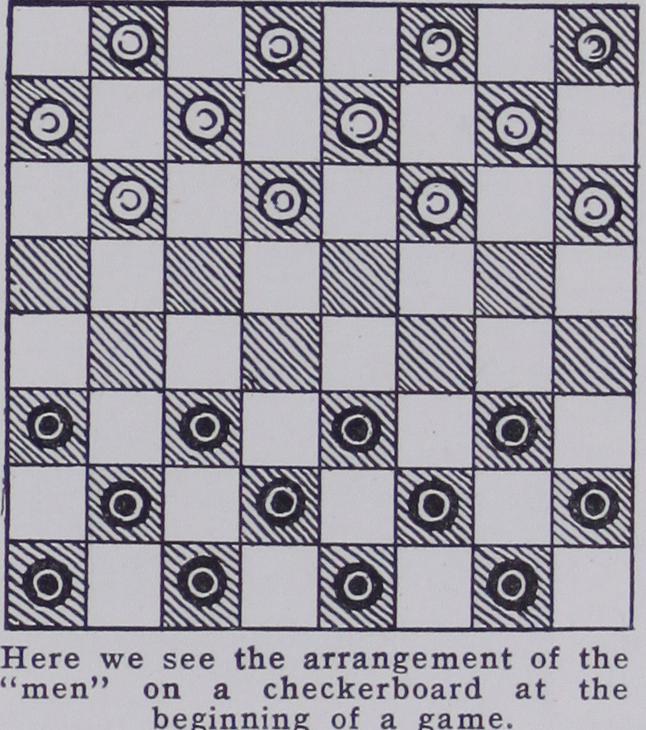
The forces are drawn up on the first three rows of the black squares, on opposite sides of the field, as in diagram 1. Each side moves alter nately, and the men may only be moved forward diagonally, to the right or left, to the next unoccupied black square.
When the adjoining square is occupied by one of the enemy and the square next in line is vacant, the player may "jump" his man over his opponent's piece to the vacant square, and remove the enemy's man from the board. Sometimes two or more jumps can be made by a single move (see diagram 2).
When a man has penetrated to the last or "king" row of the enemy's line, it becomes a "king" (indicated by placing another checker on top of it). A king can move either forward or backward, but still only on the squares of the color in which the game is played.

When all the men of one side have been captured, or when the remaining men of that side are so block ed by the opposing forces that none of them can be moved without capture, the game is won by the player who has thus outgeneraled the other.