Cheese
milk, hard, curd, mold, cheeses, flavor, soft, sort and american
CHEESE. You can imagine the delight with which, thou sands of years ago, when primitive man had learned to tame and milk goats, sheep, and cattle, some wise old housewife discovered that if the milk is allowed to sour into a thick mass, then squeezed to press out the whey, and allowed to age for a few weeks or months, the result is a pleasant and nu tritious sort of food.
In some such w a y cheese was invented in the far-off forgot ten past. The oldest mention of it is about 1400 years before Christ. It was known to the ancient Egyptians and is men tioned in the Bible.
The early Greeks were familiar with cheese long bef ore they knew how to make butter, and also the Romans.
But in all the thousands of years that man has been making cheese, he did not discover until a few years ago why it was that he could never tell how his cheese was going to turn out—what sort of flavor it would have and whether it would be good or poor. Today we know that the chief factor is the " ripening" or "aging," and that the flavor depends largely on the sort of bacteria that are active during this process. Scientists have now succeeded in obtaining separately the different varieties of cheese bacteria, so that the dairyman can put in any particular sort needed and thus get the flavor he wants. Added variety is obtained by flavoring the cheese with pimentoes, sage, parsley or other herbs, and often artificial coloring matter is put in. Most cheese is made from cow's milk, r but the milk of sheep and goats is also used. By varying the materials, and using cream, whole milk, or skimmed milk, and by changing the sea soning and the process of curing, more than 150 varieties of cheese are today made in Europe and America.
Until 1851 all cheese was made on the farm and in the home, but today it is practically all made in factories. About the only cheese now made at home is the familiar "cottage cheese," which is merely the fresh curd of milk, usually mixed with cream. While the United States imports considerable amounts of the famous cheeses of Europe, it makes about ten times as much as it imports. Many of the foreign cheeses are successfully imitated, but 90 per cent of the output—the so-called American cheese— is practically the same as the English Cheddar, and is often known by that name. New York and Wis consin between them make about three-fourths of the entire output of the country.
Cheese ranks very high in nutritive value. One pound of American cheese has nearly the whole of the protein and most of the fat of a gallon of milk, while an equal weight of beef contains less than half as much nourishment. Hence cheese may well take the place of meat in a meal. Experiments show tha it is a wholesome food, having no harmful effect on digestion even when eaten in quantities as meat substitute.
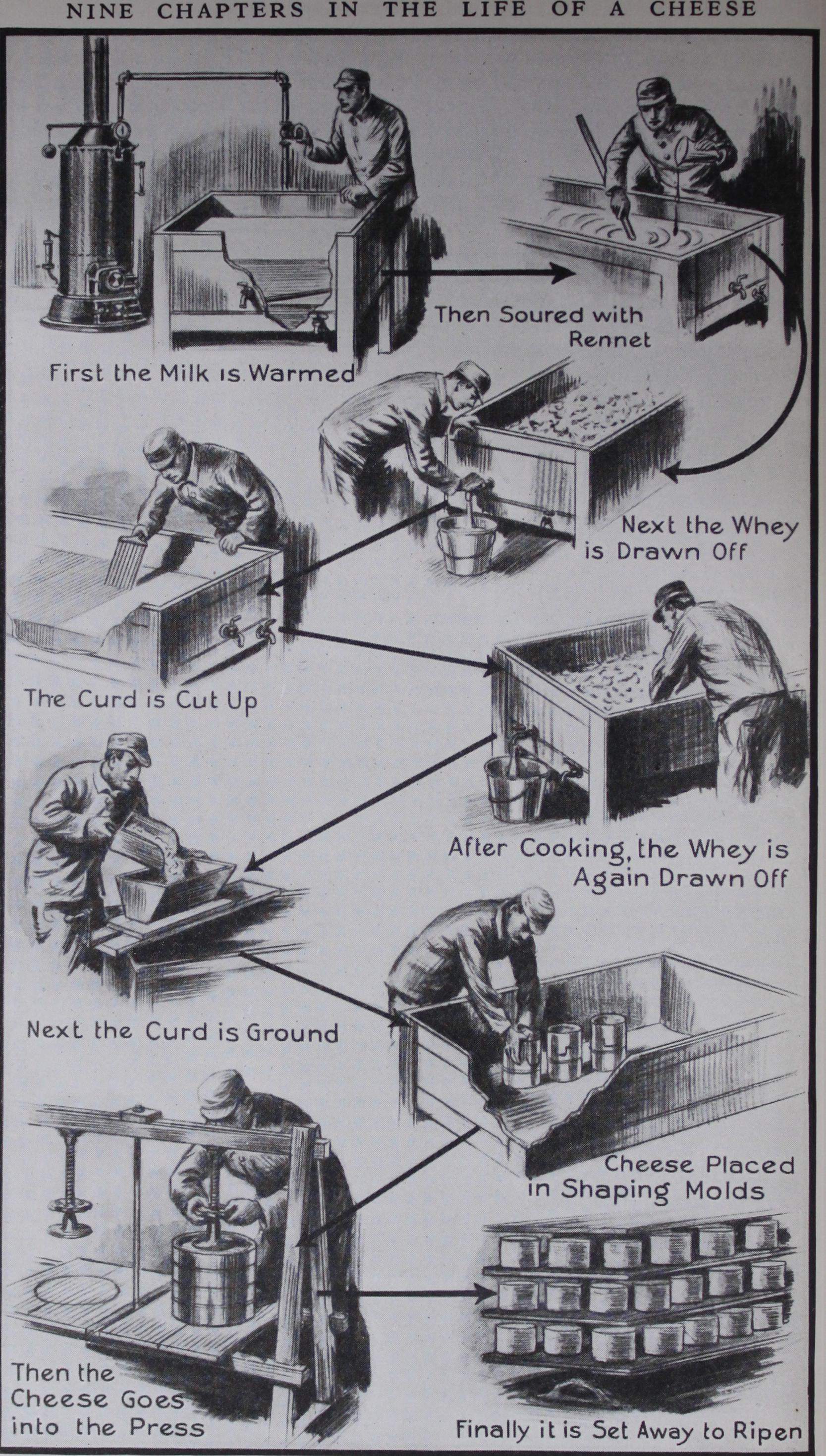
Cheese is made from the curd of milk, which contain: casein (a protein compound), fat, and other constituents In making American cheese, the milk, preferably swee milk rich in fat, is slowly heated to about 84° Fahren.
heit. Artificial souring of the milk or coagulation is then produced by adding rennet extract, which is obtained frorr the stomach of a calf or other young animal. After stand.
ing 30 to 45 minutes the whey or watery portion is drainec off and the curd is cut into small bits and stirred slowly so that more whey is drained out. The curd is then heatec slowly to about 92 degrees and cooked for several hours until the curd is firm when squeezed in the hand. The whey is again drained ofl and the curd turned and piled. When well drained the curd is ground ox thoroughly broken up by stirring, and salt is added. After this it is pressed into shaping molds or "cheese hoops" lined with cloth which will cover the finished cheese to keep it clean. The cheese is then put away in a cool dry place to ripen.
In the process of ripening, many types of cheese be come streaked with mold, which gives them a charac teristic highly prized flavor. The mold is sometimes arti ficially cultivated and intro duced into the cheese before it is put away to ripen. According to the amount of water it contains and the method of ripening, cheese is classified as hard or soft. The best known cheeses, their characteristic qual ities, and their place of origin are: Brie, soft white cream cheese, France; Camembert, soft rich cheese, France; Cheshire, hard dry reddish cheese with blue green mold, England; Edam, hard mild reddish cheese, pressed in round molds and dyed crimson on the outside, Holland; Gor gonzola, hard rich cheese with green and red mold, Italy; Gruyere, hard yellow ish cheese full of holes, Switzerland and France; Limburger, soft cheese with a very strong flavor and odor as the result of fermentation induced by keeping it exceedingly moist while ripening, Holland; Parmesan, hard greenish skim-milk cheese, Italy; Roquefort, slightly soft cheese made from sheep's milk, streaks of mold, ripened in caves, France; Stilton, hard rich strong cheese streaked with mold, ripened for two years, England; Swiss, similar to Gruyere, Switzerland. Most foreign cheeses and the highly flavored domestic varieties are made and sold in characteristic molds con taining enough for a few meals for a family. Swiss and so-called American cheeses, however, are often made in huge molds shaped like millstones, some of them weighing several hundred pounds.