Chesapeake Bay
move, king, square, pawn, pieces, moves, knight and queen
CHESAPEAKE BAY. Late in April 1607, three frail little vessels sailed between two capes into the great arm of the Atlantic which was later named Chesa peake Bay. These vessels found their way up a stream emptying into the bay, and on its banks founded Jamestown, the first permanertt English settlement in America. In the next two years the energetic leader of the colony, Captain John Smith, explored the shores of the bay and many of its tributaries.
Many other historic events are connected with this great inlet—the largest on the Atlantic coast. Its waters were plowed by the vessels which carried to England the tobacco and the furs of the colonists.
On one of its tributaries was played out the closing scene of the Revolutionary War—the defeat and surrender of Cornwallis at Yorktown. Through its quiet waters passed the British expedition that burned Washington in 1814.
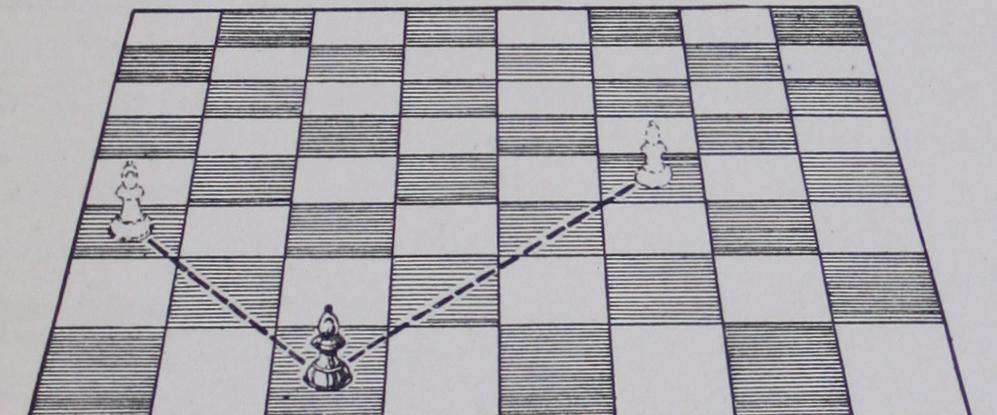
Today the bay, which divides the state of Maryland in two and separates also one part of Virginia from the rest, is busy with a great traffic. Ocean liners and big cargo steamers mingle with the host of smaller craft. The latter are either oystermen, or carry on a brisk trade in vegetables and watermelons Chess is probably the most ancient of all games of pure skill. Its origin is lost in the legends and traditions of the past. It was undoubtedly invented somewhere in the Far East, passing from India to Persia, and thence to Europe. The word " chess" is supposed to be derived from " Shah," the Persian word for king, and " checkmate" from "shah mat," meaning "the king is dead." The chessboard is the same as the ordinary checker board. It is divided into 64 alternating black and white (or red) squares, and the board is so placed that each player sits with a white (or red) square at his right hand. In setting up the pieces always The moves of the Bishop are diagonal, but if there's nothing in the way he can go as far as he pleases. His method of travel, as you can see, keeps him always on squares of the same color.
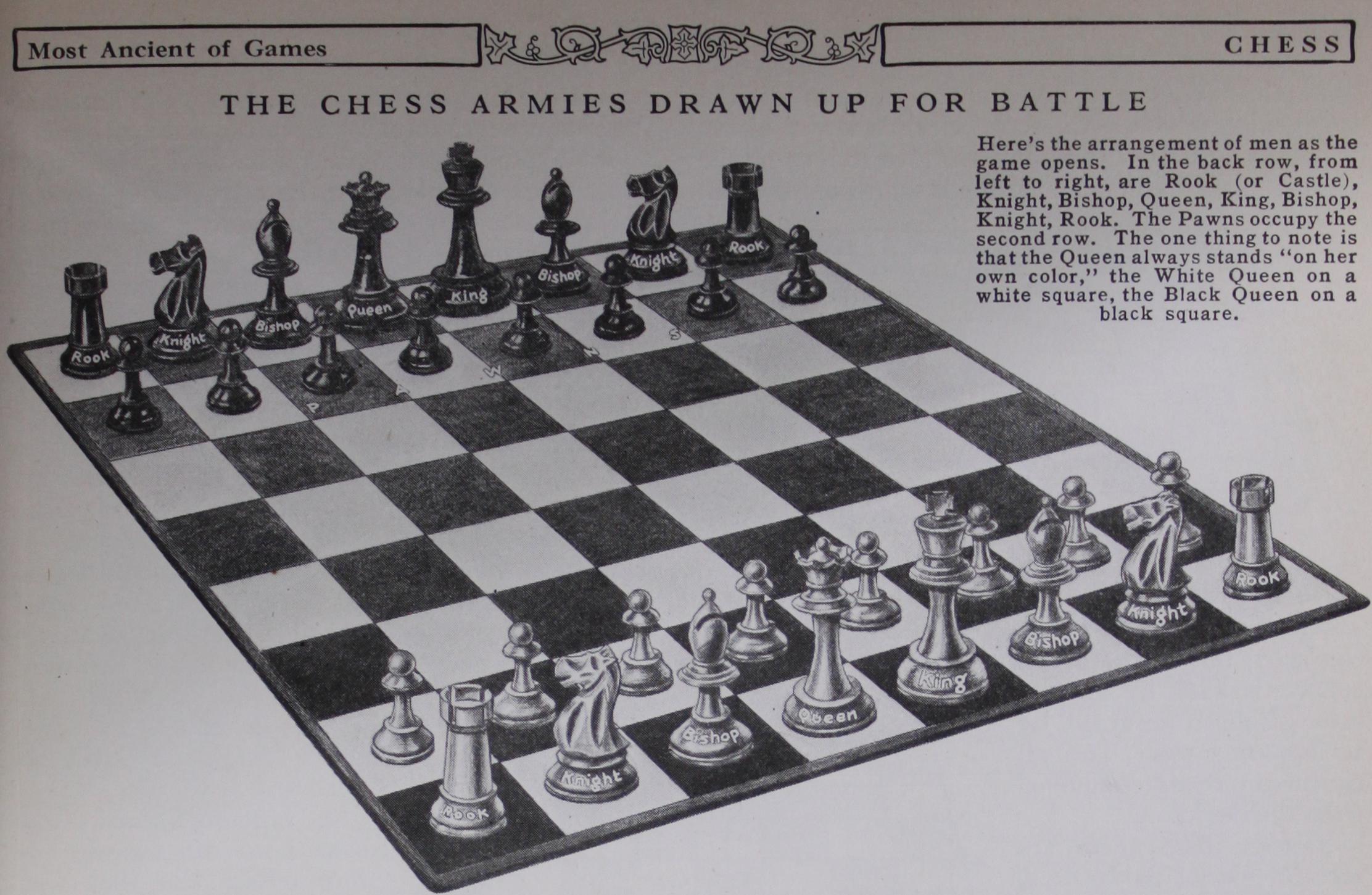
"give the queen her color," that is, always place the white (or red) queen on the proper white (or red) square and the black queen on the proper black square.
How the Pieces are Placed The accompanying diagram shows the position of the pieces and pawns on the chessboard at the beginning of a game. The pieces next to the king are called king's bishop (K.B.), king's knight (K. Kt.), and king's rook (K. R.) or castle; while those next to the queen are designated as the queen's pieces; for example, queen's bishop (Q. B.), etc. In front of these pieces are arranged the pawns. The notation "P—K.Kt. 4" indicates that the pawn (in this case the pawn in front of the king's knight) moves to the fourth square in the king's knight column.
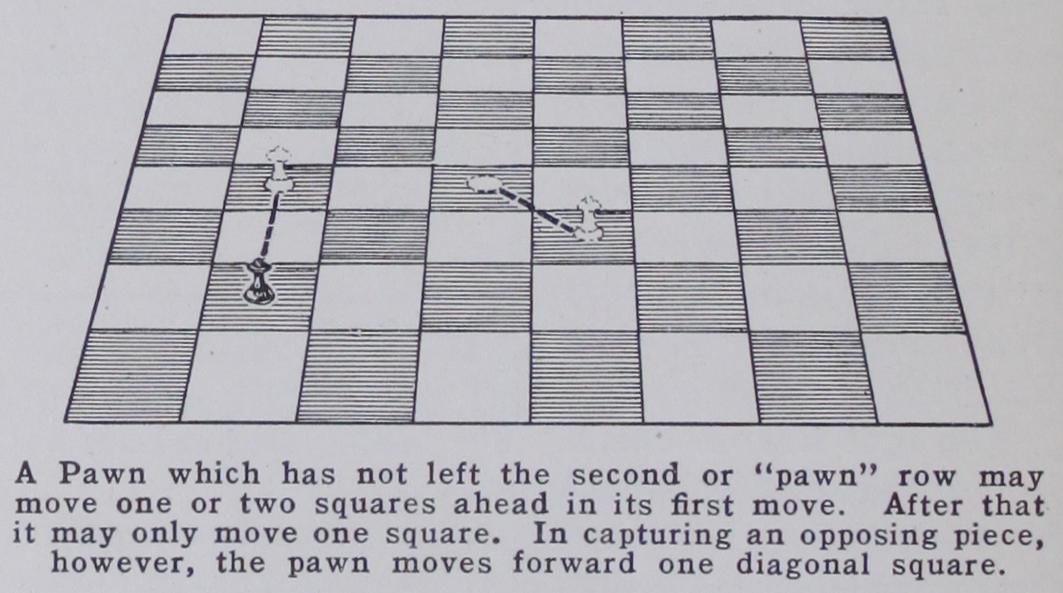
A very simple game, called the "scholar's mate" or "fool's mate," is given here: This game, though won by White by methods that could easily be defeated, illustrates several of the moves of chess. A pawn moves one square ahead, except on the first move when it may be advanced two squares. Pawns cannot move backwards. In making a capture, however, the pawn moves diago nally and occupies the square of the captured man.
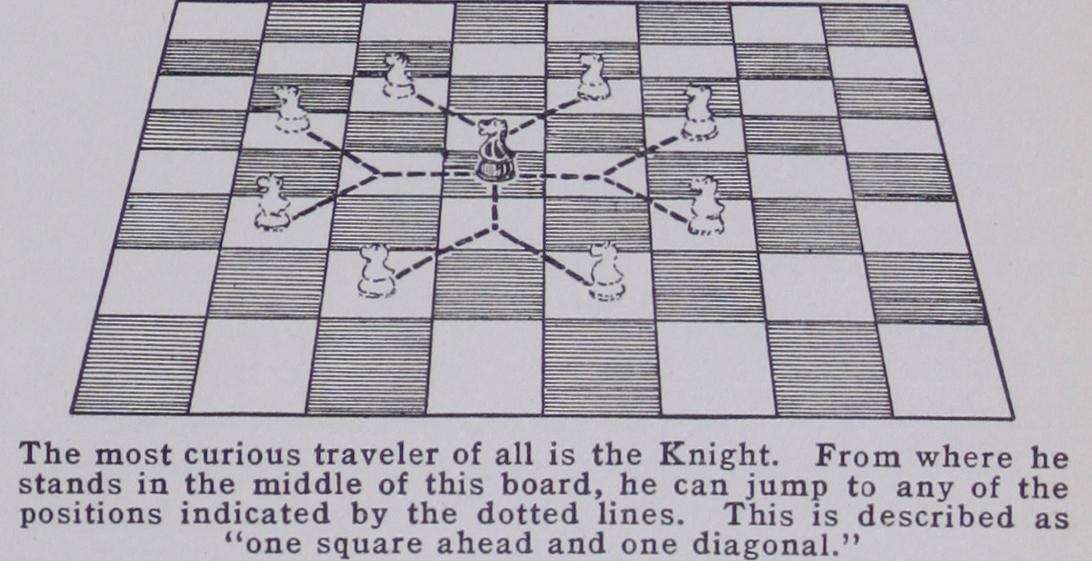
A bishop moves diagonally in any direction and for any distance so long as it keeps to the square of its own color. The knight moves one square vertically or horizontally and one square diagonally. The knight has a special privilege not accorded to the other pieces; it can accomplish its move by jumping over any men that happen to be in the way, provided the move can be completed on a vacant square, or on one occupied by an opposing man, in which case the knight captures it. Unlike checkers, however, " jumping" does not involve the capture of the intervening pieces. The rook or castle moves either vertically or horizontally any distance so long as the path is open. The queen is the most valuable of all front of the king as a protection, he is " checkmated." The king is never actually captured, and is never per mitted himself to move into check. A "stalemate" occurs when one player or the other, though not in check, cannot move any of his pieces; more specifi cally, when one side cannot move without bringing his king into check. This is a draw. A game is also a draw when neither player has sufficient men left on• the board to checkmate the other, as, for instance, when a king and one bishop are left against a king, or a king and one or two knights against a king.
"Perpetual check" occurs when a player who cannot hope for checkmate is nevertheless able to check his opponent's king, move after move, with no possi bility of escape, and this also constitutes a draw.
If a pawn which has not left the pawn row attempts to move two squares ahead, when such a move places it beside an opposing pawn, the opposing pawn may take the first pawn, just as if the latter had only moved one square ahead.
This is called taking a pawn "in passing" or en passant.
A brilliant attack will sometimes win success be fore either side has lost many men, but in a hard fought match the game is usually won by an accumu lation of a great number of small successes which weaken the enemy. A definite plan of attack is as a rule far better than a haphazard attempt to weaken the enemy by carrying off his pieces. A careful player always studies his opponent's moves as thoroughly as his own not to do so is to invite disaster.