Chestnut
king, species, nuts, piece and move
CHESTNUT. When the first frost touches the prickly burrs of the chest nut tree the brown nuts rain down to the ground, bringing joy to the hearts of the boys and girls who are lucky enough to live in the vicinity. There are about five species of the true chestnut in temperate regions of America, Europe, northern Africa, and Asia. The American chestnut, which thrives in the Appalachian region from Maine to Georgia, and westward to Mich igan and Louisiana, furnishes nuts which though small are superior in flavor to all other species. The tree, rising to a height of 60 to 100 feet, is symmetrically shaped, with a heavy top covered with an abundance of foliage. Another American species is the small chinquapin which thrives in the more southerly regions (see Chinquapin). Several species of the chest the pieces; she can move vertically, horizontally, or diagonally, and for any distance. The king, on the other hand, is rather restricted; he can move in any direction, but to the extent of only one square. A capture is made by moving into a square occupied by an opposing piece, and all captured pieces are removed from the board.
Besides these there are certain special moves. A player may " castle" when his king row is open on either side between the king and the rook. The rook is moved up to the king and the king is "jumped" over to the other side of the rook. This cannot be done if either piece has previously been moved, if the king is in check, or if an opposing man could reach one of the intervening squares in a single move. A pawn which reaches the king row of the opposing side becomes a queen or any other piece the owner of the pawn may choose. It is thus possible to have two or more pieces with queen's privileges at the same time.
To " check" the opposite player is to maneuver one piece or several pieces so that the enemy king is in danger of capture on the next move. Each time a king is thus threatened, the fact must be announced by the word "check." (The same is true when a queen is threatened, the word "queen" being used.) If a player is in check and cannot extricate his king, or capture the attacking man, or place some piece in nut are cultivated in the United States for their nuts The lumber is also valuable, being used extensively foi interior finish, the manufacture of furniture, ties, posts, and fuel.
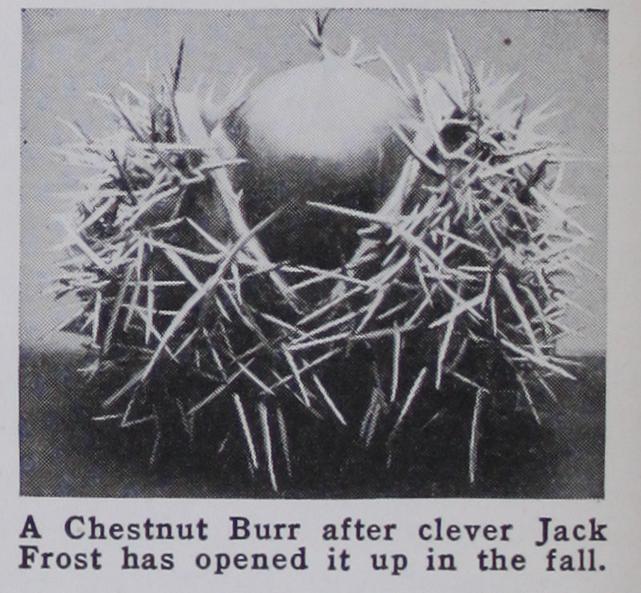
The large Italian or Spanish chestnut is a very important food product, and though its nuts are not so sweet as those of the Ameri can species, they are very palatable when cooked. These nuts grow on large trees, bearing correspondingly large burrs. The Japanese species is a dwarfish tree, but the fruit is larger than the American chest nut, though inferior in quality.
Scientific name of the American chestnut, Castanea dentata. Bark gran ite-gray, ridged in older trees. Leaves simple, alternate, oblong-lanceolate, feather veined. Fruit maturing in green prickly husks which open in four sec tions, disclosing three or four oval nuts.