Chimpawzee
chile, spanish, european, peru, cent and bolivia
CHIMPAWZEE. The most intelligent of the anthro poid or manlike apes, the chimpanzee is also very docile, and individuals are often shown in the theaters so highly trained that they wear clothes, sleep in beds, and eat with a knife and fork. It is affectionate when treated kindly, and becomes exceedingly jealous of any rivals for its master's affections. In confine ment it is highly susceptible to disease and rarely survives long; in its native haunts its average life is from 20 to 24 years. R. L. Garner, who spent four months in a cage in an African jungle studying this remarkable animal, says that it has a vocabulary made up of from 12 to 20 distinct sounds.
The chimpanzee is smaller than the gorilla, which From 30 to 40 per cent of the population is said to be of pure European descent, a larger proportion than in any other South American state except Argentina. Nearly 60 per cent is made up of the so-called mestizos, of mixed Indian and European parentage. The fusion of the races has proceeded further here than in Peru and Bo vi a , and the half-breeds are a hardy, vigorous, and independent class. More than half of the popu lation is engaged in agriculture.
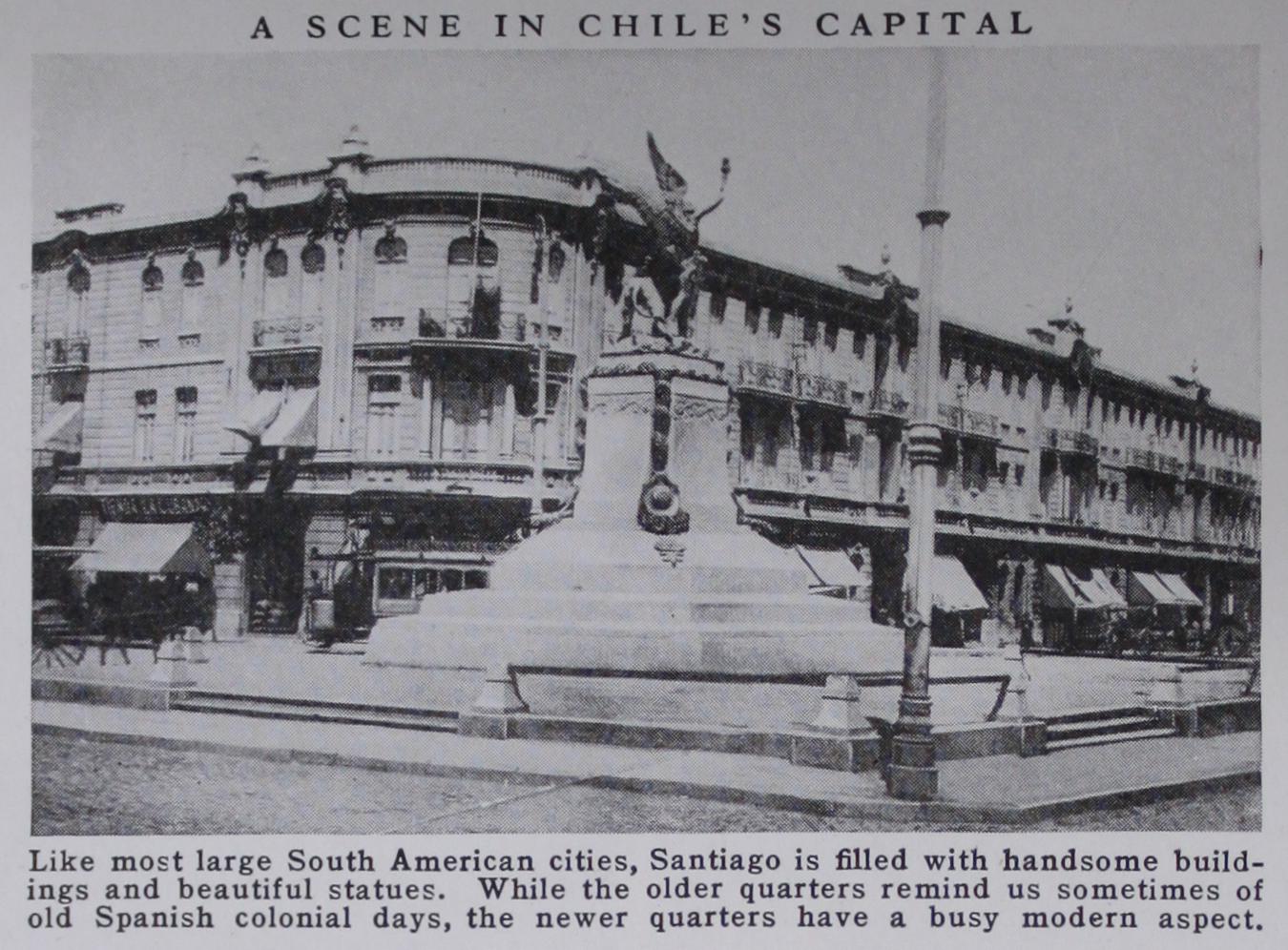
The system of land tenure, where by the lands are held by a few great landowners who live in princely fashion on their great estates, while the labor is per formed by badly treated and ill paid tenants or peons, has kept the workers ignorant, poor, and without a voice in the government. Only about 60 per cent of the population can read and write. There are government-controlled schools in all the towns, and education is free but not com pulsory. Chile also has a state university and a number of trade schools and teachers' colleges.
Civilization has as yet scarcely touched the Araucanian Indians, who live on the slopes of the central Andes. The Araucanians can be said to be the one aboriginal people of the Western Hemisphere that were never conquered by the European invader.
For centuries they successfully resisted the power of the Spanish invaders and their descendants, and it was not until 1881 that their nation, greatly reduced in numbers, recognized the authority of Chile.
The Spanish Conquest of Chile The Spanish conquest of what is now Chile was begun in 1535 by one of the lieutenants of Pizarro (see Pizarro, Francisco). Five years later the city of Santiago, which has ever remained the capital, was founded. Chile rose against Spanish rule in 1810, finally winning independence in 1818. General Don Bernardo O'Higgins, an Irishman who had • dis tinguished himself in the war, was chosen dictator, hut was deposed by the aristocratic party because of his attempts to establish a representative constitu tional government. From 1865 to 1869 Chile was at war with Spain as an ally of Peru, and Valparaiso suffered severely from the guns of the Spanish fleet.
Boundary disputes with Bolivia again led to war in 1879. Peru came to the aid of Bolivia; but Chile was overwhelmingly victorious and stripped Bolivia it closely resembles. An average specimen is about 5% feet tall, with a spread of arms and hands of nearly 6 feet. The head is rounded and short, with 'large and prominent ears. It has no tail and is covered with short black or brownish-black hair.
These animals are dwellers in the tropical forests of Africa from the Atlantic to the Nile and spend most of their time in trees, in which they build beds of twigs and leaves. They live in families of four or more individuals and treat their young with great tenderness until six or eight years old. When walk.
ing ow the • ground the chimpanzee steadies itself with its hands, resting part of the weight on the bent knuckles. When brought to bay, it is a terrible fighter. Fruit, nuts, and insects form its favorite diet. Scientific name, Anthropopithecus niger.