Chipmunk
tamias, stripes and sometimes
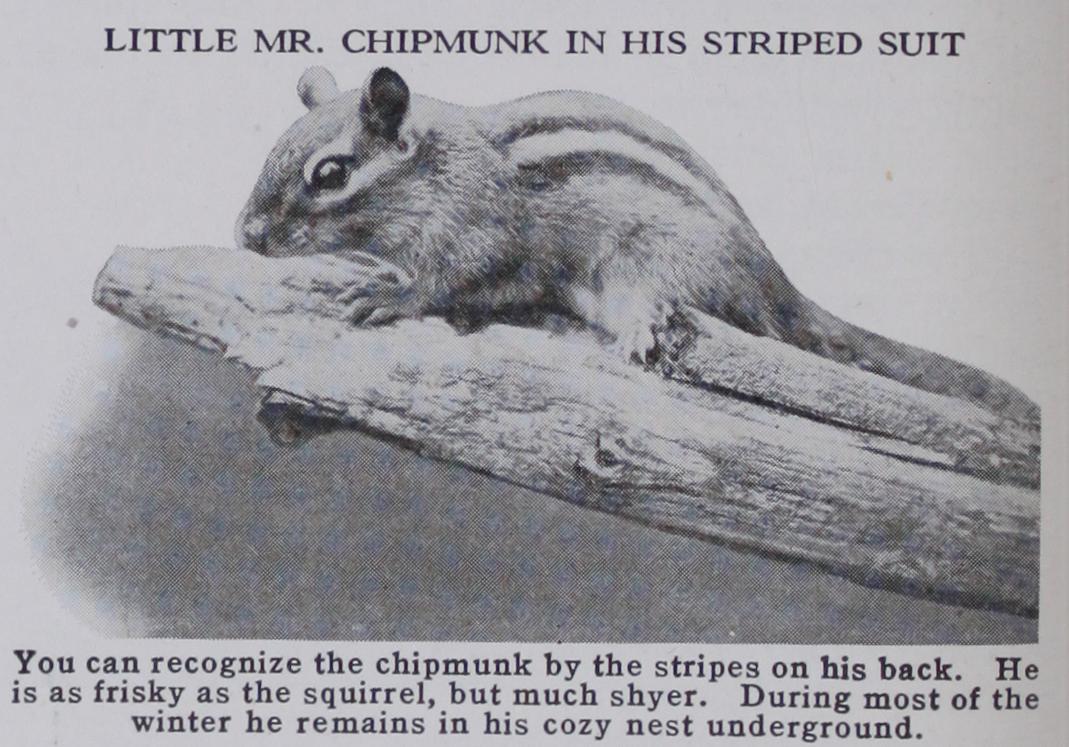
CHIPMUNK. This wide-awake, sun-loving little chipmunk, often called the ground squirrel, is noted for its beautiful markings. Its grayish or reddish brown fur is conspicuously marked with light buff stripes along the back and sides. It is about six inches long with a bushy tail nearly as long as its body. In its roomy cheek-pouches it carries sur prising quantities of nuts and grains, which it stores in its underground nest for winter use.
None but the keenest eyes can discover the chip munk's artfully concealed burrow, which is a tunnel sometimes 20 feet long. This is enlarged at intervals into chambers which serves as storehouses, and leads to a tiny nest, cozily carpeted with grass and lying well below the frost line. To provide escape when its chief enemy, the weasel, invades the burrow, another opening leads out of the far end. The chip munk will sometimes climb a tree to escape its other enemies, the mink and the fox, but it prefers when hard pressed to make for its burrow, where it is not at the mercy of birds of prey.
This little creature is shy in the presence of man, but loves to keep up an animated chatter with its mates. It is often seen frisking along stone walls, occasionally stopping and sitting erect to dart quick glances about it.
The chipmunk is widely distributed through North America. In the West it is sometimes quite a nuisance, since it runs off with berries, fruits, and newly planted corn. It should not be confused with the striped gopher, which it resembles.
Scientific name, Tamias. Tamias striatus of the Eastern states has two white stripes on the body: Tamias quadrivit tatus, common in the Rocky Mountain region, has four white stripes; Tamias tridecemlineatus, a thirteen-striped variety, is also widespread in the Western states.