Lost in Chicago
louis, grass, jean, boy, village, indians and found
" Monsieur de Tonty," he said politely, " I'll go on ahead." " No, my son, you will wait," said his guardian, kindly but firmly.
Waiting was hard. A tiresome Indian orator talked and talked and talked. It was a bright October morning. The high brown grass, thick with purple and yellow flowers, rolled in waves under the wind. The circling forest-covered ridge made one long billow of crimson and gold. And there lay the old Indian trail to the West, worn deep in the soft earth by many moccasined feet. Louis Jean thought it would be a very stupid boy who could not follow that plain path.
" I'm not a baby, who has to be watched every minute; I can look after myself," he said.
It was easy for him to run around the wigwams and slip out of the village. As soon as he was on the trail the tall grass hid him. It made a wall on either side and closed behind him. For the first half-mile the beaten path was plainly marked. Then it ran into a swamp. But there were footprints in the mud, so Louis Jean went on. He waded boldly across a small pond and found tracks on the other side. There they stopped. He had missed the trail! He turned at once and tried to find his way back to the pond.
Suddenly he knew he was lost in that sea of prairie grass. He could see nothing except the sky above him. There were no trees to climb. Badly fright ened he struggled on, trying to find the pond or the trail. He stumbled over rough hummocks. He splashed into deep mud holes. The wiry grass tangled around his feet. The dusty seeds, blowing in the wind, hurt his nose and throat.
After a long time he heard a gunshot. He had been missed in the village and men were out looking for him. He should have stood perfectly still and waited, but in a panic of fright he ran toward every report of a gun that he heard. He shouted until his voice was only a hoarse whisper. The searchers had out of his mind. They did not know where he had come from, and he could not tell them.
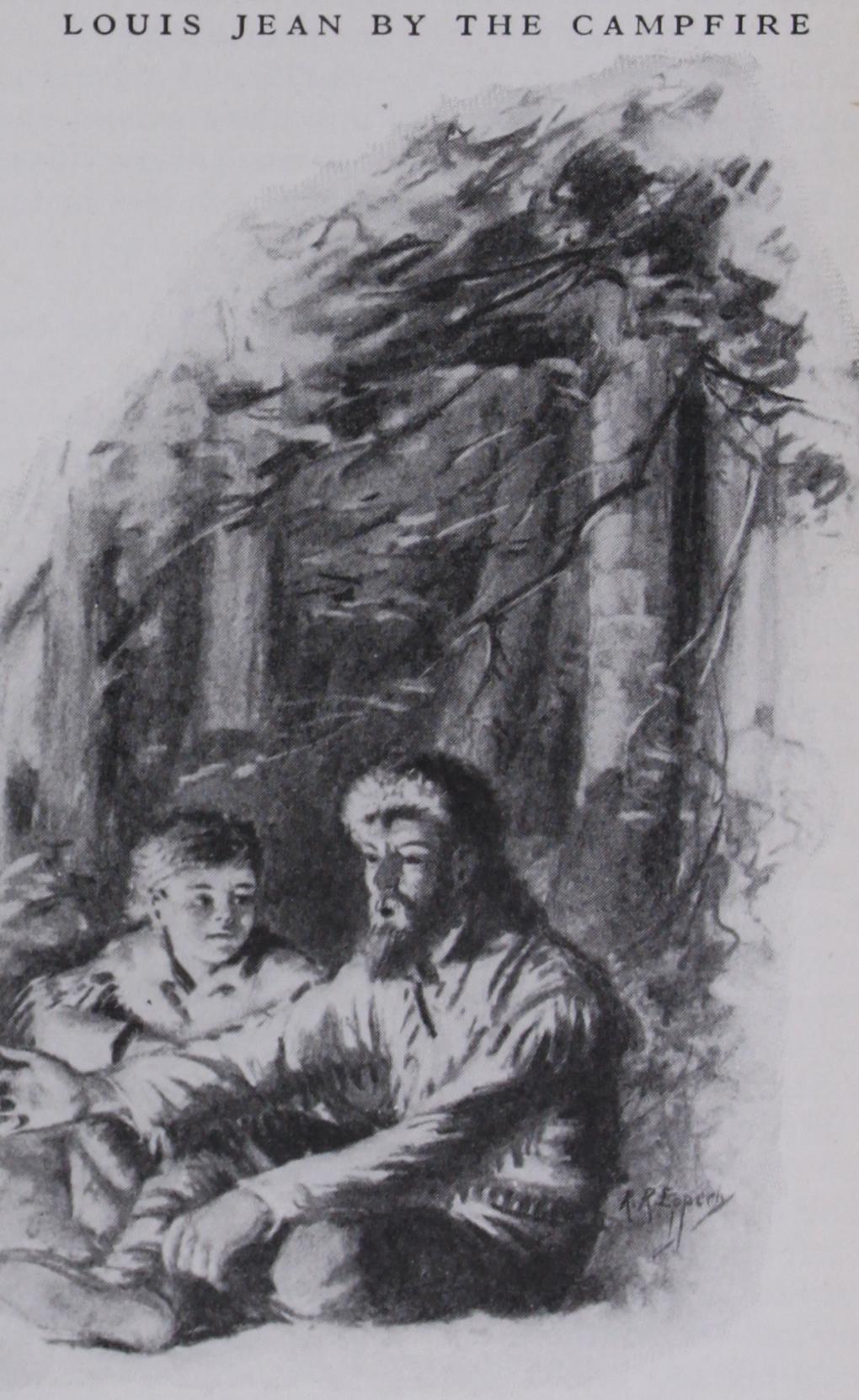
Monsieur de Tonty found him lying on a pile of skins, in a rude tent-shaped tepee of poles and buffalo hides—for the Kickapoos were one of the poorest of the prairie tribes. They thought the handsome white boy was an angel from heaven. The squaws had taken as good care of him as they knew how.
Medicine men had danced and shouted around his bed, to scare the evil spirits of his sickness away.
Yet he lay in a burning fever, talking wildly. Mon
sieur de Tonty's eyes filled with tears as he and a missionary priest carried the unconscious boy to a blanket bed in a Miami canoe.
As fast as men and canoes could travel he was taken down to the fort on Starved Rock, where there was a French army doctor. There the boy was slowly nursed back to health and strength. It was Christ mas before he was well again.
So Louis Jean Learned His Lesson! Louis Jean wanted to be a gentleman and a soldier of the king when he grew up. So he knew exactly what he had to do now without being told. He was a Catholic, so he went to a priest in his little bark chapel in the village of Illinois Indians, near the fort.
There he confessed his great sin of disobedience.
Then he begged the forgiveness of his father and of Monsieur de Tonty for all the sorrow and trouble he had caused. He would never forget his terrible punishment, and never, never disobey orders again.
scattered. The shots sounded farther and farther away. At night Louis Jean sank down in the grass and sobbed himself to sleep.
Monsieur de Tonty sent half the men on to the fort with the goods. He stayed to hunt for the little lost boy. Soldiers, trappers, and Indians divided into small bands, and scattered over that 250 square miles of prairie. Louis Jean's footprints were found in muddy places. But the grass was so trampled by wild herds that even the Indians could not follow his wanderings.
After three days everyone thought he must be dead. So many terrible things could have happened to him. He might have fallen into the river. He might have been knocked down and trampled by a herd of deer, or gored by a bull buffalo. He might easily have starved. There were gray wolves in the timber that came out at night to hunt helpless animals. And any day that dry prairie might be set on fire by a spark from the campfire of a band of hunters. Miami braves got into their canoes and paddled up and down the river to warn every village of Indians that a little French boy was lost in the tall grass.
Louis Jean in the Kickapoo Tent That was how Louis Jean was found, after two long dreadful weeks of search. He was in a village of Kickapoo Indians, ten miles up on the north fork of the Chicago River. A band of Kickapoo hunters had found him when he was almost starved and quite