Classifications of Types of Boilers
classification and circulation
CLASSIFICATIONS OF TYPES OF BOILERS Many attempts have been made to classify water-tube boilers. By some writers a classification based on circulation, or on the principle of operation, is claimed, to be superior to any division according to construction. Therefore, they di vide them into classes as follows—boilers with limited circulation; boilers with free circulation; boilers with accelerated circulation.
In the first part of this Instruction Paper, is given a classification according to features of construction. No classification is altogether satisfactory because boilers overlap into other divisions; a water-tube boiler may be sectional, of the double-tube type, have horizontal tubes, straight tubes, and free circulation. In order to have some sort of classification, and as no discussion will be entered into regarding relative merits, the classification given on page 6 will be here adopted and followed as closely as conditions will permit.
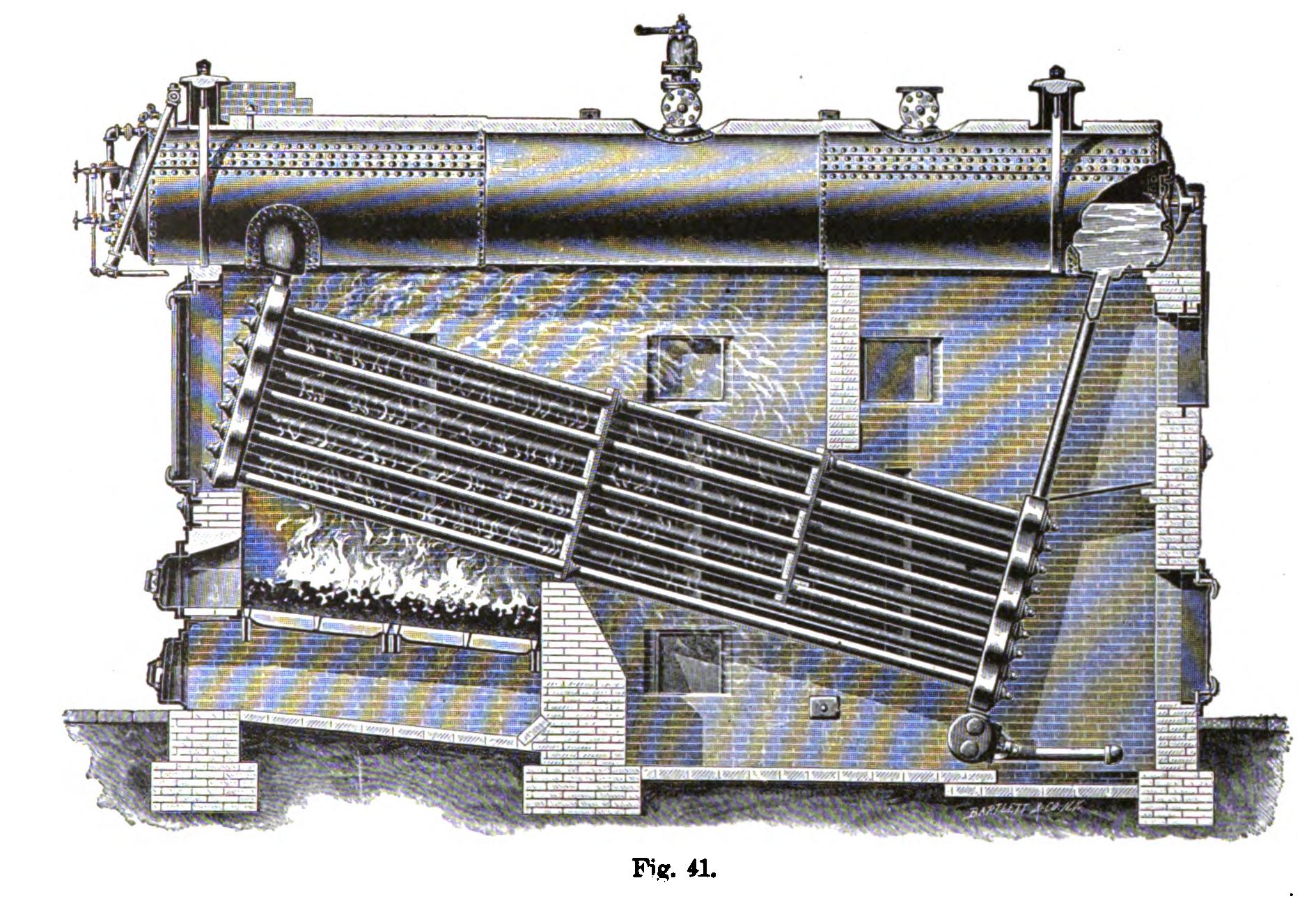
Water-tube boilers are divided into two great classes—horizontal and vertical. Under these heads come sectional and nonsectional, straight-tube and curved-tube, and single-tube and double-tube. If the tubes are nearly horizontal, such as is the case of the Babcock and Wilcox, Root, etc., the boiler will be called horizontal. If the tubes are vertical, or nearly so, as in the Wickes, Stirling, etc., the boiler will be classed as vertical.
Although most boilers can be classified as outlined on page 6, there are a few of such peculiar construction and arrangement that they must be placed by themselves under "Peculiar Forms." These are described without any further attempt at classification.
As it is impossible to discuss all makes of boilers, a few representative forms will be considered as types of their respective classes. No attempt will be made to choose any make as being the best, because many conditions must be considered in selecting a boiler. The boilers described, except in a few cases, are now used extensively in either stationary or marine work.