Flue Boilers - the Cornish Boiler Horizontal Single-Flue Internally-Fired
fire and ring
FLUE BOILERS - THE CORNISH BOILER: HORIZONTAL, SINGLE-FLUE, INTERNALLY-FIRED When it was found that about 25 per cent of the total heat of combustion was lost by radiation from the furnace, a Cornish engineer named Trevithick, conceived the idea of placing the fire inside the large internal flue. He introduced this type which is known as the Cornish boiler.
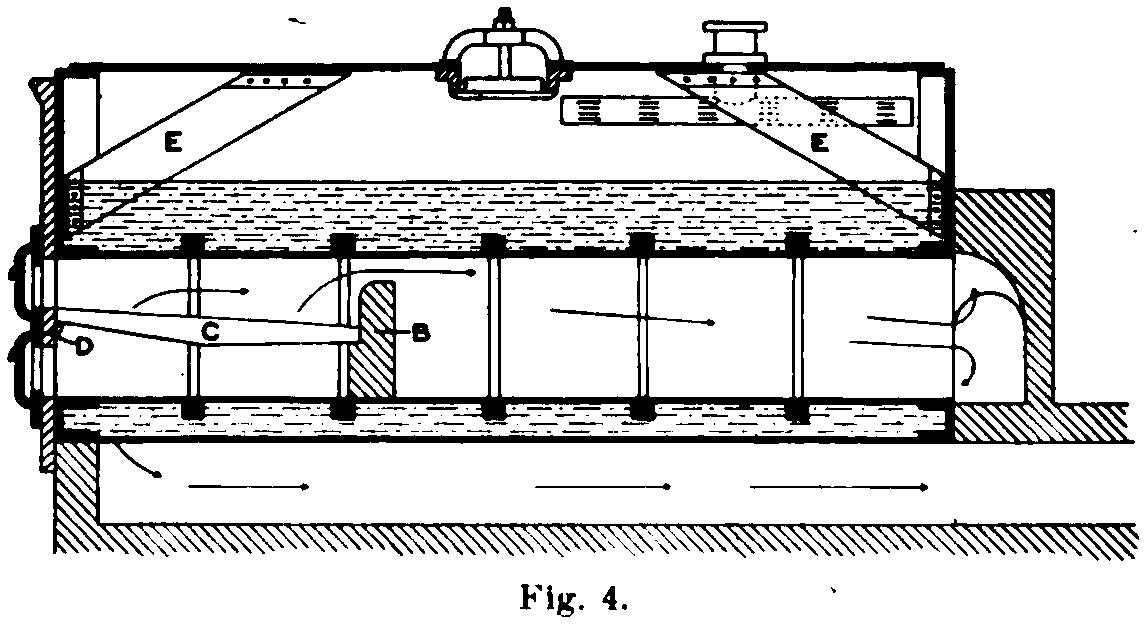
The products of combustion pass from the fire on the grate bars C (Fig. 4) through the flue to the back end where they divide and return to the front end by means of the lateral flues L in the brickwork. See Fig. 4a. At the front the hot gases pass downward, and uniting pass through the flue F in contact with the bottom of the boiler. On leaving the boiler they go to the chimney. This arrangement of flues reduces the temperature of the gases before they come in contact with the bottom of the boiler where sediment collects. The grate bars rest on the dead plate I) at one end and on the bridge B at the other; if made in two lengths (as is often the case) theyare supported at the center by a cross bearer. The bridge is built of fire brick and the external flues are lined with fire brick. The heads are stayed to the shell by gusset stays E E.
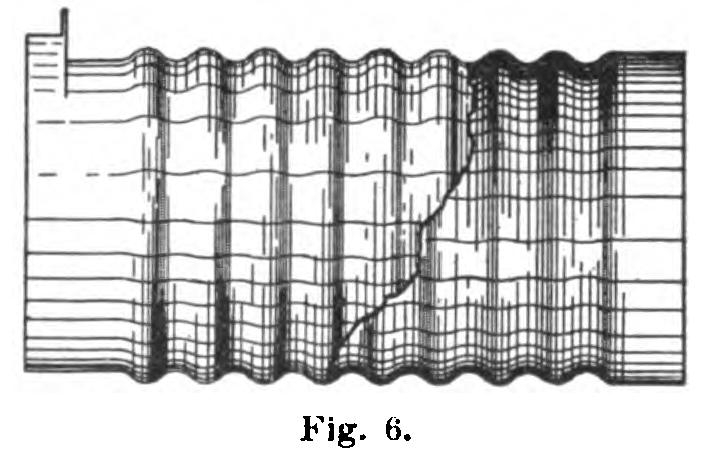
The large internal flue is the latest portion of the boiler because it contains the fire. For this reason the flue has greater linear expansion than the shell and, if the flue is a plain cylinder, the increase in length causes the ends to bulge. When the boiler is cold, the flue returns to its normal length. This lengthen. ing and shortening will soon loosen the flue at the ends. To over. come this, the flue is sometimes made up of several short rings flanged at the ends and joined by being riveted to a plain ring. This construction is shown in section in Fig. 4. Another method is shown in section in Fig. 5. The plain ring is riveted to the curved ring; this ring takes up the expansion, increases the heating surface, and strengthens the flue against external pressure. The same results may be obtained by the use of the corrugated flue, one form of which is shown in Fig. 6. The corrugated flue has many advantages over the devices shown in Figs. 4 and 5; it is frequently used in marine boilers.