Economic Growth Trends in the United States
Private Investment
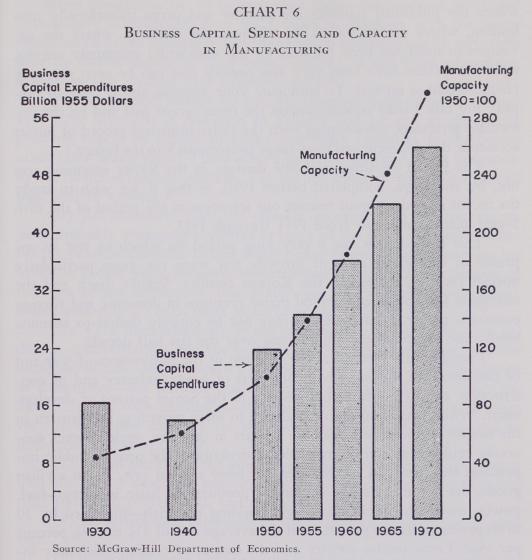
Residential nonfarm construction is assumed to increase from $16.6 billion in 1955 to $19 billion in 1960, $22 billion in 1965 and $26 billion in 1970. This assumes an increase in homebuilding to provide homes for new families, and for replacement or improvement of older dwellings. The fact that much of our population changes residence each year suggests a fairly high rate of replacement. And the present trend toward larger families may require additions or alterations to many otherwise serviceable homes.Expenditures on plant and equipment by business, farmers, and private nonprofit institutions are expected to increase, in constant 1955 dollars, from near $40 billion in 1955 to $49 billion in 1960, $60 billion in 1965, and $70 billion in 1970. (This series differs, for the most part, from the series on business capital expenditures shown in chart 6 in that it includes farm buildings and equipment. However, the reasons for the increase are the same.) The annual increase in inventories is expected to be $3 billion in 1960, $4 billion in 1965, and $5 billion in 1970. These estimates are about what will be needed in order to take care of the rate of increase in output expected over the future years.
Net Foreign Investment
We assumed that net foreign investment will be zero in the years ahead. In 1955 it was—$0.5 billion. This year it will probably average about $1 billion.
Government Expenditures
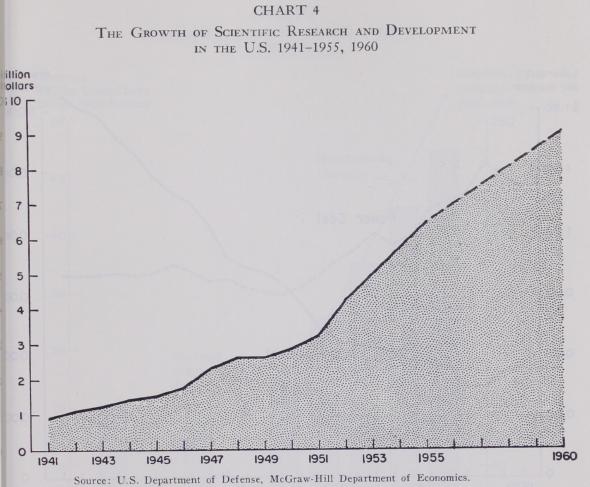
It is expected that expenditures for national-security programs will rise in the years to come despite a decline in the number of military personnel. Complexity of weapons and increasing research will require larger dollar spending.It is expected that more civilian Government personnel will be needed in the future, as our national economy expands, simply to meet the increase in demand for present Government services.
State and Local Expenditures
State and local spending must increase rapidly if our projected needs for roads, schools, etc., are to be met. The next 10 or 15 years will see some cutting down of the backlog in these fields—a backlog of needs which has been accumulating since the depression years, and only recently been attacked with real vigor. But for most of the period we are considering, the only limits on this type of spending will be the ability to finance it and to obtain the necessary resources.