Efforts to Modify Income Distribution Minimum Wage Legislation an Economic Analysis
Second, entrepreneurs may be shocked out of lethargy to adopt techniques which were previously profitable or to discover new techniques. This "shock" theory is at present lacking in empirical evidence but not in popularity.
There are several reasons for believing that the "shock" theory is particularly inappropriate to the industries paying low wages. All of the large manufacturing industry categories which in 1939 paid relatively low wages (measured by the payroll of wage-earners divided by their average number) are listed in Table I. A study of this table suggests two generalizations: (1) the low-wage industries are competitive, and (2) the ratio of wages to total-processing-cost-plus-profit is higher than in high-wage industries. The competitive nature of these industries argues that the entrepreneurs are not easy-going traditionalists: vigorous competition in national markets does not attract or tolerate such men. The relatively high labor costs reveal that inducements to wage-economy are already strong.
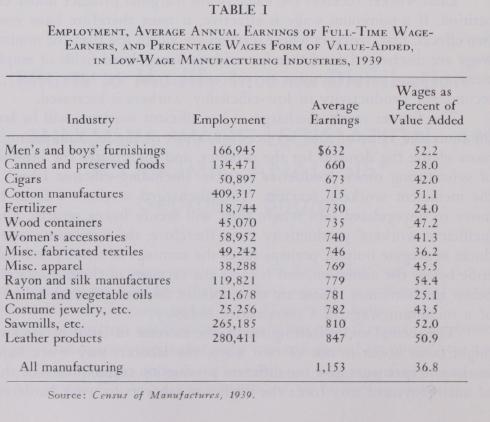
These considerations both work strongly against the shock theory in lowwage manufacturing industries in 1939. Since these industries were on the whole much less affected by the war than other manufacturing industries, they will probably be present in the post-war list of low-wage industries. The low-wage industries in trade and services display the same characteristics and support the same adverse conclusion with respect to the shock theory.
Employer Wage Determination
If an employer has a significant degree of control over the wage rate he pays for a given quality of labor, a skillfully-set minimum wage may increase his employment and wage rate and, because the wage is brought closer to the value of the marginal product, at the same time increase aggregate output. The effect may be elucidated with the hypothetical data in Table II. If the entrepreneur is left alone, he will set a wage of $20 and employ 50 men; a minimum wage of $24 will increase employment to 70 men.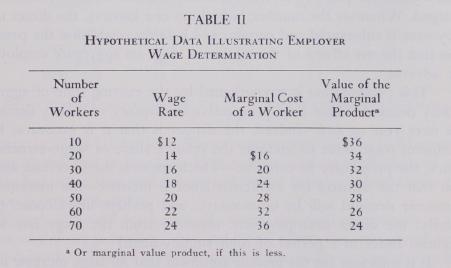
This arithmetic is quite valid, but it is not very relevant to the question of a national minimum wage. The minimum wage which achieves these desirable ends has several requisites: 1. It must be chosen correctly: too high a wage (over $28 in our example) will decrease employment. The accounting records describe, very imperfectly, existing employment and wages; the optimum minimum wage can be set only if the demand and supply schedules are known over a considerable range. At present there is no tolerably accurate method of deriving these schedules, and one is entitled to doubt that a legislative mandate is all that is necessary to bring forth such a method.
2. The optimum wage varies with occupation (and, within an occupation, with the quality of worker).
3. The optimum wage varies among firms (and plants).
4. The optimum wage varies, often rapidly, through time.
A uniform national minimum wage, infrequently changed, is wholly unsuited to these diversities of conditions.
We may sum up: the legal minimum wage will reduce aggregate output, and it will decrease the earnings of workers who had previously been receiving materially less than the minimum.