The Problem of Poverty
THE PROBLEM OF POVERTY Minimum wage legislation commonly has two stated objectives: the reduction of employer control of wages; and the abolition of poverty. The former and much lesser purpose may better be achieved by removing the condition of labor immobility which gives rise to employer control. Labor immobility would be reduced substantially by public provision of comprehensive information on employment conditions in various areas and industries. The immobility would be further reduced by supplying vocational training and loans to cover moving costs. But employer wage control is not the important problem; let us turn to the elimination of poverty.
Incomes of the poor cannot be increased without impairing incentives. Skillful policies will, for a given increase in the incomes of the poor, impair incentives less than clumsy policies. But the more completely poverty is eliminated, given the level of intelligence with which this is done, the greater will be the impairment of incentives. This is a price we must pay, just as impairment of incentives is a price we have willingly paid to reduce the inequality of income by progressive income and estate taxes. Society must determine, through its legislators, what minimum income (or addition to income) should be guaranteed to each family. We shall assume that this difficult decision has been made.
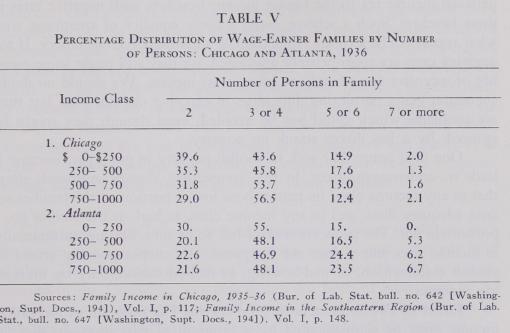
One principle is fundamental in the amelioration of poverty: those who are equally in need should be helped equally. If this principle is to be achieved, there must be an objective criterion of need; equality can never be achieved when many cases are judged (by many people) "on their merits." We are driven almost inexorably to family size and composition as this criterion of need. It is obviously imperfect; the sickly require more medical care than the healthy. But it is vastly easier to accord special treatment to certain families for a few items like medical care than to accord special treatment to every family for the sum of all items of expenditure.
It is a corollary of this position that assistance should not be based upon occupation. The poor farmer, the poor shopkeeper, and the poor miner are on an equal footing. There may be administrative justification (although I doubt it) for treating the farmer separately from the urban dweller, but there is no defense in equity for helping the one and neglecting the other. To render the assistance by manipulating prices is in any
case objectionable: we help the rich farmer more than the poor, and give widely differing amounts of help to the poor farmer from year to year.
The principle of equity thus involves the granting of assistance to the poor with regard to their need (measured by family composition) but without regard to their occupation. There is a possible choice between grants in kind and in money. The latter comments itself strongly: it gives full play to the enormous variety of tastes and it is administratively much simpler. Yet it raises a problem which will be noticed shortly.
Even if these general observations be accepted, the structure of administration is of grave importance, and I do not pretend to have explored this field. There is great attractiveness in the proposal that we extend the personal income tax to the lowest income brackets with negative rates in these brackets. Such a scheme could achieve equality of treatment with what appears to be a (large) minimum of administrative machinery. If the negative rates are appropriately graduated, we may still retain some measure of incentive for a family to increase its income. We should no doubt encounter many perplexing difficulties in carrying out this plan, but they are problems which could not be avoided, even though they might be ignored, by a less direct attack on poverty.
One final point: We seek to abolish poverty in good part because it leads to undernourishment. In this connection, dietary appraisals show that in any income class, no matter how low, a portion of the families secure adequate diets, and in any income class, as high as the studies go, a portion do not. The proportion of ill-fed, to be sure, declines substantially as income rises, but it does not disappear. We cannot possibly afford to abolish malnutrition, or mal-housing, or mal-education, only by increasing incomes.
Either of two inferences may be drawn. The program of increasing income must be supplemented by a program of education—in diet, in housing, in education! Or the assistance to the poor should be given in kind, expertly chosen. The latter approach is administratively very complex, but quicker and in direct expenditure vastly more economical. These factors affect our choice, but a thought should be given also to the two societies to which they lead.