Association Rules for Structural Timbers
pine and knot
Framing for Building.
Posts, mud sills, girders, framing, joists.
Ship Timbers Ship timbers, ship decking. Cross-Arms for Poles.
IL Standard Defects Measurements which refer to the diameter of knots or holes should be considered as referring to the mean or average diameter.
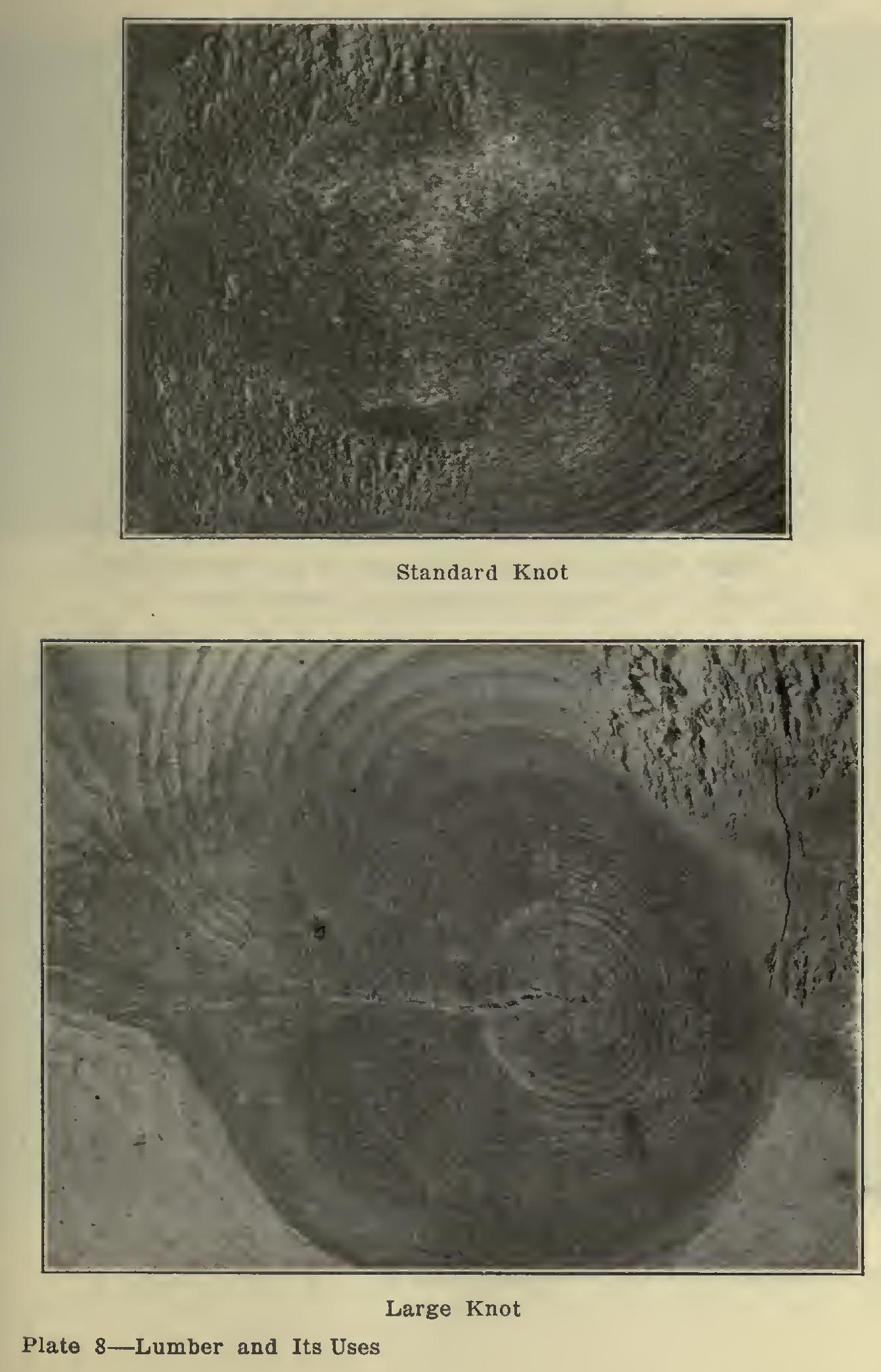
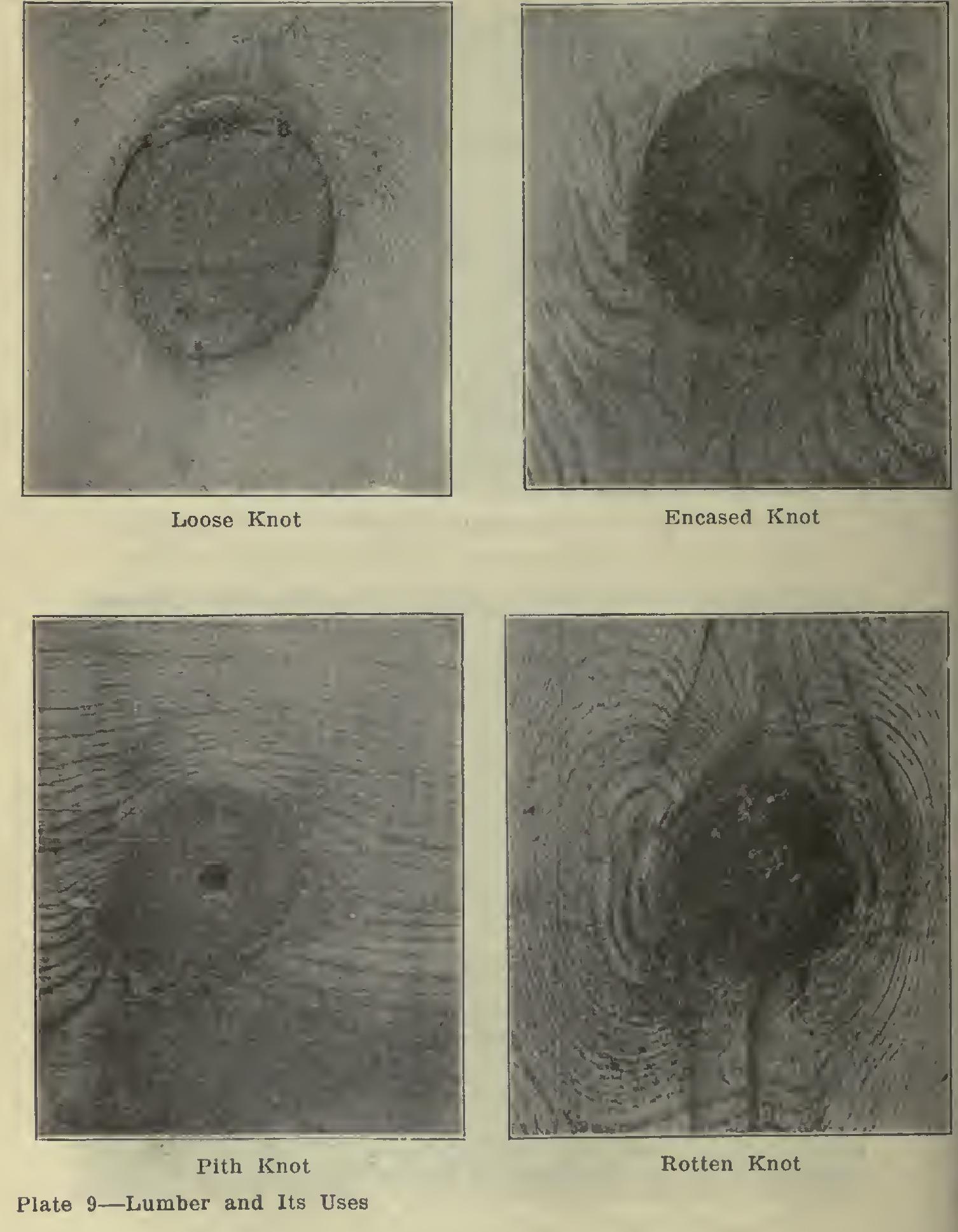
1. Sound Kno.
A sound knot is one which is solid across its face, and which is as hard as the wood surrounding it; it may be either red or black, and is so fixed by growth or position that it will retain its place in the piece.
2. Loose Kno.
A loose knot is one not firmly held in place by growth or position.
3. Pith Kno.
A.pith knot is a sound knot with a pith hole not more than inch in diameter in the center.
4. Encased Kno.
An encased knot is one which is surrounded wholly or in part by bark or pitch. Where the encasement is less than of an inch in width on both sides, not exceeding one-half the circumference of the knot, it shall be considered a sound knot.
5.. Rotten Kno.
A rotten knot is one not as hard as the wood it is in.
6. Pin Kno.
A pin knot is a sound knot not over inch in diameter.
7. Standard Kno.
A standard knot is a sound knot not over 1% inches in diameter.
8. Large Kno.
A large knot is a sound knot more than inches in diameter.
9. Round Kno.
A round knot is one which is oval or circular in form.
10. Spike Kno.
A spike knot is one sawn in a lengthwise direction ; the mean or average width shall be considered in measuring these knots.
11. Pitch
Pockets—Pitch pockets are openings between the grain of the wood containing more or less pitch or bark. These shall be classified as "small," "standard," and "large" pitch pockets.
(a) Small Pitch Pocket. A
small pitch pocket is one not over of an inch wide.
(b) Standard Pitch Pocket. A
standard pitch pocket is one not over % of an inch wide or 3 inches in length.
(c) Large Pitch Pocket. A
large pitch pocket is one over % of an inch wide or over 3 inches in length.
12. Pitch Strea.
A pitch streak is a well-defined accumulation of pitch at one point in the piece. When not sufficient to develop a well-defined streak, or where the fiber between grains—that is, the coarse-grained fiber, usually termed "Spring wood"—is not saturated with pitch, it shall not be considered a defect.
13. Wane—Wane is bark, or the lack of wood from any cause, on edges of timbers.
14. Shake.
Shakes are splits or checks in timbers which usually cause a separation of the wood between annual rings.
15. Rot, Dote, and Red Hear.
Any form of decay which may be evident either as a dark red discoloration not found in the sound wood, or the presence of white or red rotten spots, shall be considered as a defect.
16. Ring Shak.
An opening between the annual rings.
17. Through Shake—A shake which extends between two faces of a timber.
III. Standard
Names for Structural Timbers 1. Southern Yellow Pine—Under this heading, two classes of timber are used: (1) Longleaf Pine; (2) Shortleaf Pine.
It is understood that these two terms are descriptive of quality, rather than of botanical species. Thus, "Shortleaf Pine" would cover such species as are now known as North Carolina pine, loblolly pine, and shortleaf pine. "Longleaf Pine" is descriptive of quality; and if Cuban, shortleaf, or loblolly pine is grown under such conditions that it produces a large percentage of hard summer wood, so as to be equivalent to the wood produced by the true longleaf, it would be covered by the term "Longleaf Pine." 2. Douglas Fir—The term "Douglas Fir" to cover the timber known likeWise as yellow fir, red fir, Western fir, Washington fir, Oregon or Puget Sound fir or pine, norwest and west coast fir.
3. Norway Pine, to
cover what is known also as "Red Pine." 4. Hemlock, to cover Southern or Eastern hemlock— that is, hemlock from all States east of and including Minnesota.
5. Western Hemlock,
to cover hemlock from the Pacific coast.
6. Spruce,
to cover Eastern spruce—that is, the spruce timber coming from points east of Minnesota.
7. Western Spruce,
to cover the spruce timber from the Pacific coast.
8.. White Pine,
to cover the timber which has hitherto been known as white pine, from Maine, Michigan, Wisconsin, and Minnesota.
9. Idaho White Pine,
the variety of white pine from western Montana, northern Idaho, and eastern Washington.
10. Western Pine,
to cover the timber sold as white pine coming from Arizona, California, New Mexico, Colorado, Oregon, and Washington. This is the timber sometimes known as "Western Yellow Pine," or "Ponderosa Pine," or "California White Pine," or "Western White Pine." 11. Western Larch, to cover the species of larch or tamarack from the Rocky Mountain and Pacific coast regions.
12. Tamarack,
to cover the timber known as "Tamarack," or "Eastern Tamarack," from States east of and including Minnesota.
13. Redwood,
to include the California wood usually known by that name.
IV. Standard Specifications for Bridge and Trestle Timbers (To be applied to solid members and not to composite members)