Lumber Prices
grades and materials
LUMBER PRICES Many well-informed people have the impression that lumber has become so scarce and high-priced that the ordinary man can no longer afford to build. a wooden house. This impression, like the agitation against wood construction on account of fire risk, has been assiduously cultivated by the vendors of substitute materials. It is true that certain grades of some species of timber are high-priced, compared with the price at which the same grades could be obtained 20 to 30 years ago; but, on the other hand, there is still much good building material available for every purpose, at reasonable cost. While some kinds are scarcer than they once were, we are now using many valuable woods which were formerly wholly neglected. The last ten years has seen tremendous advances in the appreciation of red gum, beech, birch, maple, and the West Coast woods. While the highest grades of liearly all kinds of timber command high prices, because only a small amount of high-grade lumber is produced, we must remember that the ordinary structural materials consist of the medium grades, of which there is a much greater supply than of the higher grades. These medium grades have not had the same advance in price as the upper grades, owing both to their abundance and to the competition of other materials. The same causes will prevent their advance to excessive prices for many years to come; hence these grades will continue for a long time to be the chief reliance of builders in many parts of the country.
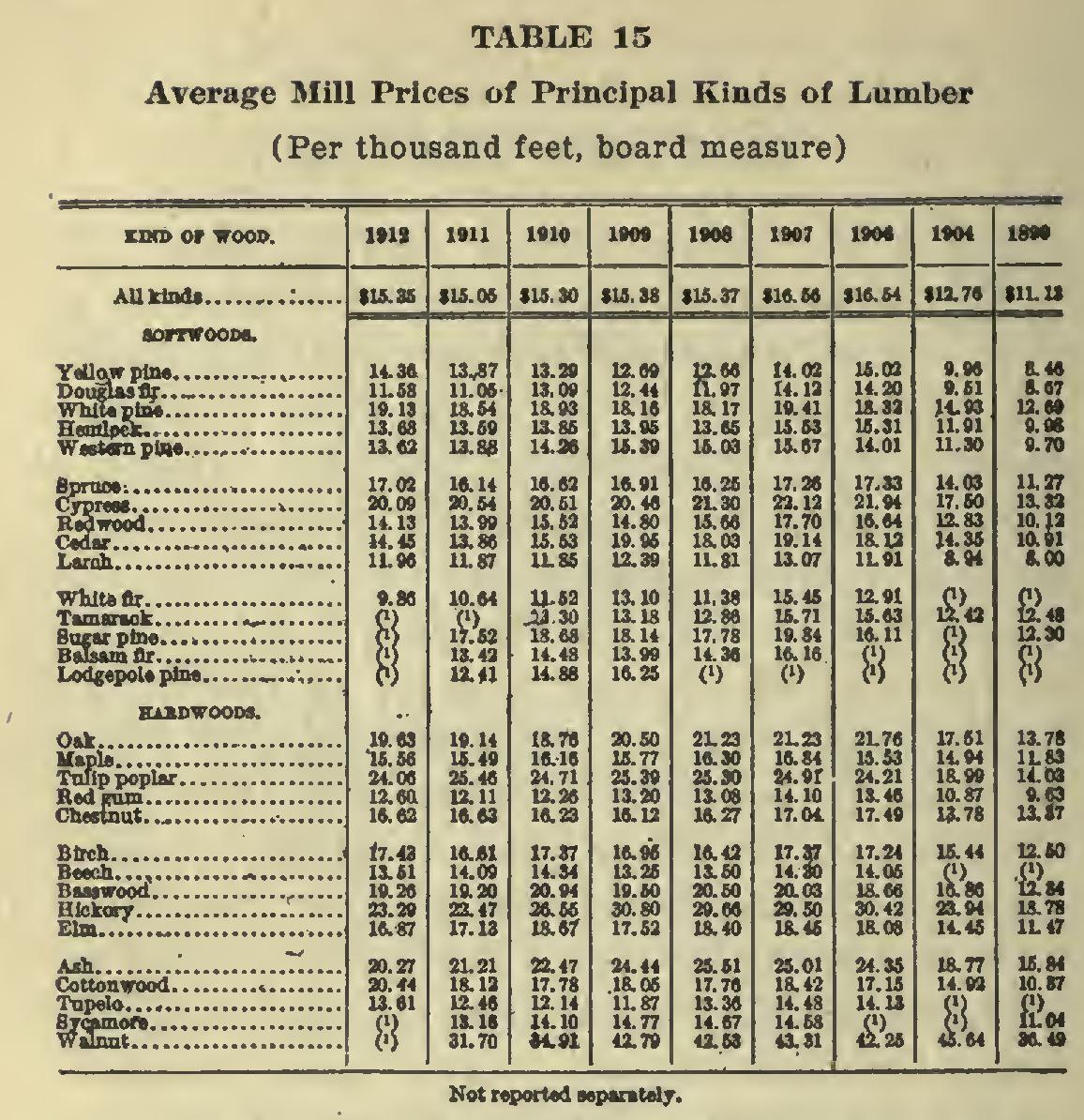
That the price of lumber has not advanced more than that of many other commodities, and in fact, is scarcely as high now as it was several years ago, is shown by Table 15, which gives a tabulation, compiled by the Census Bureau and the Forest Service, of the average values per thousand feet at the sawmill, of the principal kinds of lumber.
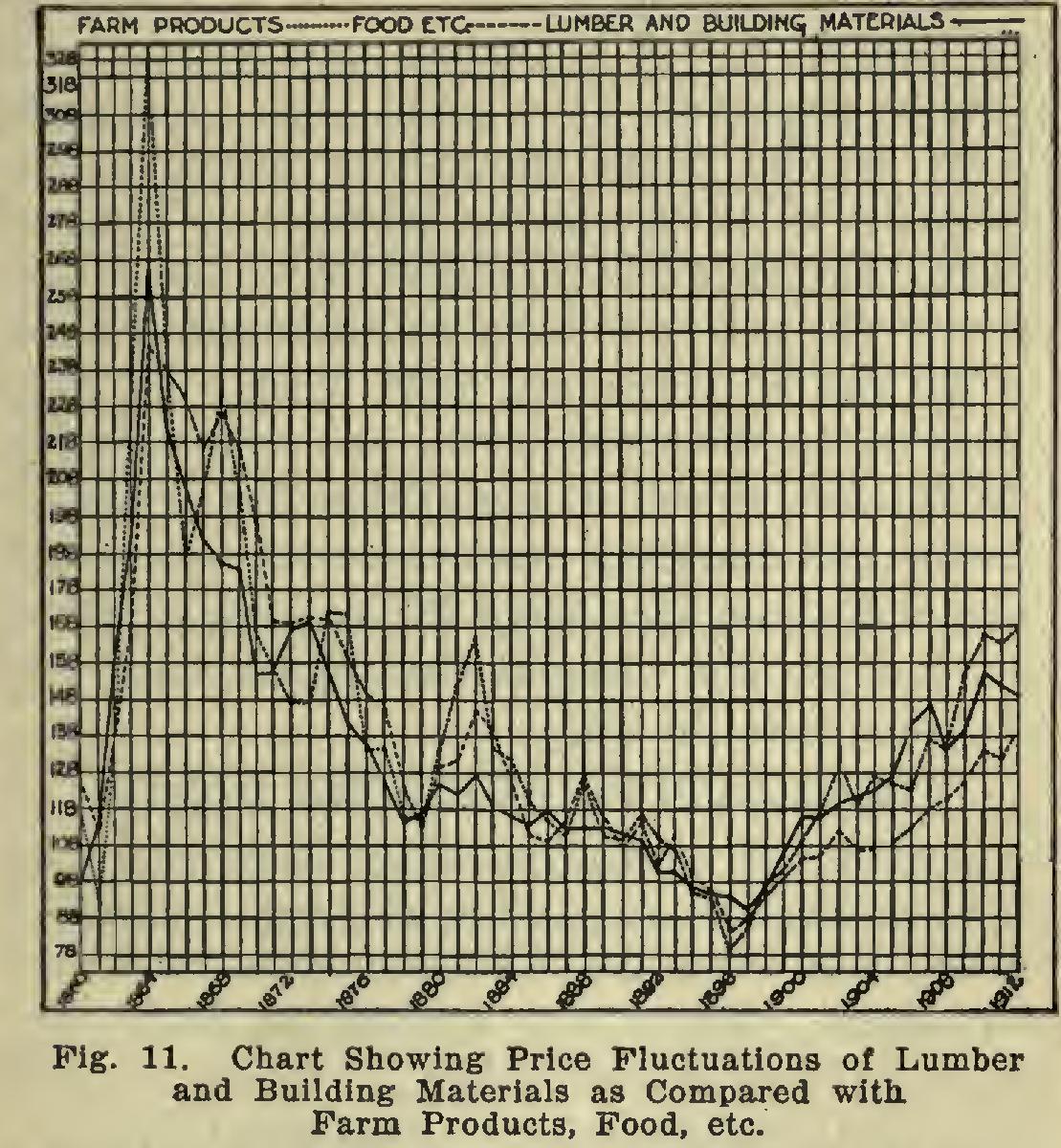
The statement that lumber has reached such an exorbitant price that it can no longer be'used, is best met by the records of the United States Bureau of Labor, the authority on the wholesale prices of all commodities. On page 149 of Bulletin 114 of the Bureau is given a table of the relative prices of nine groups of commodities from 1860 to 1912, the average price from 1890 to 1899 being taken as 100. The chart (Fig. 11) shows in graphic form the record of the Bureau for three of the most important groups of commodities—farm products, food, and lumber and building materials. On the t, farm products are indicated by a dotted line, food by a line of dashes, and lumber and building materials by a solid line. A single glance at the chart completely answers the statement as to the undue advance in lumber prices. On an average, these prices have run between the prices of farm products and of food for the last 50 years, and with neither as high points nor as low points as the two other groups. Still further, it will be noted that the prices of lumber and building materials are relatively lower now than they were 40 years ago; yet at that time no one thought that lumber was too expensive to build with.