Natural Fire-Resistance
woods and ignition
NATURAL FIRE-RESISTANCE Not all woods are susceptible to fire in the same degree. Indeed, at the lower temperatures, there is a considerable range between the different woods in the resistance which they offer to ignition. Still further, the ease with which wood burns depends upon its moisture content, a piece of dry wood catching fire, of course, much more quickly than a moist piece.
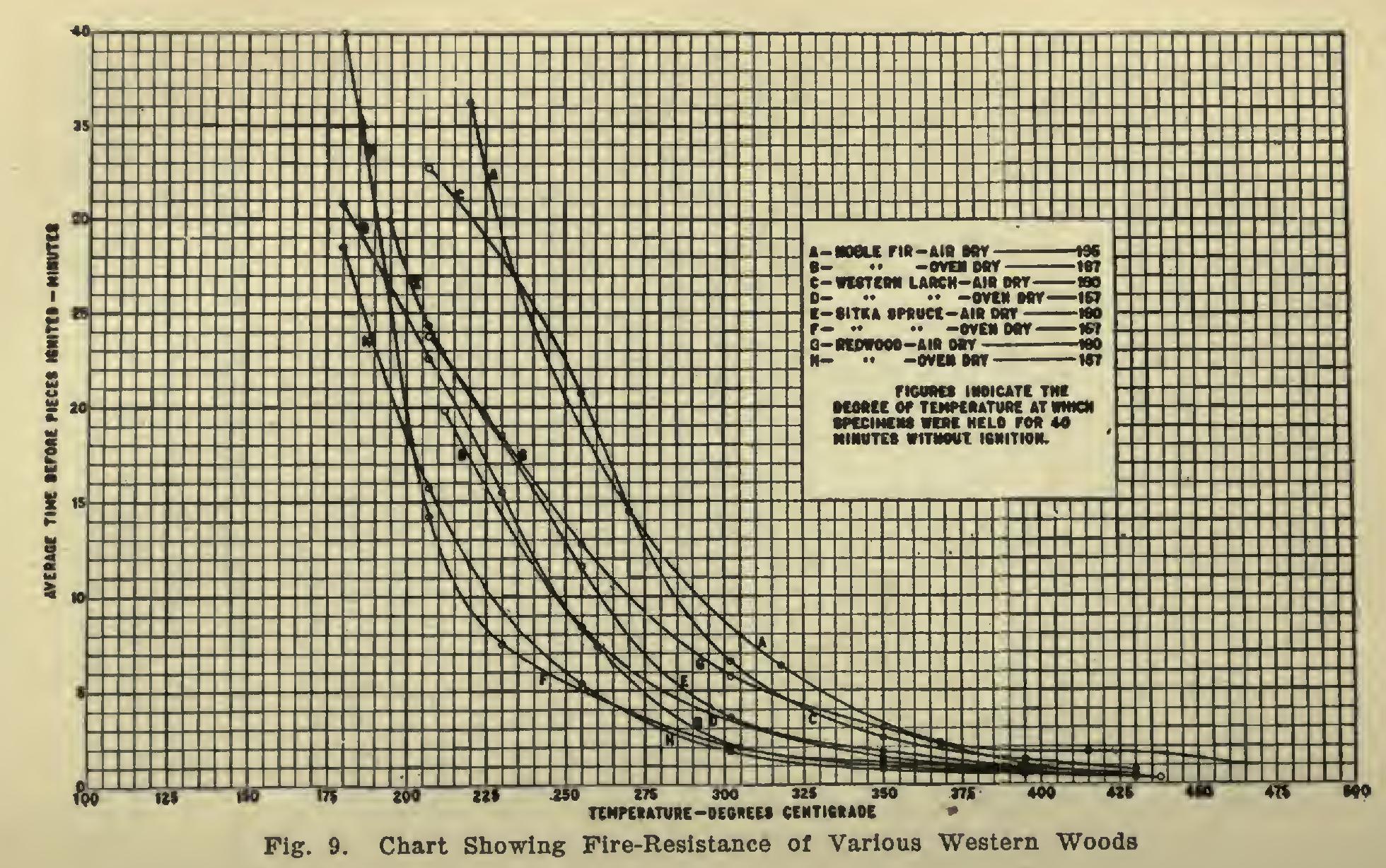
The United States Forest Service has recently concluded an interesting series of tests upon the natural fire-resistance of a number of species of timber. The results of these tests are shown graphically in charts on pages 148 and 150. It will be noted from these tests, that in the case of the Western woods, Western larch resisted ignition longest; and that among the Eastern woods, tamarack or Eastern larch held same position. In fact, tamarack seems to be the most fire-resistant of eight woods tested. Curve A shows for example, that it was necessary to expose a piece of air-dry tamarack to a temperature above 205° C. (or 401° F.) for 40 minutes, in order to make it burn; while Curve F shows that a piece of oven-dry longleaf pine ignited in 15 minutes at a temperature of • 175° C. (or 347° F.). On the other hand, airdry tamarack and air-dry longleaf pine were both held at a temperature of 180° C. (or 356° F.) for 40 minutes, without ignition. When, however, the temperature became as great as 350° C. (or 662° F.), there was little difference in any of the species in resistance to ignition.