Forest Products Laboratory
wood and properties
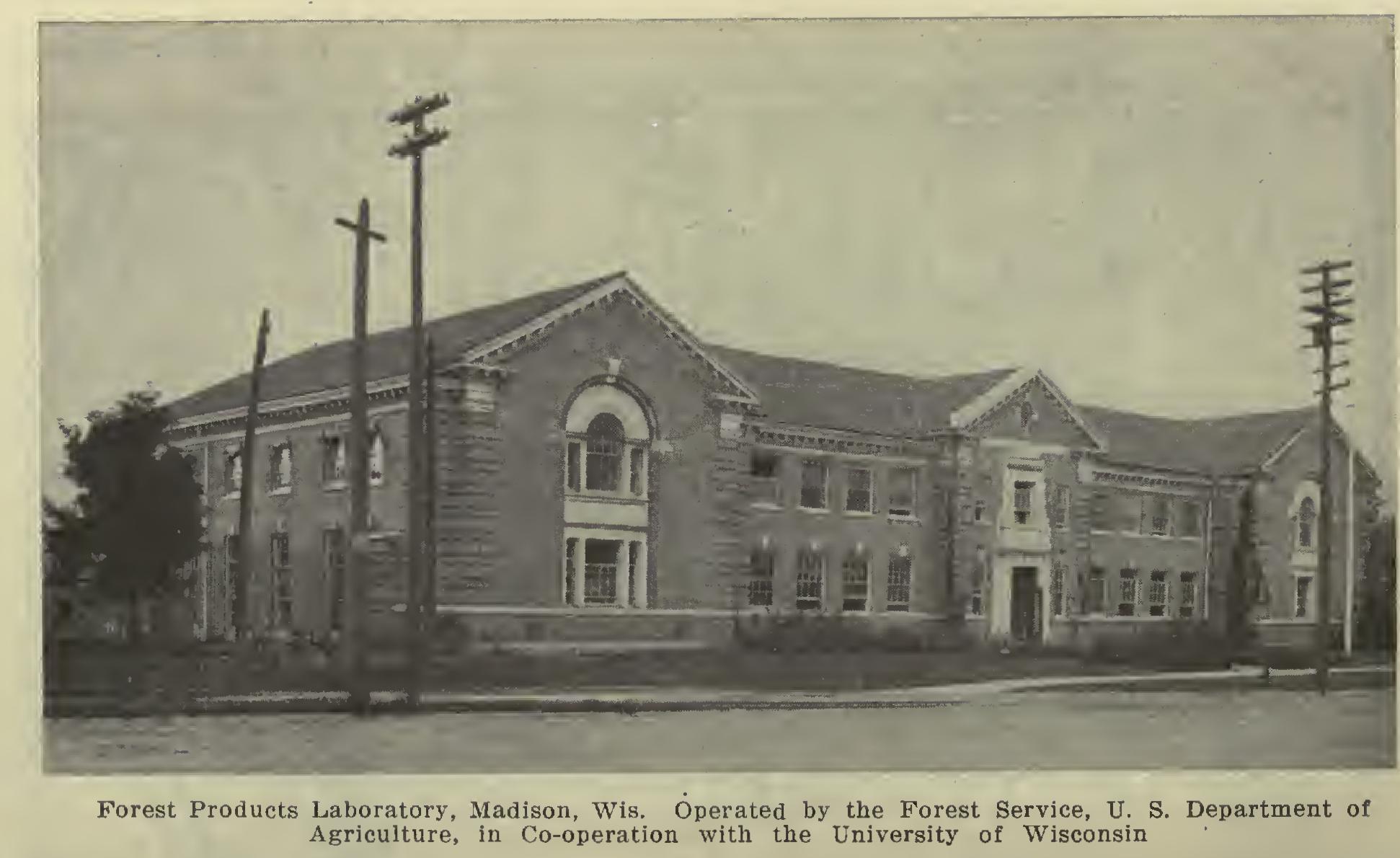
FOREST PRODUCTS LABORATORY At Madison, Wis., the Forest Service operates, in co-operation with the University of Wisconsin, a large and completely equipped laboratory in which are carried on many investigations and a great deal of research relating to the properties and uses of commercial woods.
Without going into details, it can be said that the laboratory is thoroughly equipped with all the machinery and scientific appliances necessary to carry on the following lines of investigation, as well as several others: Mechanical Properties of Timber Mechanical tests of timber are highly valuable to engineers, manufacturers, and other users of wood, since they enable the man who specifies timber for a particular purpose to know exactly the properties of the material he is dealing with.
The first series of mechanical tests is upon small, clear sticks of all the leading species, which gives a reliable basis for the comparison of their strength, weight, and other properties.
The second series of tests is upon timbers of the quality and sizes commonly used in bridges and general building construction. The purpose of these tests is to furnish engineers and architects with information which may be safely used in the design of timber structures, and to establish a correct basis for the grading of large timbers according to their mechanical properties.

Another series of tests is upon axles, spokes, crossarms, poles, and other manufactured articles, for the purpose of demonstrating the fitness of various species and grades of material for these uses.
The fourth series of mechanical tests is for the purpose of studying the effect of preservative treatments, methods of seasoning, fireproofing, and similar processes, upon the properties of wood.
Physical Properties of Timber
A knowledge of the physical properties of wood is necessary in a large number of industries, and essential to the investigation of problems relating to the seasoning and preserving of timber. The physical properties of wood which are given especial attention at the Madison laboratory include density, shrinkage, heat conductivity, and ability to absorb water and other liquids. The seasoning of timber is probably the most important single step in the transformation of wood into usable form, and much material is annually lost because of poor seasoning methods. It is the purpose of the Service investigations to assist in the introduction of better methods of seasoning; and much has been accomplished, especially in the devising of a scientific dry-kiln.
Another important line of study is that of the relation of the structure of wood to its physical properties. This
is a subject upon which there is far too little information. For example: Two pieces of white oak of apparently like quality, from adjacent trees, were recently received at Madison. So far as could be determined by all ordinary means, the two pieces should have been of equal strength ; yet, when tested, one piece was found to be twice as strong as the other. There seemed to be no explanation for this peculiar result until sections of the two pieces of wood were put under the microscope, when it was quickly discovered that the fibers of the stronger piece were twice as long as the fibers of the weaker piece. This was a peculiarity of the growth of an individual tree, just as one boy of a family may be stronger than another, although the two are reared under exactly the same conditions.
Wood Preservation
The statisticians say that 126,000,000 cubic feet of wood were given preservative treatment in 1912; so there is no need to discuss the importance of a thorough understanding of timber-treating materials and the processes by which they are applied. The work of the Service laboratory along this line has already been very extensive, and recently it has gone a step further to include a study of methods by which wood may be rendered fireproof. Legislation against wood as a building material in cities is becoming so general that it will be completely banished from many places where it is most useful and economical unless a method can be devised of making wood fireproof at reasonable cost.
Co-Operation with the Public
It is the policy of the Forest Products Laboratory to secure as fully as possible the co-operation of the industries most directly concerned with the problems under investigation. In some cases, where the resulting work is of much value to the co-operating firm, a charge to cover part of the cost is made by the Service; in other cases, where the investigations are of an experimental nature and of general value, the services of the laboratory are entirely free. At all times, the laboratory furnishes, either by letter or through its publications, much useful information upon a wide variety of subjects.
The officers in charge of the laboratory are of the highest type of public servants whom it is always a pleasure to meet or to correspond with. Any manufacturer of forest products or consumer of wood who has difficulty of any kind in the handling of his material, will find it worth while to lay his problems before the Forest Service experts. The chances are that he will get help, and get it promptly.