Measurement of Brickwork
wall and cubic
MEASUREMENT OF BRICKWORK It is customary to estimate brickwork by the thousand brick contained in the wall. As many parts are not open to inspection, it is clearly not possible to determine the number by actual count, and recourse must be had to measurement.
The work of building around openings is not nearly so difficult with brick as with stone; and accordingly not so great an allowance for openings need be made in the case of brickwork as in the case of stone masonry.
The actual number of bricks in a cubic foot varies with the thickness of the mortar joints as well as with the size of the brick; but usually the average is between and An average of 18 may be taken as very nearly suitable in most cases when the work is continuous, and the joints inch thick. When there are many openings and small piers, requiring much cutting and consequent waste, it is safe to allow 20 brick per cubic foot for the work.
When asking for bids on work, it is well to specify just how the measurement of the quantity shall he made; and the following rule is to be recommended as fair and tending to prevent controversy: Divide the total number of superficial feet of wall surface of a given thickness by 160, and multiply the result by the number of brick widths the wall is thick. The result will be the number of thousand of brick contained.
This rule is based on the fact that a 4-inch wall contains about 1,000 brick to 160 superficial feet, if the joints be 1/4 inch thick.
For example, a 12-inch wall 40 feet long and 20 feet high would contain 40 X20÷160x 3=15 thousand bricks.
While the above rule gives the munber of brick to be purchased for the wall, another abitrary rule for the payment of the masons is sometimes adopted: Count bricks for each superficial foot of wall for each half-brick (halflength of brick) thickness of wall.
In the same example as above, this would give 40 thousand bricks as a basis of payment for the labor.
The allowance for openings is not a uniform practice, but may be fairly well established by custom in any given city. These customs must be consulted in letting or computing such work.
When no deduction is made for openings, it is not customary to make extra payment for arches, buttresses, pilasters, and the like.
Amount of Material Required. In estimating the cost of a proposed piece of brickwork, the rule given above determines the number of thousand of brick required. The amount of sand,
lime, or cement depends on the richness of the mortar and the thickness of the joints.
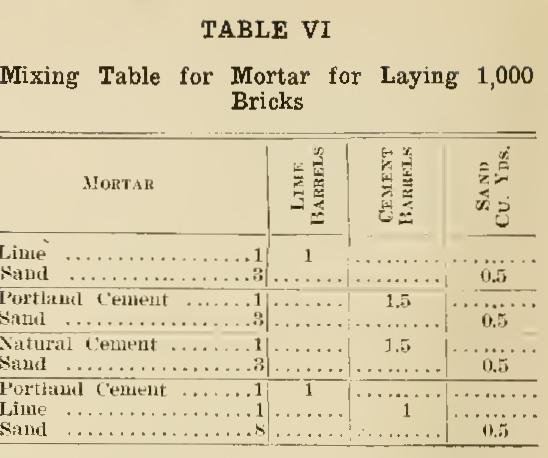
Table VI gives the necessary amount of sand and cement to lay 1,000 bricks with joints about inch thick.
Stated otherwise, a cubic yard of brick masonry with Winch joints requires rather more than 1-3 of a cubic yard of mortar. If the joints are 14 inch thick, 14 cubie yard of mortar will be sufficient to lay a cubic yard of brickwork. When joints are only inch thick, cubic yard of mortar will be required to a cubic yard of brickwork.
A barrel of lime will make 214 barrels (or 3 cubic yards) of lime paste. A barrel of this paste, with 3 barrels .of sand, will make 3 barrels of Ellie mortar. A barrel of =slaked lime is sufficient for barrels of 1 to 3 mortar: Data Concerning Brickwork. The weight of brick walls, at 112 pounds per cubic foot, is: 9-inch wall, 84 pounds per superficial foot.
13-inch wall, 121 pounds per superficial foot.
18-inch wall, 168 pounds per superficial foot.
22-ineh wall, 205 pounds per superficial foot.
26-ineh wall, 243 pounds per superficial foot.
A load of sand or mortar is a cubic yard.
Sand weighs from SO to 115 pounds per cubic foot. or l to tons per cubic yard.
A cubic yard of mortar requires a cubic yard of sand, and equals 30 hodfuls.
A bricklayer's hod holds 20 bricks.
Masonry with %-inch joints contains 500 bricks per cubic yard. With inch joints, the number will be 575.
No 8-inch brick wall should be over 14 feet in height.
A mason and his helper should lay 1,000 bricks in seven hours on plain work.
The waste of brick in good material is about 2 per cent for ordinary work; in soft or salmon, as much as 5 per cent.
Walls that are a brick-length thick are often called 9-inch walls.
A 13-inch wall is a brick-length, plus its width, phis the thickness of a mortar joint.
A 17-inch wall has a thickness equal to the length of two bricks, with the mortar joint.
A barrel of Portland cement, nominally 400 pounds, weighs about 380 pounds net.
A barrel of natural cement, nominally 300 pounds, weighs about 265 pounds net.
A barrel of lime weighs about 200 pounds.
Two and a half bushels equals a barrel.