Specifications for Paving Etc
brick and bricks
Twenty or more specimen bricks shall also be furnished by each bidder, for submission to the abrasion test by the Board of Local Improvements. Such test shall be made in the following manner, to wit: Such specimen brick, or a sufficient number to fill 15 per cent of the volume of the rattler, shall be submitted to a test for one hour in the machine known as the rattler, which shall measure 20 inches in length and 28 inches in diameter, inside measurement, and shall be revolved at the rate of 30 revolutions per minute. If the loss of weight by abrasion during such teat shall exceed 20 per cent of the original weight of the brick tested, then such bid shall be rejected.
All brick shall have a specific gravity of not less than 2.1, as determined by the formula Specific Gravity = where W equals weight of brick dry, W' equals weight of brick after being immersed in water for 72 hours, and W" equals weight of brick in water.
All brick used must be equal in every respect to the specimen submitted by the bidders to the Board of Local Improvements for test.
How Laid. All brick shall be delivered on the work in barrows; and in no ease will teams be allowed on the street before the wearing surface is rolled.
Broken bricks can be used only to break joints in starting courses and in making closures, but in no ease shall less than half a brick be used. ' The bricks shall he laid on edge, close together, in straight lines across the roadway, between gutters; and at right angles to the curbs, and perpendicular to the grade of the street. Gutters shall be constructed as directed by the Engineer.
The joints shall be broken by a lap of not less than 3 inches.
On intersections and junctions of lateral streets, the bricks shall be laid at an angle of 45 degrees with the line of the street, unless otherwise ordered by the Engineer.
The bricks, when set, shall be rolled with a roller weighing not less than 5 tons, until the bricks are well settled and made firm. Or, if the Engineer shall direct, the bricks, when set, shall be thoroughly rammed two or more times, the ramming to be done under a fatter, with a paving rammer weighing not less than 30 pounds, the iron of the rammer face in no ease to come in contact with the pavement.
After rolling and ramming, all broken brick found in the pavement must be at once removed and replaced by sound and perfect brick.
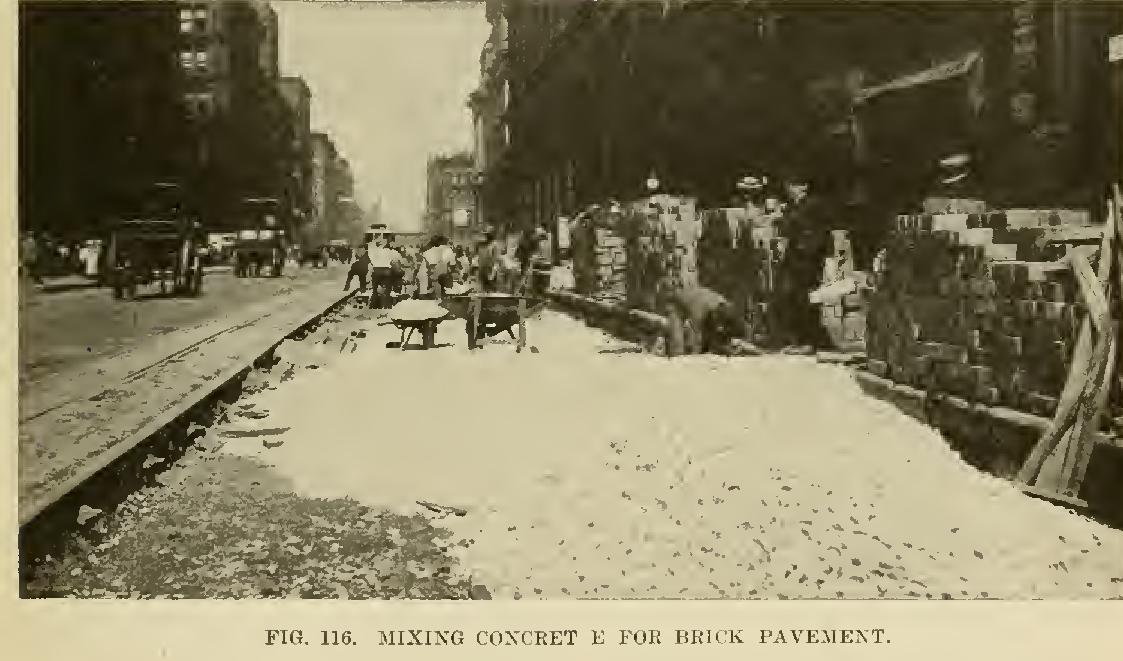
Pitching or Grouting, and Top-Dressing. When the bricks are thoroughly bedded, the surface of the pavement must be true for grade and crown. The surface of the pavement shall then be swept clean ; and the joints or spaces between the brick shall be completely filled with a paving pitch which is the direct result of the distillation of "straight-run" coal-tar, and of such quality and consistency as shall be approved by the Board of Local Improvements. The pitch must be used at a temperature of not less than 280 degrees Fahrenheit.
When the brick are thoroughly bedded, the surface of the pavement must be true far grade and crown. The surface of the pavement shall then be swept clean, and the joints or spaces between the bricks shall be filled with a cement grout filler composed of limestone 65 per cent, furnace slag 25 per cent, and potter's clay 10 per cent, to be made as follows: The above materials, in the proportions stated, shall be mixed together and ground into an impalpable powder, and then burned in kilns until reduced to clinker, after which it shall again he ground into an impalpable powder. Equal-portions of said grout and clean, sharp sand shall then be thoroughly mixed, and sufficient water added to bring the mixture to such a consistency as will allow it to run to the bottom of the joints between the brick. After said joints are filled to the top, the surface shall be finished off smooth with steel brooms.
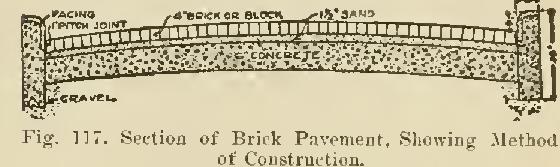
After the spaces between the brick have been filled with the pitch or grout as above specified, the surface of the pavement shall then receive a 1/2-inch dressing of sand, evenly spread over the whole surface.
Where cement grout is used as a filler, the pavement must be kept clear of traffic for a period of 4 days—or as much longer as the Engineer may direct—after the application thereof.
In determining the number of brick necessary for paving any desired area, Table XXVI will be found of assistance.