Cell-Division
division and process
CELL-DIVISION " Wo eine Zelle entsteht, da muss eine Zelle vorausgegangen sein, ebenso wie das Thier nur aus dem Thiere, die Pflanze nur aus der Pflanze entstehen kann. Auf diese Weise ist, wenngleicb es einzelne Punkte im Korper gibt, wo der strenge Nachweis noch nicht geliefert ist, dock das Princip gesichert, Bass in der ganzen Reihe alles Lebendigen, dies magen nun gauze Pflanzen oder thierische Organismen oder integrirende Theile derselben sein, ein ewiges Gesetz der continuirlichen Entwicklung besteht." THE law of genetic cellular continuity, first clearly stated by Virchow in the above words, has now become one of the primary data of biology. The cell has no other mode of origin than by division of a pre-existing cell. In the multicellular organism all the tissue-cells have arisen by continued division from the original germ-cell, and this in its turn arose by the division of a cell pre-existing in the parent-body. By cell-division, accordingly, the hereditary substance is split off from the parent-body ; and by cell-division, again, this substance is handed on by the fertilized egg-cell or oosperm to every part of the body arising from Cell-division is, therefore, one of the central facts of development and inheritance.
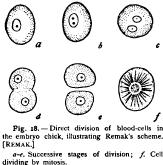
The first two decades after Schleiden and Schwann (184o-6o) were occupied with researches, on the part both of botanists and of zoologists, which finally demonstrated the universality of this process and showed the authors of the cell-theory to have been in error in asserting the independent origin of cells out of a formative The mechanism of cell-division was not precisely investigated until long afterwards, but the researches of Remak ('41), Kolliker ('44), and others showed that an essential part of the process is a division of both the nucleus and the cell-body. In 1855 pp. 174, 175), and again in 1858, Remak gave as the general result of his researches the following synopsis or scheme of cell-division. Cell-division, he asserted, proceeds from the centre toward the It begins with the division of the nucleolus, is continued by simple constriction and division of the nucleus, and is completed by division of the cellbody and membrane (Fig. i8). For many years this account was accepted, and no essential advance beyond Remak's scheme was made for nearly twenty years. A number of isolated observations were, however, from time to time made, even at a very early period, which seemed to show that cell-division was by no means so simple an operation as Remak believed. In some cases the nucleus seemed to disappear entirely before cell-division (the germinal vesicle of the ovum, according to Reichert, Von Baer, Robin, etc.); in others
to become lobed or star-shaped, as described by Virchow and by Remak himself (Fig. t8, f). It was not until 1873 that the way was opened for a better understanding of the matter. In this year the discoveries of Anton Schneider, quickly followed by others in the same direction by Butschli, Fol, Strasburger, Van Beneden, Flemming, and Hertwig, showed cell-division to be a far more elaborate process than had been supposed, and to involve a complicated transformation of the nucleus to which Schleicher ('78) afterwards gave the name of Karyokinesis. It soon appeared, however, that this mode of division was not of universal occurrence ; and that celldivision is of two widely different types, which Van Beneden ('76) distinguished as fragmentation, corresponding nearly to the simple process described by Remak, and division, involving the more complicated process of karyokinesis. Three years later Flemming ('79) proposed to substitute for these the terms direct and indirect division, which are still used. Still later ('82) the same author suggested the terms mitosis (indirect or karyokinetic division) and amitosis (direct or akinetic division), which have rapidly made their way into general use, though the earlier terms are often employed.
Modern research has demonstrated the fact that amitosis or direct division, regarded by Remak and his immediate followers as of universal occurrence, is in reality a rare and exceptional process ; and there is reason to believe, furthermore, that it is especially characteristic of highly specialized cells incapable of long-continued multiplication or such as are in the early stages of degeneration, for instance, in glandular epithelia, in the cells of transitory embryonic envelopes, and in tumours and other pathological formations, where it is of frequent occurrence. Whether this view be well founded or not, it is certain that in all the higher and in many of the lower forms of life, indirect division or mitosis is the typical mode of cell-division. It is by mitotic division that the germ-cells arise and are prepared for their union during the process of maturation, and by mitotic division the oosperm segments and gives rise to the tissue-cells. It occurs not only in the highest forms of plants and animals, but also in such simple forms as the Rhizopods, Flagellates, and Diatoms. We may, therefore, justly regard it as the most general expression of the " eternal law of continuous development" on which Virchow insisted.