General Morphology of the Cell
nucleus and substance
GENERAL MORPHOLOGY OF THE CELL The cell is a rounded mass of protoplasm which in its simplest form is approximately spherical. This form is, however, seldom realized save in isolated cells such as the unicellular plants and animals or the egg-cells of the higher forms. In vastly the greater number of cases the typical spherical form is modified by unequal growth and differentiation, by active movements of the cell-substance, or by the mechanical pressure of surrounding structures. The Sachs has proposed the convenient word energid (Flora, '92, p. 57) to designate the essential living part of the cell, i.e. the nucleus with that portion of the active cytoplasm that falls within its sphere of influence, the two forming an organic unit both in a morphological and in a physiological sense. It is to be regretted that this convenient and appropriate term has not come into general use. (See also Flora, '95, p. 405.) protoplasm which forms its living basis is a viscid, translucent, granular substance, often forming a network or sponge-like structure extending through the cell-body and showing various structural modifications in different regions and under different physiological states of the cell. Besides the living protoplasm the cell almost invariably contains various lifeless bodies suspended in the meshes of the network ; examples of these are food-granules, pigment-bodies, drops of oil or water, and excretory matters. These bodies play a purely passive part in the activities of the cell, being either reserve food-matters destined to be absorbed and built up into the living substance, or by-products formed from the protoplasm as waste matters, or in order to play some role subsidiary to the actions of the protoplasm itself. The lifeless inclusions in the protoplasm have been collectively designated as metaplasm (Hanstein) in contradistinction to the living protoplasm ; but this convenient term is not in general use. Among the lifeless products of the protoplasm must be reckoned also the cell-wall or membrane by which the cell-body may be surrounded ; but it must be remembered that the cell-wall in many cases arises by a direct transformation of the protoplasmic substance, and that it often retains the power of growth by intussusception like living matter.
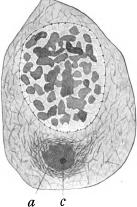
In all save a few of the lowest and simplest forms, perhaps even in them, the protoplasmic substance is differentiated into two very distinct parts, viz., the cell-body, forming the principal mass of the cell, and a smaller body, the nucleus, which lies in its interior (Fig. 5). Both structurally and chemically these two parts show differences of so marked and constant a character that they must be regarded as the most important of all protoplasmic differentiations. The nuclear substance is therefore often designated as nucleoplasm or karyoplasm ; that of the cell-body as cytoplasm (Strasburger). Some
of the foremost authorities, however, among them Oscar Hertwig, reject this terminology and use the word " protoplasm " in its historic sense, applying it solely to the cytoplasm or substance of the cell-body.
At a first examination the nucleus appears to be a perfectly distinct body suspended in the cytoplasm. Most of the latest researches point, however, to the conclusion that nucleus and cytoplasm are pervaded by a common structural basis, morphologically continuous Fig. 7.— Various cells showing the typical parts.
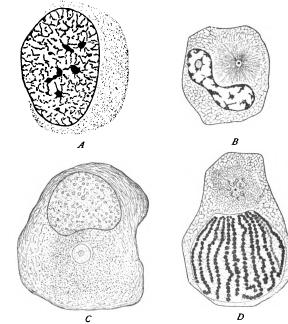
A. From peritoneal epithelium of the salamander-larva. Two centrosomes at the right. Nucleus showing net-knots. [Ft.Esi MING.] B. Spermatogonium of Attraction-sphere (aster) a centrosome. Nucleus with a plasmosonie. [HERMANN.] C. Spinal of Attraction-sphere near the centre, containing a centrosome with several centrioles. [1.ENItossEk.] D. Spermatocyte of Proteus. Nucleus in the spireme-stage. Centrosome attractionsphere rod-shaped bodies. [H ERNtANN.] under certain conditions from one to the other, and that both are to be regarded as specially differentiated areas in that basis.' The terms I The fact that the nucleus may move actively through the cytoplasm, as occurs during the fertilization of the egg and in some other cases, seems to show that the morphological continuity may at times be interrupted.
" nucleus " and " cell-body " are therefore only topographical expressions, and in a measure the same is true of the terms " karyoplasm " and " cytoplasm." The latter, however, acquire a special significance from the fact that there is on the whole a definite chemical contrast between the nuclear substance and that of the cell-body, the former being characterized by the abundance of a substance rich in phosphorus known as nuclein, while the latter contains no true nuclein and is especially rich in proteids and related substances (nucleo-albumins, albumins, globulins, and others), which contain a much lower percentage of phosphorus.
The differentiation of the protoplasmic substance into nucleus and cytoplasm is a fundamental character of the cell, both in a morphological and in a physiological sense ; and, as will appear hereafter, there is reason to believe that it is in a measure the expression of a corresponding localization of the operations of constructive and destructive metabolism which lie at the basis of the individual celllife. A third element, the centrosome (Figs. 5-7), present in many if not in all cells, is especially concerned with the process of division and cell-reproduction. Recent research has rendered it probable that in point of morphological persistency the centrosome is comparable with the nucleus ; but this conclusion is not yet definitely established.