General Sketch of the Cell
walls and protoplasm
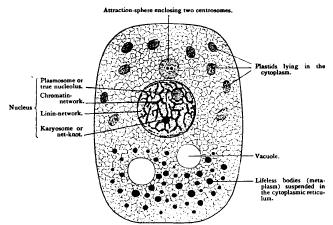
GENERAL SKETCH OF THE CELL " Wir haben gesehen, dass alle Organismen ans wesentlich gleichen Theilen, nimlich aus Zellen zusammengesetzt sind, dass diese Zellen mach wesentlich denselben Gesetzen sich bilden and wachsen, dass also diese Prozesse uberall such durch dieselben Krafte hervorgebracbt werden miissen." term " cell " is a biological misnomer ; for whatever the living cell is, it is not, as the word implies, a hollow chamber surrounded by solid walls. The term is merely an historical survival of a word casually employed by the botanists of the seventeenth century to designate the cells of certain plant-tissues which, when viewed in section, give somewhat the appearance of a The cells of these tissues are, in fact, separated by conspicuous solid walls which were mistaken by Schleiden, unfortunately followed by Schwann in this regard, for their essential part. The living substance contained within the walls, to which Hugo von Mohl gave the name protoplasm 3 (1846) was at first overlooked or was regarded as a waste-product, a view based upon the fact that in many important plant-tissues such as cork or wood it may wholly disappear, leaving only the lifeless walls. The researches of Bergmann, Ko11iker, Bischoff, Cohn, Max Schultze, and many others, showed, however, that some kinds of cells, for example, the corpuscles of the blood, are naked masses of living protoplasm not surrounded by walls, — a fact which proves that not the wall, but the cell-contents, is the essential part, and must therefore be the seat of life. It was found further that with the possible exception of some of the lowest forms of life, such as the bacteria, the protoplasm invariably contains a definite rounded body, the which in turn may contain a still smaller body, the nucleolus. Thus the cell came to be defined by Max Schultze and Leydig as a mass of protoplasm containing a nucleus, a morphological definition which remains sufficiently satisfactory even at the present day. Nothing could be less appropriate than to call such a body a " cell " ; yet the word has become so firmly established that every effort to replace it by a better has failed, and it probably must be accepted as part of the established nomenclature of science.' Fig. Diagram of a cell. Its basis consists of a thread-work (milome, or reticulum) composed of minute granules (microsomes) and traversing a transparent ground-substance.