Polarity of the Cell
centrosome and axis
POLARITY OF THE CELL In a large number of cases the cell exhibits a definite polarity, its parts being symmetrically grouped with reference to an ideal organic axis passing from pole to pole. No definite criterion for the identification of the cell-axis has, however, yet been determined; for the general conception of cell-polarity has been developed in two different directions, one of which starts from purely morphological considerations, the other from physiological, and a parallelism between them has not thus far been very clearly made out.
On the one hand, Van Beneden ('83) conceived cell-polarity as a primary morphological attribute of the cell, the organic axis being identified as a line drawn through the centre of the nucleus and the centrosome (Fig. 17, A). With this view Rabl's theory ('85) of nuclear polarity harmonizes, for the chromosome-loops converge towards the centrosome, and the nuclear axis coincides with the cell-axis. Moreover, it identifies the polarity of the egg, which is so important a factor in development, with that of the tissue-cells; for the eggA. Morphological polarity of Van Beneden. Axis passing through nucleus and centrosome. Chromatin-threads converging towards the centrosome. B. C. Physiological polarity of Rabl and Hatschek, B in a gland-cell, C in a ciliated cell.
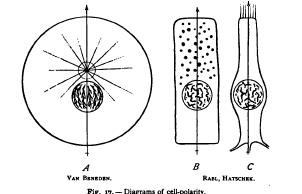
centrosome almost invariably appears at or near one pole of the