Centrosome and Archoplasm in Fertilization
centrosomes and egg-centrosome
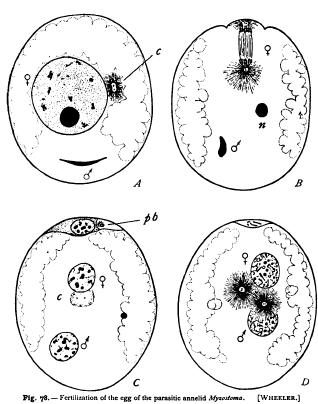
CENTROSOME AND ARCHOPLASM IN FERTILIZATION We have now finally to consider more critically the history of the centrosomes in fertilization, already briefly reviewed at p. 135. The account there given considers only the more usual and typical history of the centrosome, viz. the degeneration of the egg-centrosome and the introduction of a new centrosome by the spermatozoon. There is, however, one phenomenon which indicates a priori the possibility that other modes of fertilization may occur, namely, parthenogenesis, in which the egg develops without fertilization. In this case, as Brauer ('93) has clearly shown in Artemia, the egg-centrosome remaining after the formation of the polar bodies does not degenerate, but divides into two to form the cleavage-amphiaster. The degeneration of the egg-centrosome is therefore not a necessary or invariable phenomenon, and as a matter of fact several accounts have been given of its persistence and active participation in the process of fertilization. These accounts fall under two categories, as follows : Each germ-cell contributes two centrosomes (or one which immediately divides into two), which conjugate, paternal with maternal, to form those of the cleavage-amphiaster (Fol, in sea-urchins, '91 ; Guignard, in flowering plants, '91 ; Conklin, in gasteropods, '93).
2.
The centrosome is derived not from the spermatozoon, but from the egg (Van Beneden, doubtfully, in Ascaris, '87 ; Wheeler, in the case of Myzostoma, '95).
The first view, as embodied in the statements of Fol, Guignard, and Conklin, demands careful consideration. All these authors agree that each germ-cell contributes two centrosomes, or one which divides into two during fertilization. The daughter-centrosomes thus formed conjugate two and two in such a manner that each of the centrosomes of the cleavage-spindle is formed by the union of a centrosome derived from each germ-cell. It is an interesting and significant fact that a conjugation of centrosomes was predicted by Rabl ('89) on the a priori ground that if the centrosome is a permanent cell-organ, as Boveri and Van Beneden maintain, then a union of germ-cells must involve a union not only of nuclei, but also of centrosomes. Unusual interest was therefore aroused when Fol, in
1891, under the somewhat dramatic title of the " Quadrille of Centres," described precisely such a conjugation of centrosomes as Rabl had predicted. The results of this veteran observer were very positively and specifically set forth, and were of so logical and consistent a character as to command instant acceptance on the part of many authorities. Moreover, a precisely similar result was reached through the careful studies, in the same year, of Guignard, on the lily, and of Conklin ('93), on the marine gasteropod Crepidula, a confirmation which seemed to place the quadrille on a firm basis. Fol's result was, however, opposed to the earlier conclusions of Boveri and Hertwig, and a careful re-examination of the fertilization of the echinoderm egg, independently made in 1894-5 by Boveri (Echinus), by myself (Toxopneustes), and Mathews (Arbacia, Asterias), demonstrated its erroneous character. In the echinoderm, as in so many other cases, the egg-centrosome disappears. The cleavage-amphiaster arises solely by division of the sperm-aster, and the centrosome of the latter is derived not from the tip of the spermatozoon, as asserted by Fol, but from the middle-piece, as already described. The same result has been since reached by Hill and Erlanger. Various attempts have been made to explain Fol's results as based on double-fertilized eggs, on imperfect method, on a misinterpretation of the double centrosomes of the cleavage-spindle, yet they still remain an inexplicable anomaly of scientific literature.
Serious doubt has also been thrown on Conklin's conclusions by subsequent research. Kostanecki and Wierzejski ('96) have recently made a very thorough study, by means of serial sections, of the fertilA. Soon after entrance of the spermatozoon; the at d ; at 9 the germinal vesicle ; at c the double egg-centrosome. B. First polar body forming at 9 ; n, the cast-out nucleolus or germinal spot. C. The polar bodies formed (p.h.); germ-nuclei of equal size; at c the persistent D. Approach of the germ-nuclei ; the egg-amphiaster formed. In all other known cases this amphiaster is derived from the sperm-amphiaster.