Origin and Growth of the Germ-Cells
cells and somatic
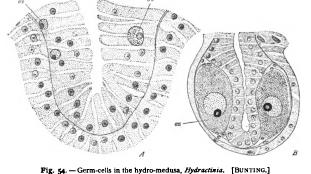
ORIGIN AND GROWTH OF THE GERM-CELLS Both ova and spermatozoa take their origin from cells known as primordial germ-cells, which become clearly distinguishable from the somatic cells at an early period of development, and are at first exactly alike in the two sexes. What determines their subsequent sexual differentiation is unknown save in a few special cases. From such data as we possess, there is very strong reason to believe that, with a few exceptions, the primordial germ-cells are sexually indifferent, i.e. neither male nor female, and that their transformation into ova or spermatozoa is not due to an inherent predisposition, but is a reaction to external stimulus. The nature of the stimulus appears to vary in different cases. Thus Maupas's experiments seem to show conclusively that, in rotifers, the differentiation may depend on temperature, a high temperature tending to produce males, a low temperature, females ; while those of Mrs. Treat on lepidoptera and of Yung on amphibia seem to leave no doubt that the differentiation here depends on the character of the nutrition, highly-fed individuals producing a great preponderance of females, while those that are underfed give rise to a preponderance of males. These and a multitude of related observations by many botanists and zoologists render it certain that sex as such is not inherited. What is inherited is, in Dusing words, only the particular manner in which one or the other sex comes to development. The determination of sex is not by inheritance, but by the combined effect of external conditions.' In some of the rotifers, however, sex is predetermined from the beginA. Section through young medusa-bud, with very young ova (ov.) lying in the ectoderm; B. Mature gonophore, showing two ova lying between ectoderm and entoderm.
ning, the eggs being of two sizes, of which the larger produce females ; the smaller, males.
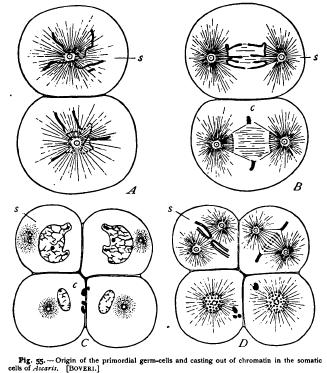
In the greater number of cases, the primordial germ-cells arise in a germinal epithelium which, in the coelenterates (Fig. 54), may be a part of either the ectoderm or entoderm, and, in the higher types, is a modified region of the peritoneal epithelium lining the body-cavity. In such cases the primordial germ-cells may be scarcely distinguishable at first from the somatic cells of the epithelium. But in other cases the germ-cells may be traced much farther back in the development, and they or their progenitors may sometimes be identified in the gastrula or blastula stage, or even in the early cleavage-stages. Thus in the worm Sagitta, Hertwig has traced the germ-cells back to I See Diising, '84; Geddes, Sex, in Encyclopedia Britannic° Geddes and Thompson, The Evolution of Sex; Watase, On the Phenomena of Sex-differentiation, two primordial germ-cells lying at the apex of the archenteron. In some of the insects they appear still earlier as the products of a large " pole-cell " lying at one end of the segmenting ovum, which divides A. Two-cell stage dividing ; s. stem-cell, from which arise the germ-cells. B. The same from the side, later in the second cleavage, showing the two types of mitosis and the casting out of chromatin (c) in the somatic cell. C. Resulting 4-cell stage ; the eliminated chromatin at c. D. The third cleavage, repeating the foregoing process in the two upper cells.
into two and finally gives rise to two symmetrical groups of germcells. Haecker has recently traced very carefully the origin of the primordial germ-cells in Cyclops from a "stem-cell" (Fig. 56) clearly distinguishable from surrounding cells in the early blastula stage, not only by its size, but also by its large nuclei rich in chromatin, and by its peculiar mode of mitosis, as described beyond.
The most beautiful and remarkable known case of early differentiation of the germ-cells is that of Ascaris, where Boveri was able to trace them back continuously through all the cleavage-stages to the two-cell stage! Moreover, from the outset the progenitor of the germcells differs from the somatic cells not only in the greater size and richness of chromatin of its nuclei, but also in its mode of mitosis ; for in all those blastomeres destined to produce somatic cells a portion of the chromatin is cast out into the cytoplasm, where it degenerates, and only in the germ-cells is the sum total of the chromatin retained. In
Ascaris megalocephala univalens the process is as follows (Fig. 55) Each of the first two cells receives two elongated chromosomes. As the ovum prepares for the second cleavage, the two chromosomes reappear in each, but differ in their behaviour (Fig. 55, A, B). In one of them, which is destined to produce only somatic cells, the thickened ends of each chromosome are cast off into the cytoplasm and degenerate. Only the thinner central part is retained and distributed to the daughter-cells, breaking up meanwhile into a large number of segments which split lengthwise in the usual manner. In the other cell, which may be called the stem-cell (Fig. 55, s), all the chromatin is preserved and the chromosomes do not segment into smaller pieces. The results are plainly apparent in the 4-cell stage, the two somatic nuclei, which contain the reduced amount of chromatin, being small and pale, while those of the two stem-cells are far larger and richer in chromatin (Fig. 55, C). At the ensuing division (Fig. 55, D) the numerous minute segments reappear in the two somatic cells, divide, and are distributed like ordinary chromosomes ; and the same is true of all their descendants thenceforward. The other two cells (containing the large nuclei) exactly repeat the history of the two-cell stage, the two long chromosomes reappearing in each of them, becoming segmented and casting off their ends in one, but remaining intact in the other, which gives rise to two cells with large nuclei as before. This process is repeated five times (Boveri), or six (Zur Strassen), after which the chromatinelimination ceases, and the two stem-cells or primordial germ-cells thenceforward give rise only to other germ-cells and the entire chromatin is preserved. Through this remarkable process it comes to pass that in this animal only the germ-cells receive the sum total of the egg-chromatin handed down from the parent. All of the somatic cells contain only a portion of the original germ-substance. "The original nuclear constitution of the fertilized egg is transmitted, as if by a law of primogeniture, only to one daughter-cell, and by this again to one, and so on ; while in the other daughter-cells, the chromatin in part degenerates, in part is transformed, so that all of the descendants of these side-branches receive small reduced nuclei." 1 It would be difficult to overestimate the importance of this discovery ; for although it stands at present an almost isolated case, yet it gives us, as I believe, the key to a true theory of differentiation and may in the end prove the means of explaining many phenomena that are now among the unsolved riddles of the cell.
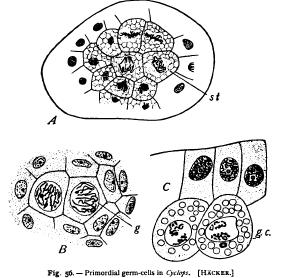
A. Young embryo, showing stem-cell (st). B. The stem-cell has divided into two, giving rise to the primordial germ-cell (g). C. Later stage, in section ; the primordial germ-cell has migrated into the interior and divided into two; two groups of chromosomes in each.
Hacker ('95) has shown that the nuclear changes in the stemcells and primordial eggs of Cyclops show some analogy to those of Ascaris, though no casting out of chromatin occurs. The nuclei are very large and rich in chromatin as compared with the somatic cells, and the number of chromosomes, though not precisely determined, is less than in the somatic cells (Fig. 56). Vom Rath, working in the same direction, has found that in the salamander also the number of chromosomes in the early progenitors of the germ-cells is one-half that characteristic of the somatic cells.' In both these cases, the chromosomes are doubtless bivalent, representing two chromosomes joined together. In Ascaris, in like manner, each of the two chromosomes of the stem-cell or primordial germ-cells is probably plurivalent, and represents a combination of several units of a lower order which separate during the segmentation of the thread when the somatic mitosis occurs.