Reduction in Unicellular Forms
nuclei and chromosomes
REDUCTION IN UNICELLULAR FORMS A reduction of the number of chromosomes as a preparation for conjugation in the one-celled forms has not yet been certainly determined, but there are many facts that render it highly probable. In the conjugation of infusoria, as already described (p. 165), the original nucleus divides several times before union, and only one of the resulting nuclei becomes the conjugating germ-nucleus, while the others perish, like the polar bodies. The numerical correspondence between the rejected nuclei or "corpuscles de rebut" has already pointed out (p. 168). Hertwig could not count the chromosomes with absolute certainty, yet he states ('89) that in Paramecium caudatum, during the final division, the number of spindle-fibres and of the corresponding chromatic elements is but 4-6, while in the earlier divisions the number is approximately double this (8-9). This observation makes it nearly certain that a numerical reduction of chromosomes occurs in the Protozoa in a manner similar to that of the higher forms ; but the reduction here appears to be deferred until the final division.' In the gregarines Wolters ('91) has observed the formation of an actual polar body as a small cell segmented off from each of the two conjugating animals soon after their union ; but the number of chromosomes was not determined.
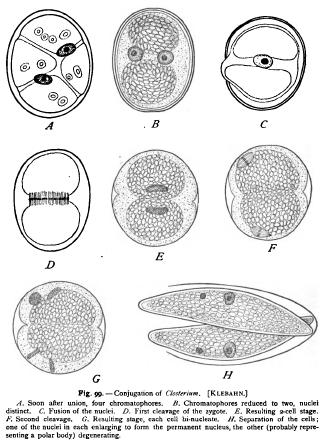
In the unicellular plants there are indications of a similar process, but the few facts at our command indicate that the reduction may here take place not before, but after, conjugation of the nuclei. Thus in the desmids Closterium and Cosmarium, according to Klebahn (Fig. 99), the nuclei first unite to form a cleavage-nucleus, after which the zygote divides into two. Each of the new nuclei now divides, one of the products persisting as the permanent nucleus, while the other degenerates and disappears. Chmielewski asserts that a similar process occurs in Spirogyra. Although the numerical relations of the chromosomes have not been determined in these cases, it appears probable that the elimination of a nucleus in each cell is a process of reduction occurring after fertilization.