Reduction in the Plants
division and chromosomes
REDUCTION IN THE PLANTS Guignard's and Strasburger's observations on reduction in the flowering plants gave a result which in substance agrees with that obtained by Boveri and Brauer in the case of Ascaris. These observers could find absolutely no evidence of a transverse or reducing division, and asserted that the reduction in number is directly effected by a segmentation of the spireme-thread into half the usual number of chromosomes ; i.e. by a process exactly corresponding with the " pseudo-reduction " of Ruckert (see Fig. 25). These observers find that in the male the chromosomes suddenly appear in the reduced number (twelve in the lily, eight in the onion) at the first division of the pollen-mother-cell, from which arise four pollen-grains. In the female the same process takes place at the first division of the mother-cell of the embryo-sac. Strasburger and Guignard agree that in the subsequent divisions these chromosomes do not form tetrads, but undergo simple longitudinal splitting at each successive division. In case of the male there are at least four of these divisions ; viz. two divisions to form the four pollen-grains, a third division to form the vegetative and generative cell of the pollen-grain, and finally a fourth division of the generative nucleus in the pollen-tube. In all these mitoses the reduced number of chromosomes appears, and each division is followed by a return of the nucleus to the resting state. In the mother-cell of the embryo-sac the number of divisions before fertilization is three, four, five, or sometimes even more, the reduced number persisting throughout. These facts led to the suspicion, first expressed by Overton in 1892, that the reduced number of chromosomes might be found in the sexual generation of higher cryptogams (which corresponds with the cells derived from the pollen-grain, or from the mother-cell of the embryo-sac). This surmise quickly became a certainty. Overton himself discovered ('93) that the cells of the endosperm in the Gymnosperm Ceratozamia divide with the reduced number, namely eight; and Dixon observed the same fact in Pinus at the same time. In the following year Strasburger brought the matter to a definite conclusion in the case of a fern (Osmunda), showing that all the cells of the prothallium, from the original spore-mother-cell onwards to the formation of the germ-cells, have one-half the number of chromosomes found in the asexual generation, namely twelve instead of twenty-four; in other words, the reduction takes place in the formation of the spore from which the sexual generation arises, scores of cell-generations before the germ-cells are formed, indeed before the formation of the body from which these cells arise. Similar facts were determined by Farmer in Pallavicinia, one of the Hepaticas, where all of the nuclei of the asexual generation (sporogonium) show eight chromosomes during division, those of the sexual generation (thallus) four. It now seems highly probable that this will be found a general rule.
The striking point in these, as in vom Rath's and Hacker's observations, is that the numerical reduction takes place so long before the fertilization for which it is the obvious preparation. Speculating
on the meaning of this remarkable fact, Strasburger advances the hypothesis that the reduced number is the ancestral number inherited from the ancestral type. The normal, i.e. somatic, number arose through conjugation by which the chromosomes of two germ-cells were brought together. Strasburger does not hesitate to apply the same conception to animals, and suggests that the four cells arising by the division of the oogonium (egg plus three polar-bodies) represent the remains of a separate generation, now a mere remnant included in the body in somewhat the same manner that the rudimentary prothallium of angiosperms is included in the embryo-sac. This may seem a highly improbable conclusion, but it must not be forgotten that so able a zoologist as Whitman expressed a nearly related thought, as long ago as 1878: " I interpret the formation of polar globules as a relic of the primitive mode of asexual reproduction."' Could Strasburger's hypothesis be substantiated, it would place the entire problem, not merely of maturation, but of sexuality itself, in a new light.
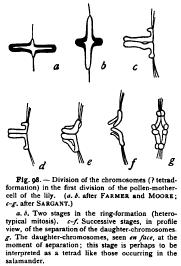
Strasburger's hypothesis is, however, open to a very serious a priori objection, as Hacker has pointed out ; for if the account of " reduction " in the plants given by Guignard and Strasburger be correct, it corresponds exactly to the " pseudo-reduction " in animals, and the " chromosomes " of the sexual generation must be bivalent like those of the early germ-cells in animals. The recent observations of Belajeff, Farmer, and especially those of Sargant, give, however, good reason to believe that both Guignard and Strasburger have overlooked some of the most essential phenomena of reduction. These observations have not yet revealed the exact nature of the process, yet they show that the first division of the pollenmother-cells (in the lily) is of the heterotypical form ; i.e. that the chromosomes have the form of rings. It is impossible to avoid the suspicion that these rings may be of the same nature as the ringshaped tetrads in animals, though apparently they do not actually break up into a tetrad. Until this point has been cleared up by further investigation the nature of reduction in the plants remains an open question. Belajeff and Farmer showed that as the daughter-chromosomes diverge after the first division they assume a Vshape, and Miss Sargant's very interesting observations give some reason to believe that the V breaks at the apex precisely as described by Hacker in Cyclops and vom Rath in the salamander (Fig. 98, g). Should this prove to be the case the way would be opened for an interpretation of reduction in the plants agreeing in principle with that of Ruckert, Hacker, and vom Rath ; and as far as the plants are concerned, the a priori objection to Strasburger's interesting hypothesis might be removed.