The Archoplasmic Structures
centrosome and aster
The Attraction-sphere
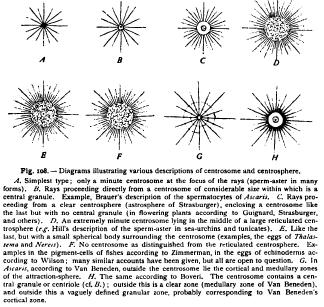
The foregoing conception of the asters receives a strong support from the study of the attraction-sphere in resting cells. It is agreed by all observers that this structure is derived from the aster of the dividing cell ; but there is still no general agreement regarding its precise mode of origin from the aster, and the subject is confused by differences in the terminology of different authors. There are some cases in which the entire aster persists throughout the resting cell (leucocytes, connective tissue-cells) and the term " attraction-sphere " has by some authors been applied to the whole structure. As originally used by Van Beneden, however,' the word was applied (in Ascaris) not to the entire aster but only to its central portion — a spherical mass bounded by a circle of microsomes from which the astral rays proceed. At the close of division the rays fade away in the general network, leaving only the central sphere containing the centrosome. Boveri's account of the same object was entirely different; for he conceived the attraction-sphere (" archoplasm-sphere ") of the resting cell as representing the entire aster, the rays being withdrawn towards the centrosome and breaking up into a mass of granules. Later workers have proposed different terminologies, which are at present in a state of complete confusion. Fol ('91) proposed to call the centrosome the astrocentre, and the spherical mass surrounding it (attraction-sphere of Van Beneden) the astrosphere. Strasburger accepted the latter term and proposed the new word " centrosphere " for the astrosphere and the centrosome taken to This terminology has been accepted by most botanists and by some zoologists. A new complication was introduced by Boveri ('95), who applied the word " astrosphere " to the entire aster exclusive of the centrosome, in which sense the phrase " astral sphere " had been employed by Mark in 1881. The word "astrosphere" has therefore a double meaning and would better be abandoned in favour of Strasburger's convenient term " centrosphere," which may be understood as equivalent to the " astrosphere " of Fol.
As regards the structure of the centrosphere, two well-marked types have been described. In one of these, described by Van Beneden in Ascaris, by Heidenhain in leucocytes, by Druner and Braus in dividing cells of amphibia, the centrosphere has a radiate structure, being traversed by rays which stretch between the centrosome and the peripheral microsome-circle (Figs. 34, 1o8, G). In the other form, described by Vejdovsky in the eggs of Rhynchelmis, by Solger and Zimmermann in pigment-cells, by myself in sea-urchin eggs and in Nereis, by Ruckert in Cyclops and in a number of other cases, the centrosphere has a non-radiate reticular structure (Figs. 7!, 108, E). In some cases no centrosome has been found in this sphere ; but for reasons already stated (p. 228) I incline to believe that a centrosome is really present.
In many, if not in all cases of both types, the sphere consists of an outer and an inner zone, the latter enclosing the centrosome ; but the relation of the inner zone to the centrosome still remains, in a measure, in doubt. Van Beneden described the centrosphere in Ascaris as consisting of an outer cortical and an inner medullary zone, both of which were conceived as only a modification of the inner region of the aster. Boveri's account is somewhat different. The centrosome
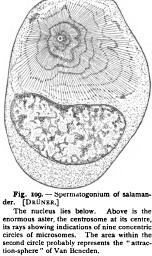
is described as surrounded by a clear zone (" heller Hof "), — probably corresponding with Van Ben eden's " medullary zone," — while the " cortical zone " of the latter author is not recognized as distinct from the aster (or archoplasm-sphere). The centrosome itself contains a minute central granule or centriole. This discrepancy between Boveri and Van Beneden was cleared up in a measure by Heidenhain's beautiful studies on the asters in leucocytes, and the still more thorough later work of Druner on the spermatocyte-divisions of the salamander. In leucocytes (Fig. 35) the large persistent aster has at its centre a well-marked radial sphere bounded by a circle of microsomes, as described by Van Beneden, but without division into cortical and medullary zones. The astral rays, however, show indications of other circles of microsomes lying outside the centrosphere. Druner found that a whole series of such concentric circles might exist (in the cell shown in Fig. 109 no less than nine), but that the innermost two are often especially distinct, so as to mark off a centrosphere composed of a medullary and a cortical zone precisely as described by Van Beneden. These observations show conclusively that the ccntrosphere of the radial type is merely the innermost portion of the aster, which acquires an apparent boundary through the especial development of a ring of microsomes. And thus Van Beneden's original view is confirmed, that not only the aster as a whole, but also the centrosphere, is but a modified area of the general cytoplasmic thread-work.
Heidenhain points out that there are many cases — for instance, the young sperm-aster in which there is at first no clearly marked central sphere, and the rays proceed outward directly from the centrosome. The sphere, in such cases, seems to arise secondarily through a modification of the inner ends of the astral rays. Heidenhain therefore concludes that the centrosome is the only constant element in the sphere, the latter being a secondary formation and not entitled to rank as a persistent cell-organ, though it may in certain cases persist and divide like the centrosome. Vom Rath, who has made a very careful study of the attraction-spheres in a large number of cells among both vertebrata and invertebrata, arrives at a nearly similar view, though he lays greater stress on the differentiation and independence of the sphere. In asters of dividing cells he could find in many cases no limit between sphere and aster, though in other cases it is distinctly present. In the resting cell, on the other hand, the boundary of the sphere is often very sharply marked, so that the sphere appears as a well-defined spherical body. The origin of such a definite sphere from the aster has not been very definitely determined, but Druner's observations indicate that it arises in the manner described by Van Beneden, through the disappearance of the more peripheral portions of the astral rays. It is, in other words, the persistent centrosphere.