The Centrosome Cell Organ
nucleus and latter
THE CENTROSOME CELL ORGAN When we turn to the centrosome, we find clear evidence of the existence of a cell-organ which, though scarcely larger than a cytomicrosome, possesses specific physiological powers, assimilates, grows, divides, and may persist from cell to cell, without loss of identity. It is far easier to define the centrosome in physiological than in morphological terms. In the former sense Boveri ('95, 2) defines it as a single permanent cell-organ which forms the dynamic centre of the cell and multiplies by division to form the centres of the daughter-cells. A centrosome is necessarily present in all cells at the time of mitosis. Whether, however, it persists in the resting state of all cells is unknown. The most careful search has thus far failed to reveal its presence in many tissue-cells, e.g. in muscle-cells and many glandcells ; but these same cells may, under certain conditions, divide by mitosis, as in regeneration or tumour-formation, and the centrosome may be hidden in the nucleus, or so minute as to escape observation. We must, however, remember that the centrosome often disappears in the mature egg, and the same may be true of some tissue-cells.
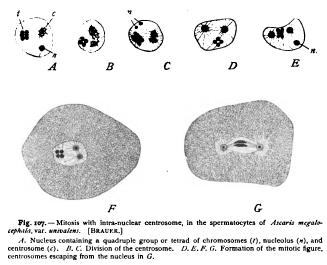
The earlier observers of the centrosome always found it lying in the cytoplasm, outside the nucleus. Almost simultaneously, in 1893, three investigators independently discovered it inside the nucleus of the resting cell,— Wasielewsky, in the young ovarian eggs (oogonia) of Ascaris ; Brauer, in the spermatocytes of the same animal ; and Karsten, in the cells of a plant, Psilotum(Humphrey states, however, that Karsten's observations were erroneous). Several later observers have described a similar intra-nuclear origin of the centrosome, and several of these (Zimmermann, Lavdovsky, Keuten) have followed Wasielewsky in locating it in the nucleolus. Evidence against this latter view has been brought forward, especially by Humphrey and Brauer. The latter observer found both nucleoli and centrosome as separate bodies within the nucleus. He made further the interesting discovery that in Ascaris the centrosome lies, in one variety (univalens) inside the nucleus, in the other variety (bivalens) outside —a fact which proves that its position is non-essential (cf. Figs. 92 and 107). Oscar and Richard Hertwig maintain that the intra-nuclear
position of the centrosome is the more primitive, the centrosome having been originally differentiated from a part of the nuclear substance. This view is based in the main on the facts of mitosis in the Infusoria, where the whole mitotic figure appears to arise within the nuclear membrane (cf. p. 62).
Whether a true centrosome may ever arise de novo is likewise undetermined. The possibility of such an origin has been conceded by a number of recent writers, among them Burger, Watase, Richard Hertwig, Heidenhain, and Reinke. The latter author ('94) would distinguish in the cell, besides the " primary centres " or centrosomes, secondary and tertiary centres, the latter being single microsomes formed at the nodes of the network. By the successive aggregations of the latter may arise the secondary and primary centres as new formations. Watase ('94) advocates a somewhat similar view, and states that he has observed numerous gradations between a true aster and such "tertiary asters " as Reinke describes. Further evidence in the same direction is afforded by Morgan's remarkable observations on the formation of " artificial asters " in unfertilized sea-urchin eggs which have lain for some time in sea-water ('96). Such eggs often contain numerous asters, each of which contains a body resembling a Beside these observations must be placed those of Richard Hertwig, on the formation of an amphiaster in ripe unfertilized sea-urchin eggs (p. 159). All these observations are of high interest in their bearing on the historical origin of the centrosome ; but they do not prove that the centrosome of the normal aster ever arises by free formation. On the whole, the evidence has steadily increased that the centrosome is to be classed among the permanent cell-organs ; but whether it ranks with the nucleus in this regard must be left an open question.