The Centrosome Organ for Cell Division
eggs and cell-division
THE CENTROSOME ORGAN FOR CELL DIVISION Nearly all investigators have now accepted Van Beneden's and Boveri's conclusion that the centrosome is an organ for cell-division, and that in this sense it represents the dynamic centre of the cell (cf. p. 56). This is most clearly shown in the ordinary fertilization of the ovum, in which process, as Boveri has insisted, it is the centrosome that is the fertilizing element par excellence, since its introduction into the egg confers upon the latter the power of division, and hence of development. Boveri's interesting observations on " partial fertilization" in the sea-urchin referred to at p. 140 afford a beautiful illustration of this point. In certain exceptional cases the egg may divide before conjugation of the germ-nuclei has occurred, the sperm-nucleus lying passive in the cytoplasm until after the first cleavage and then conjugating with one of the nuclei of the two-celled stage. The egg is here fertilized— i.e. rendered capable of division — by the centrosome, which separates from the sperm-nucleus, approaches the eggnucleus, and gives rise to the cleavage-amphiaster as usual.
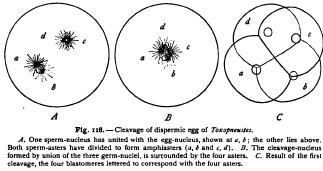
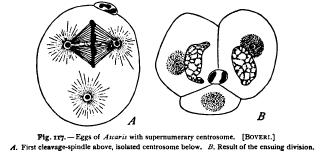
Again, Boveri has observed that the segmenting ovum of Ascaris sometimes contains a supernumerary centrosome that does not enter into connection with the chromosomes, but lies alone in the cytoplasm (Fig. 117). Such a centrosome forms an independent centre of division, the cell dividing into three parts, two of which are normal blastomeres, while the third contains only the centrosome and attraction-sphere. The fate of such eggs was not determined, but they form a complete demonstration that it is the centrosome and not the nucleus that is the active centre of cell-division in the cell-body. Scarcely less conclusive is the case of dispermic eggs in sea-urchins. In such eggs both sperm-nuclei conjugate with the egg-nucleus, and both sperm-centrosomes divide (Fig. II8). The cleavage-nucleus, therefore, arises by the union of three nuclei and four centrosomes. Such eggs invariably divide at the first cleavage into four equal blastomeres, each of which receives one of the centrosomes. The latter must, therefore, be the centres of division.' The statement that the centrosome is an organ for cell-division does not, however, express the whole truth ; for in leucocytes and pigment-cells the astral system formed about it is devoted, as there is good reason to believe, not to cell-division, but to movements of the cell-body as a whole ; and, moreover, amitotic division may apparently take place independently of the centrosome. The role of the
centrosome and attraction-sphere in gland-cells (where they are sometimes very large) and in the nerve-cells is still wholly problematical. It would seem, therefore, that the primary function of the centrosome is to organize an astral system, of which it forms the focus, that is primarily an apparatus for mitotic division, but may secondarily become devoted to other functions. The nature of the energy by which this organization takes place is almost wholly in the dark. The extraordinary resemblance of the amphiaster to the lines of force in a magnetic field has impressed many observers, but Roux has proved that the axis of the mitotic figure is not affected, during its formation, by a powerful electro-magnet. The molecules or microsomes of the fibres must be in some manner polarized by an influence emanating from the centrosome, but in the present state of knowledge it would be useless to speculate on the nature of this influence. One fact, however, should be borne in mind, namely, that the centrosome differs chemically from the substance of the fibres as shown by its staining-reactions ; and this may form a clue to the further investigation of this most interesting problem.
The principal point in connection with our present theme is that the centrosome cannot be regarded as taking any important part in the general metabolism of the cell, nor can it be an organ of inheritance ; for on the one hand it is absent or so small as to be indistinguishable in many actively metabolizing cells, such as those of the pancreas or kidney, or the older ovarian eggs, and, on the other hand, in fertilization it may be derived from one sex only. The conclusion regarding inheritance would not be invalidated, even if it could be positively shown that in some cases both germ-cells might contribute a centrosome ; for a single case of its one-sided origin would be conclusive, and many such are actually known.