The Theory of Germinal Localization
cleavage and definite
THE THEORY OF GERMINAL LOCALIZATION Although the naive early theory of preformation and evolution was long since abandoned, yet we find an after-image of it in the theory of germinal localization which in one form or another has been advocated by some of the foremost students of development. It is maintained that, although the embryo is not pre formed in the germ, it must nevertheless be pre-determined in the sense that the egg contains definite areas or definite substances predestined for the formation of corresponding parts of the embryonic body. The first definite statement of this conception is found in the interesting and suggestive work of Wilhelm His (74) entitled Unsere Korperform. Considering the development of the chick, he says : " It is clear, on the one hand, that every point in the embryonic region of the blastoderm must represent a later organ or part of an organ, and on the other hand, that every organ developed from the blastoderm has its preformed germ (" vorgebildete Anlage ") in a definitely located region of the flat germ-disc. . . . The material of the germ is already present in the flat germ-disc, but is not yet morphologically marked off and hence not directly recognizable. But by following the development backwards we may determine the location of every such germ, even at a period when the morphological differentiation is incomplete or before it occurs ; logically, indeed, we must extend this process back to the fertilized or even the unfertilized egg. According to this principle, the germ-disc contains the organ-germs spread out in a flat plate, and, conversely, every point of the germdisc reappears in a later organ ; I call this the principle of organforming His thus conceived the embryo, not as pre-formed, but as having all of its parts pre-localized in the eggprotoplasm (cytoplasm).
A great impulse to this conception was given during the following decade by discoveries relating, on the one hand, to protoplasmic structure, on the other hand, to the promorphological relations of the ovum. Ray Lankester writes, in 1877 : " Though the substance of a cells may appear homogeneous under the most powerful microscope, it is quite possible, indeed certain, that it may contain, already formed and individualized, various kinds of physiological molecules. The visible process of segregation is only the sequel of a differentiation already established, and not The egg-cytoplasm has a definite molecular organization directly handed down from the parent ; cleavage sunders the various " physiological molecules " and isolates them in particular cells. Whitman expresses a similar thought in the following year : " While we cannot say that the embryo is predelineated, we can say that it is predetermined. The Histo
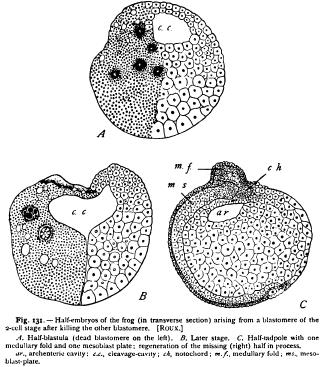
genetic sundering' of embryonic elements begins with the cleavage, and every step in the process bears a definite and invariable relation to antecedent and subsequent steps. . . . It is, therefore, not surprising to find certain important histological differentiations and fundamental structural relations anticipated in the early phases of cleavage, and foreshadowed even before cleavage begins." 1 It was, however, Flemming who gave the first specific statement of the matter from the cytological point of view : " But if the substance of the egg-cell has a definite structure (Bau), and if this structure and the nature of the network varies in different regions of the cellbody, we may seek in it a basis for the predetermination of development wherein one egg differs from another, and it will be possible to look for it with the microscope. How far this search can be carried no one can say, but its ultimate aim is nothing less than a true morphology of In the following year Van Beneden pointed out how nearly this conception approaches to a theory of preformation : " If this were the case (i.e. if the egg-axis coincided with the principal axis of the adult body), the old theory of evolution would not be as baseless as we think to-day. The fact that in the ascidians, and probably in other bilateral animals, the median plane of the body of the future animal is marked out from the beginning of cleavage, fully justifies the hypothesis that the materials destined to form the right side of the body are situated in one of the lateral hemispheres of the egg, while the left hemisphere gives rise to all of the organs of the left half." 3 The hypothesis thus suggested seemed, for a time, to be placed on a secure basis of fact through a remarkable experiment subsequently performed by Roux ('88) on the frog's egg. On killing one of the blastomeres of the two-cell stage by means of a heated needle the uninjured half developed in some cases into a perfectly formed halflarva (Fig. 131), accurately representing the right or left half of the body, containing one medullary fold, one auditory pit, etc.' Analogous, though less complete, results were obtained by operating with the four-cell stage. Roux was thus led to the declaration (made with certain subsequent reservations) that " the development of the frog-gastrula and of the embryo formed from it is from the second cleavage onward a mosaic-work consisting of at least four vertical independently developing pieces." 1 This conclusion seemed to form a very strong support to His's theory of germinal localization, though, as will appear beyond, Roux transferred this theory to the nucleus, and thus developed it in a very different direction from Lankester or Van Beneden.