
GHENT, the capital of East Flanders, Belgium, at the junc tion of the Scheldt and the Lys (Ley). Pop. (1930) 170,358. The city is divided by the rivers (including the small streams Lieve and Moere) and by canals, some navigable, into numerous islands connected by over 200 bridges of various sorts; there are fine quays and docks. The cathedral of St. Bavon has a rich in terior, its crypt dates from 941, the choir from 1274-1300, the Late Gothic choir chapels from the 15th century, and the nave and transept from 1533-54. Among the treasures of the church is the famous "Worship of the Lamb" by Hubert and Jan van Eyck. The original 12 panels, dispersed since 1816, were brought together again in 1920 under the provisions of the Treaty of Versailles. Among the other 55 churches may be mentioned that of St.
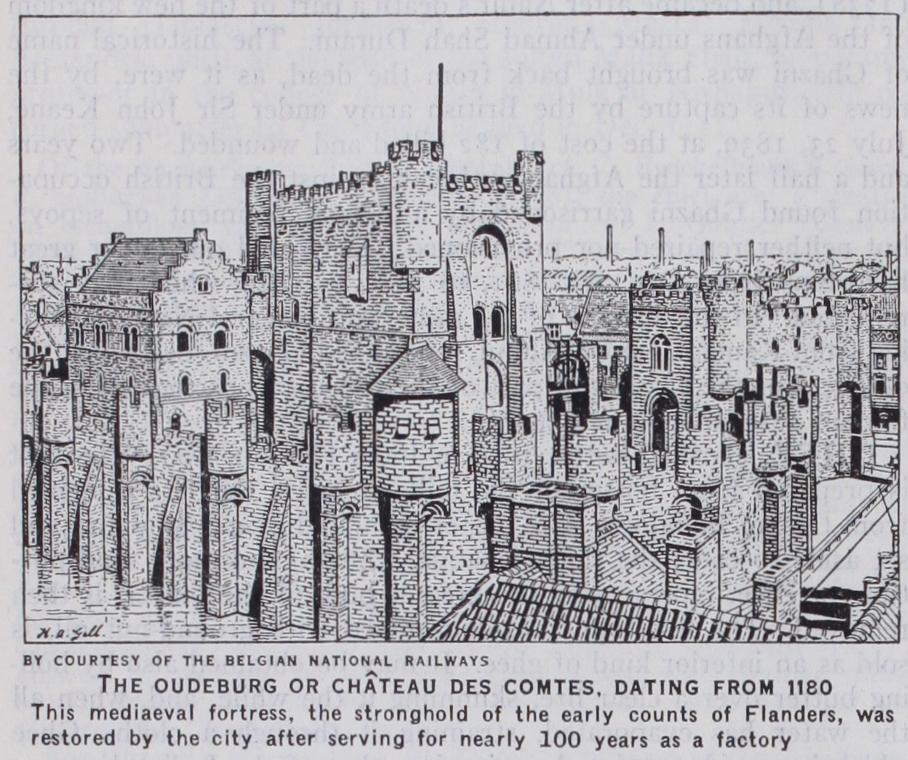
Nicholas, an Early Gothic building, the oldest church in date of foundation in Ghent, and that of St. Michael, completed in 148o, with an unfinished tower. In the centre of the city stands the unfinished Belfry (Beffroi), a square tower some 30o ft. high, built 1183-1339. It has a cast-iron steeple (restored in on the top of which is a gold dragon which, according to tradition, was brought from Constantinople either by the Varangians or by the emperor Baldwin after the Latin conquest. Close to it is the former Cloth-hall, a Gothic building of 1325. The hotel-de ville consists of two distinct parts. The northern facade, a mag nificent example of Flamboyant Gothic, was erected between 1518 and 1J33, restored in 1829 and again some so years later. The eastern facade overlooking the market-place was built in 1595-1628, in the Renaissance style, with three tiers of columns. It contains a valuable collection of archives, from the 13th cen tury onwards. On the left bank of the Lys is the Oudeburg, the former castle of the first counts of Flanders, dating from 118o and now restored.
To the north of the Oudeburg, on the other side of the Lys, is the Marche du Vendredi, the principal square of the city. This was the centre of the life of the mediaeval city, the scene of all great public functions, such as the homage of the burghers to the counts, and of the auto-da-fes under the Spanish regime. On the Scheldt, near the Place Laurent, is the Geerard-duivelsteen (château of Gerard the Devil), a 13th-century tower formerly belonging to a patrician family, now restored and used as the office of provincial records. In the park on the site of the citadel erected by Charles V. are some ruins of the ancient abbey of St. Bavon and of a I2th-century octagonal chapel dedicated to St. Macharius. In the park is also situated the Museum of Fine Arts, completed in 1902. One of the most interesting institutions of Ghent is the great Beguinage (Begynhof) which, originally established in 1234 by the Bruges gate, was transferred in 1874 to the suburb of St. Amandsberg. It constitutes a little town of itself, surrounded by walls and a moat, and contains numerous small houses, 18 convents and a church. It is occupied by some 700 Beguines, women devoted to good works (see BEGUINES). Near the station is a second Beguinage with 400 inmates.
The main industries are cotton-spinning, flax-spinning, cotton printing, tanning and sugar refining; in addition to which there are iron and copper foundries, machine-building works, breweries and factories of soap, paper, tobacco, etc. As a trading centre the city is even more important. It has direct communication with the sea by a ship-canal, greatly enlarged and deepened since 1895, which connects the Grand Basin, stretching along the north side of the city, with a spacious harbour excavated at Terneuzen on the Scheldt, m. to the north, thus making Ghent practically a sea-port ; while a second canal, from the Lys, connects the city via Bruges with Ostende. A new lock at Terneuzen enables vessels up to 26 ft. draught to pass at any tide into or out of the canal between that port and Ghent.
Among the many educational establishments is the State uni versity founded by King William I. of the Netherlands in 1816, actually a Flemish university. With it are connected a school of engineering, a school of arts and industries and the famous library (about 300,000 printed volumes and 2,000 mss.) formerly belong ing to the city. The art academy has a fine collection of pictures taken from religious houses on their suppression in 1795. Ghent has more than 700 horticultural establishments. Every five years her great flower shows, "Floralies" attract visitors from all parts of the world.
Ghent was in the hands of the Germans from Oct. 1914 till Armistice day, Nov. I1, 1918. The west part of the town suffered some damage in the final operations. The university was reopened in Oct. 1923.
In the long struggle of the Netherlands against Spain, Ghent took a conspicuous part, and it was here that, on Nov. 8, 1576, was signed the instrument known as the Pacification of Ghent, which established the league against Spanish tyranny.
War, persecution and the emigration or expulsion of its people wrecked the prosperity of Ghent, the recovery of which was made impossible by the closing of the Scheldt. After 1714 it formed part of the Austrian Netherlands, and in 1794 became the capital of the French department of the Scheldt. In 1814 it was incor porated in the kingdom of the United Netherlands, and after 183o became part of Belgium.
For a comprehensive bibliography, see Ulysse Chevalier, Repertoire des sources hist. topo bibliogr., s.v. "Gand."