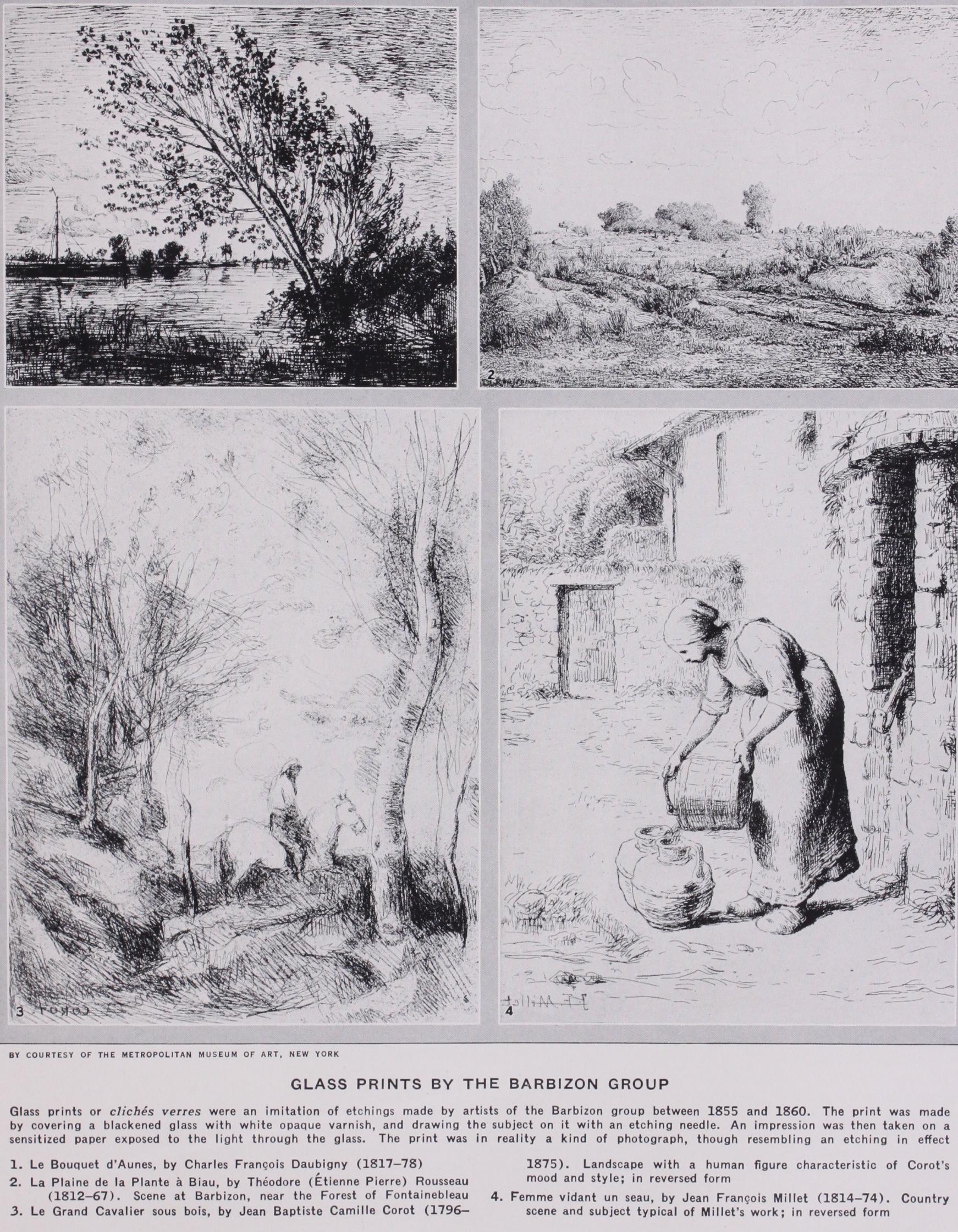
GLASS PRINTS, or, as the French call them, clichés-verres, were an imitation of etchings in the making of which the Barbizon group of artists, Daubigny, Rousseau, Millet and Corot, would amuse their leisure during the years between 1855 and 186o. On a blackened piece of glass, covered with a white opaque varnish, they would draw their subjects with an etching-needle, as on a copper-plate, then they would take an impression on a sensitized paper exposed to the light behind the glass. The effect was curiously like an etching, though the print was really rather in the nature of a photograph, for no pressure had been used to crush the paper into bitten lines which did not exist. Daubigny was, we fancy, the most successful maker of these clichés-verres, though the needling of his lines, not being subjected to any mor dant process, looked rather like lines drawn with a pen and ink, as in Le Bouquet d'Aunes, for instance, which, of course, has not at all the essential character of etching. There was another form of glass prints popular in England in the later decades of the 18th century, which transferred to glass many contemporary mezzo tint and stipple colour-prints, mostly of the cruder kind, but occa sionally some of a more pretentious artistic order. The glass, cut to the size of the print, was covered with a thin coating of turpentine, then the print, well damped, was laid on this, face downwards. The paper was most carefully rubbed away with the finger, until only the veriest film of the print was left with its design on the turpentine-covered glass. When this was dry, the impression was painted on the back, sometimes richly, sometimes simply, even crudely, but often with a brilliancy of colouring superior to that of the original print on paper. These glass col oured prints enjoyed a brief contemporary vogue, but they died out with the old coloured stipple and mezzotint. Some 25 years ago there was a fashion in collecting them, but the field, it appears, was soon exhausted, and the actual old prints are valued too highly for it to be extended. (M. C. S.)