GOITRE. Goitre or "Derbyshire neck" is a term used for abnormal enlargements, usually chronic, of the thyroid gland in the front of the neck. The enlargement may be general and uni form (parenchymatous goitre), or may be localised to one part of the gland or to the isthmus connecting the two halves or lobes. Local enlargements are either innocent, which are common, or malignant, which are rare ; the innocent growths are known as adenomas (adenomatous goitre) which at first solid may soften down and become liquid-forming cysts ; these cystic goitres or bronchoceles contain yellow, glue-like material (colloid) ; from bleeding into, their interior may rapidly enlarge, otherwise they grow slowly, or may exist for many years without increasing in size or causing discomfort. They often arise in parenchymatous goitres. Malignant disease commonly starts in an adenoma and is generally a carcinoma which grows slowly but has a special tendency to produce secondary deposits (metastases) in bones.
The other form of malignant disease, sarcoma, is much rarer, but runs a rapid course.
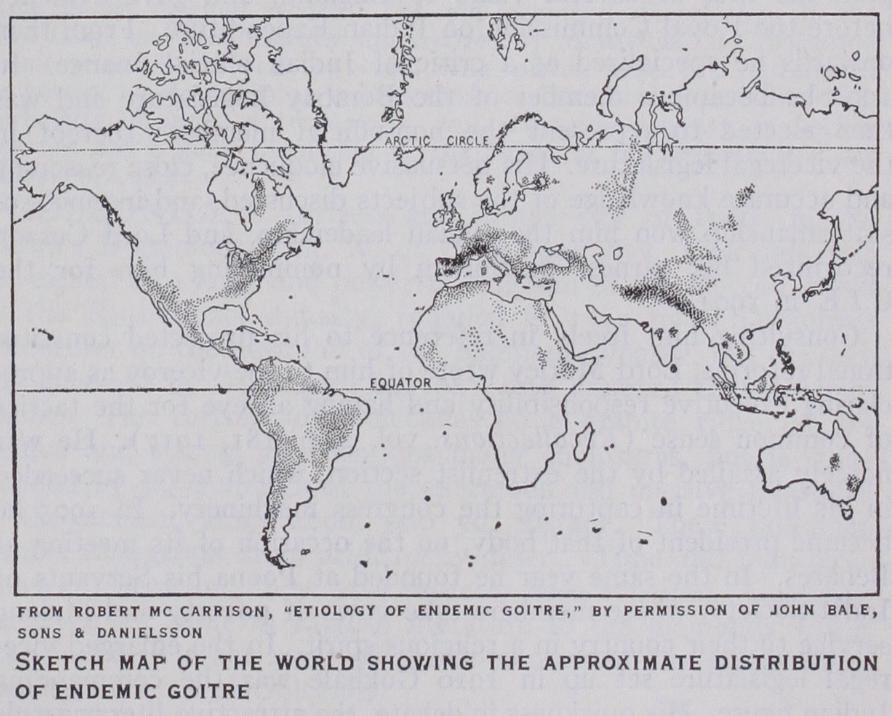
This is usually endemic, i.e., occurring in special regions, such as Derbyshire, the Thames Valley, the York shire Dales, Hampshire and Sussex, in the neighbourhood of the Great Lakes in North America, in Switzerland, the Pyrenees and some mountainous parts of Asia, and is then due to some local condition, especially the water supply. In Kashmir Col. R. McCarrison correlated it with infection of the drinking water; "goitre springs" and "wells" are known, and fish and animals may also be affected in endemic areas. The observation that boiling the water prevents the incidence of goitre and the occurrence of epidemics of acute goitre in schools are compatible with this view. But that this is the only cause is uncertain, for simple goitre can be prevented by the administration of iodine and the water in goitrous regions is hard and poor in iodine. Goitre may also occur sporadically in areas where it is rare, but is seldom congenital except in endemic regions. It appears most commonly about puberty and is about seven times commoner in females than in males. Large goitres may give rise mechanically to difficulty of breathing by compressing the windpipe.
The adenomatous enlargement may remain latent without any symptoms for years, and then become active and produce an internal secretion which excites toxic symptoms resembling, but not exactly the same as, those of exophthalmic goitre, protrusion of the eyes being absent.
The preventive treatment of simple goitre consists in boiling the water, removal from an endemic district, and the administra tion of iodine, or iodide of potassium, in small doses. But in cases of adenomatous goitre iodine is said to lead to a toxic goitre. Exposure to X-rays may reduce the size of the goitre, but by producing adhesions renders surgical removal, should it become necessary, less easy. Surgical removal is necessary for pressure symptoms, toxic manifestations, and may be desirable for cosmetic considerations.
(Synonyms, Graves' or Basedow's disease.)—This ha,s very striking symptoms—an enlarged thyroid gland, protrusion of the eyes, rapid action of the heart and palpitation, tremor, extreme nervousness, wasting, flushing, sweat ing and mental irritability. It is indeed the converse of myxoe dema. The skin may be pigmented, and in bad cases diarrhoea, vomiting and indigestion may be troublesome. Ninety per cent, if not more, of the patients are women. The basal metabolism (the minimal production of heat) is raised and this may be con nected with the wasting and tolerance to cold. There is a struc tural change in the thyroid, probably due to poisons from the alimentary canal, but it may come on after mental shock or emotion. As a result of the change in the thyroid its internal secretion is altered (dysthyroidism) and causes the nervous symp toms. The disease is usually chronic ; more than half the patients recover and others improve but do not become absolutely normal. Acute infections, such as influenza, are likely to prove fatal. In a few instances the morbid activity of the thyroid gland is fol lowed by atrophy and myxoedema.
The patients should live a simple life in fresh, country air, avoid much protein (meaty) food, stuffy rooms and excitement. Bromides, quinine hydrobromate, belladonna, digitalis and X-rays or radium to the gland should be employed. If these measures fail, and the case is severe, operative removal of part of the gland or ligature of some of its arteries should be undertaken ; the operative mortality of excision of half the gland is now about five per cent. Iodine in the form of Lugol's solution improves the patient's condition so that operation can be more safely undertaken. (H. R.)
