GOLDBEATING. The art of goldbeating is of great an tiquity, being referred to by Homer; and Pliny (N.H. 33.19) states that I oz. of gold was extended to 75o leaves, each leaf be ing f our fingers (about 3in.) square; such a leaf is three times as thick as the ordinary leaf gold of the present time. In all prob ability the art originated among the eastern nations, where the working of gold and the use of gold ornaments have been dis tinguished characteristics from the most remote periods. On Egyptian mummy cases specimens of original leaf-gilding are met with, where the gold is so thin that it resembles modern gilding (q.v.) . The minimum thickness to which gold can be beaten is not known with certainty. According to Mersenne (16a 1) I oz. was spread out over I o5sq.f t. ; Reaumur 0710 obtained 1461 sq.f t. ; other values are 18gsq.f t. and 3oosq.f t. Its malleability is greatly diminished by the presence of other metals, even in very minute quantity. In practice the average degree of tenuity to which the gold is reduced is not nearly so great as the last ex ample quoted above. A "book of gold" containing 25 leaves measuring each 31in., equal to an area of 264sq.in. generally weighs from four to five grains.
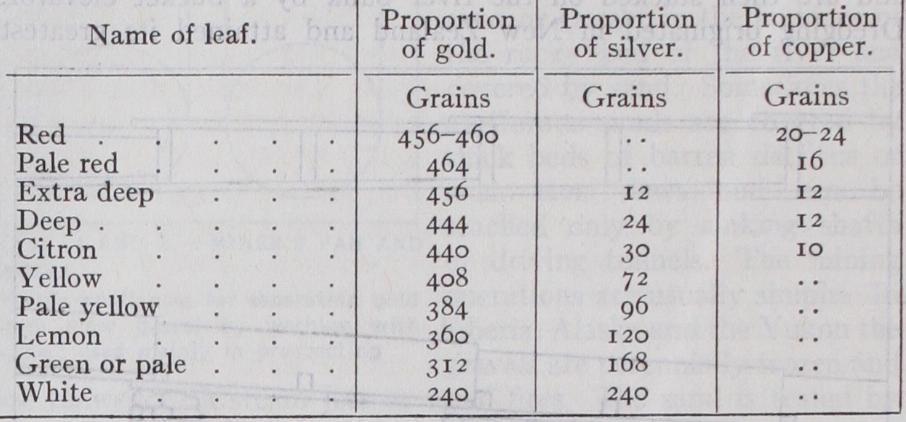
The gold used by the goldbeater is variously alloyed, according to the colour required. Fine gold is commonly supposed to be incapable of being reduced to thin leaves. This, however, is not the case, although its use for ordinary purposes is undesirable on account of its greater cost. It also adheres on one part of a leaf touching another, thus causing a waste of labour by the leaves being spoiled; but for work exposed to the weather it is much preferable, as it is more durable, and does not tarnish or change colour. The external gilding on many public buildings, e.g., the Albert memorial in Kensington gardens, London, is done with pure gold. The following is a list of the principal classes of leaf recognized and ordinarily prepared by British beaters, with the proportions of alloy per oz. they contain.
The process of goldbeating is as follows : The gold, having been alloyed according to the colour desired, is melted in a crucible at a higher temperature than is necessary simply to fuse it, as its malleability is improved by ex posure to a greater heat ; sudden cooling does not interfere with its malleability, gold differing in this respect from some other metals. It is then cast into an ingot, and flattened, by rolling between a pair of powerful smooth steel rollers, into a ribbon of 1 tin, wide and 'oft. in length to the oz. After being flattened it is annealed and cut into pieces of about 62grs. each, or about 75 per oz., and placed between the leaves of a "cutch," which is about fin. thick and 31in. square, containing about 18o leaves of a tough paper. Formerly fine vellum was used for this purpose, and generally still it is interleaved in the proportion of about one of vellum to six of paper. The cutch is beaten on for about 20 minutes with a 17 lb. hammer, which rebounds by the elasticity of the skin, and saves the labour of lifting, by which the gold is spread to the size of the cutch ; each leaf is then taken out and cut into four pieces and put between the skins of a "shoder," 41in. sq. and fin. thick, containing about 72o skins, which have been worn out in the finishing or "mould" process. The shoder requires about two hours' beating upon with a g-lb. hammer. As the gold will spread unequally, the shoder is beaten upon after the larger leaves have reached the edges. The effect of this is that the margins of larger leaves come out of the edges in a state of dust. This allows time for the smaller leaves to reach the full size of the shoder, thus producing a general evenness of size in the leaves. Each leaf is again cut into four pieces, and placed between the leaves of a "mould," composed of about 950 of the finest gold beaters' skins, sin. square and fin. thick, the contents of one shoder filling three moulds. The material has now reached the last and most difficult stage of the process ; and on the fineness of the skin and judgment of the workman the perfection and thinness of the leaf of gold depend. During the first hour the hammer is allowed to fall principally upon the centre of the mould. This causes gaping cracks upon the edges of the leaves, the sides of which readily coalesce and unite without leaving any trace of the union after being beaten upon. At the second hour, when the gold is about 15o,000th part of an inch in thickness, it for the first time permits the transmission of the rays of light. Pure gold, or gold but slightly alloyed, transmits green rays, gold highly al loyed with silver transmits pale violet rays. The mould requires in all about four hours' beating with a 7-lb. hammer, when the ordinary thinness for the gold leaf of commerce will be reached. A single ounce of gold will at this stage be extended to 75X 4 X4 =1,200 leaves, which will trim to squares of about akin. each.
The dryness of the cutch, shoder, and mould is a matter of ex treme delicacy. The finished leaf is taken out of the mould, and the rough edges are trimmed off by slips of the ratan fixed in par allel grooves of an instrument called a waggon, the leaf being laid upon a leathern cushion. The leaves thus prepared are placed into "books" capable of holding 25 leaves each, which have been rubbed over with red ochre to prevent the gold clinging to the paper. Dentist gold is gold leaf carried no farther than the cutch stage, and should be perfectly pure gold.
By the above process also silver is beaten, but not so thin, the inferior value of the metal not rendering it commercially desirable to bestow so much labour upon it. Copper, tin, zinc, palladium, lead, cadmium, platinum, and aluminium can be beaten into thin leaves, but not to the same extent as gold or silver.
The fine membrane called goldbeaters' skin, used for making up the shoder and mould, is the outer coat of the caecum or blind gut of the ox. It is stripped off in lengths about 25 or 3oin., and freed from fat by dipping in a solution of caustic alkali and scraping with a blunt knife. It is afterwards stretched on a frame ; two membranes are glued together, treated with a solution of aromatic substances or camphor, in isinglass, and subsequently coated with white of egg. Finally it is cut into squares of 5in. or 51in. ; and to make up a mould of 950 pieces the gut of about 38o oxen is required, about 21 skins being got from each animal. A skin will endure about 200 beatings in the mould, of ter which it is fit for use in the shoder alone.
