
GOLF (in its older forms GOFF, GOUFF, or GOWFF, the last of which gives the genuine old pronunciation), a game which prob ably derives its name from the Ger. kolbe, a club—in Dutch, kolf—which last is nearly in sound identical and might suggest a Dutch origin, which many pictures and other witnesses support.
From an enactment of James VI. of Scotland (then James I. of England), bearing date 1618, we find that a considerable im portation of golf balls at that time took place from Holland, and thereby "no small quantitie of gold and silver is transported zierly out of his Hienes' kingdome of Scoteland." From this it might seem that the game was at that date still known and prac tised in Holland.
It is uncertain at what date golf was introduced into Scotland, but in 1457 the popularity of the game had become so great as to interfere with the more important pursuit of archery. In March of that year the Scottish parliament "decreted and ordained that wapinshawingis be halden be the lordis and baronis spirituale and temporale, four times in the zeir; and that the futeball and golf be utterly cryit down, and nocht usit; and that the bowe-merkis be maid at ilk paroche kirk a pair of buttis, and schuttin be usit ilk Sunday." Fourteen years afterwards, in May 1471, it was judged necessary to pass another act "anent wapenshawings," and in 1491 a final and evidently angry fulmination was issued on the general subject, with pains and penalties annexed. It runs thus : "Futeball and Golfe forbidden. Item, it is statut and ordainit that in na place of the realme there be usit fute-ball, golfe, or uther sik unprofitabill sportis," etc. This, be it noted, is an edict of James IV.; and it is not a little curious presently to find the monarch himself setting an ill example to his commons, by practice of this "unprofitabill sportis," as is shown by various entries in the ac counts of the lord high treasurer of Scotland (1503-6).
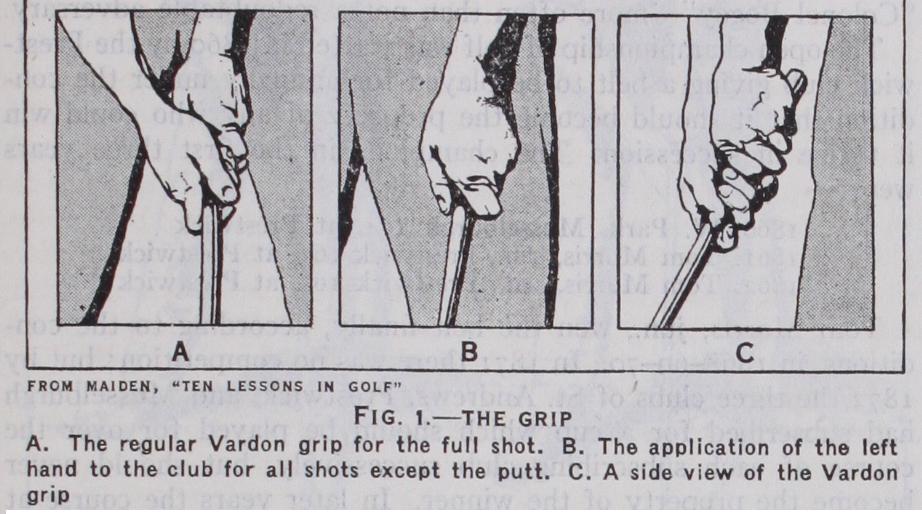
About a century later, the game again appears on the surface of history, and it is quite as popular as before. In the year the town council of Edinburgh "ordanis proclamation to be made threw this burgh, that na inhabitants of the samyn be seen at ony pastymes within or without the toun, upoun the Sabboth day, sic as golfe, etc." The following year the edict was re-announced, but with the modification that the prohibition was "in tyme of sermons." Golf has from old times been known in Scotland as "The Royal and Ancient Game of Goff." James IV. is the first who figures formally in the golfing record. James V. was also very partial to the game distinctively known as "royal" ; and there is some evi dence to show that his daughter, the unhappy Mary Stuart, was a golfer. It was alleged by her enemies that, as showing her shame less indifference to the fate of her husband, a very few days after his murder, she "was seen playing golf and pallmall in the fields beside Seton." That her son, James VI. (afterwards James I. of England), took an interest in golf we have evidence in his act— already alluded to—"anent golfe ballis," prohibiting their importa tion except under certain restrictions. Charles I. was devotedly attached to the game. Whilst engaged in it on the links of Leith, in 1642, the news reached him of the Irish rebellion. He had not the equanimity to finish his match, but returned precipitately and in much agitation to Holyrood. Afterwards, while prisoner to the Scots army at Newcastle, he found his favourite diversion in "the royal game." Sykes (Records of Northumberland) says : "The King was nowhere treated with more honour than at New castle, as he himself confessed, both he and his train having liberty to go abroad and play at goff in the Shield Field, without the walls." Of his son, Charles II., as a golfer, nothing whatever is known, but James II. was a known devotee. After the restoration, James, then duke of York, was sent to Edinburgh in 1681-2 as commissioner of the king to parliament, and a historical monu ment of his prowess as a golfer remains in the "Golfer's Land," as it is still called, 77 Canongate. The duke, challenged by two English noblemen of his suite to play a match against them, along with any Scotch ally he might select, chose as his partner one "Johne Patersone," a shoemaker. The duke and the said Johne won easily, and half of the large stake the duke made over to his humble coadjutor, who therewith built himself the house men tioned above. In 1834 William IV. became patron of the St. Andrews golf club (St. Andrews being then, as now, the most famous seat of the game), and approved of its being styled "The Royal and Ancient Golf Club of St. Andrews." In 1837, as fur ther proof of royal favour, he presented to it a magnificent gold medal, which "should be challenged and played for annually"; and in 1838, the queen dowager, duchess of St. Andrews, became patroness of the club, and presented to it a handsome gold medal, —"The Royal Adelaide"—with a request that it should be worn by the captain, as president, on all public occasions. In June 1863 the prince of Wales (afterwards Edward VII.) signified his desire to become patron of the club, and in the following September was elected captain by acclamation.
In more recent days, golf has become increasingly popular; in 188o the man who travelled about England with a set of golf clubs was an object of some astonishment to his fellow-travellers. In those days the commonest of questions in regard to the game was, "You have to be a fine rider, do you not, to play golf ?" so confounded was it in the popular mind with the game of polo. At Blackheath a few Scotsmen resident in London had long played golf. In 1864 the Royal North Devon club was formed at West ward Ho, and this was the first of the seaside links laid out for golf in England. In 1869 the Royal Liverpool club established itself in possession of the second English course of this quality at Hoylake, in Cheshire. A golf club was formed in connection with the London Scottish Volunteer corps, which had its house on the Putney end of Wimbledon Common on Putney Heath; the progress of the game was slow, though steady, for many years. A few more clubs were formed ; the numbers of golfers grew ; but it could not be said that the game was yet popular in England. All at once the qualities of the ancient Scottish game seemed to strike home, and from that moment its popularity has been increasingly great. The English links to rise into most immediate favour was that of the Royal St. George's golf club, near Sandwich, on the coast of Kent. To the London golfer it was the first course of the first class that was reasonably accessible, and the fact made something like an epoch in English golf. Already there was a chain of links all round the coast, besides numerous inland courses; but since 1890 their increase has been extraordinary, and the number which has been formed in the colonies and abroad is also very large.
The immense amount of golf-playing that this denotes, the large industry in the making of clubs and balls, in the upkeep of links, in the actual work of club-carrying by the caddies, and in the in struction given by the professional class, is obvious. Golf has taken a strong hold on the affections of the people in many parts of Ireland, and the fashion for golf in England has reacted strongly on Scotland itself, the ancient home of the game. Besides the in dustry that such a growth in the game denotes in the branches mentioned above, there is to be taken into account the visiting population that it brings to all lodging-houses and hotels within reach of a tolerable golf links, so that many a fishing village has arisen into a moderate watering-place by virtue of the attrac tions offered by its golf course. Therefore to the Briton, golf has developed into something in the nature of an important business, a business that can make towns and has a considerable effect on the receipts of railway companies.
Moreover, ladies have learned to play golf. Although this is a crude and brief sentence, it does not state the fact too widely nor too forcibly, for though it is true that before 1885 many played on the short links of St. Andrews, North Berwick, West ward Ho, and elsewhere, still it was virtually unknown that they should play on the longer courses which, till then, had been in the undisputed possession of the men. Women now play on the same course as the men. They have their annual championship, which they play on the long links of the men, sometimes on one, sometimes on another, but always on courses of the first quality, demanding the finest display of golfing skill.
The claim that England made to a golfing fellowship with Scot land was conceded very strikingly by the admission of three Eng lish greens, first those of Hoylake and of Sandwich, and in 19o9 Deal, into the exclusive list of the links on which the open cham pionship of the game is decided. Before England had so fully assimilated Scotland's game this great annual contest was waged at St. Andrews, Musselburgh and Prestwick in successive years. The ancient green of Musselburgh, somewhat worn out with hard service, and moreover, as a nine-holes course inadequately accom modating the numbers who compete in the championships to-day, was superseded by Muirfield as a championship arena.
While golf was making itself a force in the southern kingdom, the professional element—men who had learned the game from childhood had become past-masters, were capable of giving in struction, and also of making clubs and balls and looking after the greens on which golf was played—was at first taken from the northern side of the Border. But when golf had been started long enough in England for the little boys employed as "caddies" to grow to sufficient strength to drive the ball as far as their masters, it was inevitable that out of their number some should develop an exceptional talent for the game. This, in fact, actually happened, and English golfers have proved themselves so adept at Scotland's game that there are as many English as Scottish professional golf players, and their number is increasing.
Golf also "caught on," to use the American expression, in the United States. To the American of 1890 golf was largely an un known thing. Since then, however, golf has become a greater factor in the life of the upper and upper-middle classes in the United States than it ever has been in England or Scotland. Golf to the English and the Scots meant only one among several of the sports and pastimes that take the man and the woman of the upper and upper-middle classes into the country and the fresh air. To the American of like status golf came as the one thing to take him out of his town and give him a reason for exercise in the country.
So much enthusiasm and so much golf in America have not failed to make their influence felt in the United Kingdom. Natu rally and inevitably they have created a strong demand for pro fessional instruction, and for professional advice and assistance in the laying out and upkeep of the many new links that have been created in all parts of the States, sometimes out of the least promising material. By the offer of great prizes for exhibition matches, and of wages that are to the British rate on the scale of the dollar to the shilling, they have attracted many of the best Scottish and English professionals to pay them longer or shorter visits as the case may be, and thus a new opening has been created for the energies of the professional golfing class.
The British amateur championship is decided by a tournament in matches thus played, each defeated player retiring, and his opponent passing on into the next round. In the open champion ship, and in most medal competitions, the scores are differently reckoned—each man's total score (irrespective of his relative merit at each hole) being reckoned at the finish against the total score of each other player in the competition. There is also a species of competition called "bogey" play, in which each man plays against a "bogey" score—a score fixed for each hole in the round before starting—and his position in the competition rela tively to the other players is determined by the number of holes that he is to the good or to the bad of the "bogey" score at the end of the round. The player who is most holes to the good, or fewest holes to the bad, wins the competition. Golf occupies the almost unique position of being the only sport in which even a single player can enjoy his game, his opponent in this event being "Colonel Bogey"—more often than not a redoubtable adversary.
The open championship of golf was started in 1860 by the Prest wick club giving a belt to be played for annually under the con dition that it should become the property of any who could win it thrice in succession. The champions in the first three years were :— Tom Morris, jun., won the belt finally, according to the con ditions, in 1868-69-70. In 1871 there was no competition; but by 1872 the three clubs of St. Andrews, Prestwick, and Musselburgh had subscribed for a cup which should be played for over the course of each subscribing club successively, but should never become the property of the winner. In later years the course at Muirfield was substituted for that at Musselburgh, and Hoylake and Sandwich were admitted into the list of championship courses. Up to 1891, inclusive, the play of two rounds, or 36 holes, de termined the championship, but from 1892 the result has been determined on 72 holes (for list of champions see page 503).
There have been some slight changes of detail and arrangement as time has gone on, in the rules of the game (the latest edition of the rules should be consulted). A new class of golfer has arisen, requiring a code of rules framed rather more exactly than the older code. The Scottish golfer, who was "teethed" on a golf club, as Mr. Andrew Lang has described it, imbibed all the traditions of the game with his natural sustenance. Very few rules sufficed for him. But when the Englishman, and still more the American (less in touch with the traditions), began to play golf as a new game, they began to ask for a code of rules that should be lucid on every point—an ideal perhaps impossible to realize. It was found, at least, that the code put forward by the Royal and Ancient Club of St. Andrews did not realize it adequately. Nevertheless the new golfers were very loyal indeed to the club that had held, by tacit consent, the position of fount of golfing legislation. The Royal and Ancient Club was appealed to by English golfers to step into the place, analogous to that of the Marylebone Cricket Club in cricket, that they were both willing and anxious to give it. It was a place that the club at St. Andrews did not in the least wish to occupy, but the honour was thrust so insistently upon it that there was no declining. The latest effort to meet the demands for some more satisfactory legislation on the thousand and one points that con tinually arise for decision consists of the appointment of a stand ing committee, called the "Rules of Golf Committee." Its members all belong to the Royal and Ancient Club ; but since this club draws its membership from all parts of Britain and Ireland, this restriction is quite consistent with a very general representa tion of the views of north, south, east, and west—from Westward Ho and Sandwich to Dornoch, and all the many first-rate links of Ireland—on the committee. Ireland has some of the best links in the British Isles, and yields to neither Scotland nor England in enthusiasm for the game. This committee, after a general re vision of the rules into the form in which they now stand, consider every month, either by meeting or by correspondence, the ques tions that are sent up to it by clubs or by individuals ; and the committee's answers to these questions have the force of law until they have come before the next general meeting of the Royal and Ancient Club at St. Andrews, which may confirm or may re ject them at will. The women of Great Britain manage otherwise. They have a golfing union which settles questions for them, but since this union itself accepts as binding the answers given by the Rules of Golf Committee, they arrive at the same conclusions by a slightly different path. Nor does the American union, governing the play of men and women alike in the States, really act differ ently. The Americans naturally reserve to themselves freedom to make their own rules, but in practice they conform to the legisla tion of Scotland, with the exception of a more drastic definition of the status of the amateur player, and certain differences as to the clubs used.
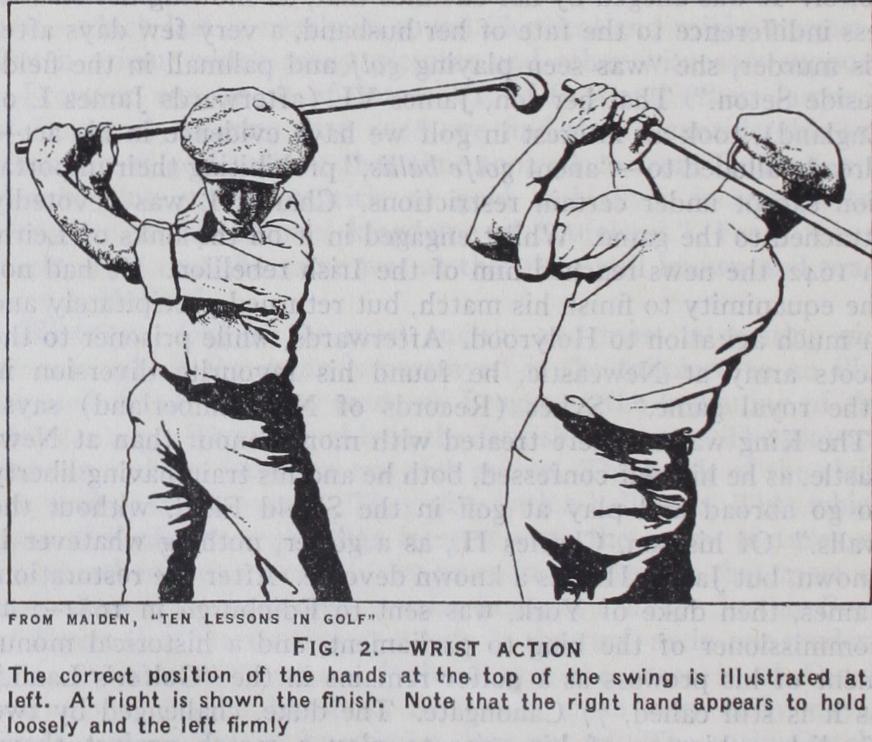
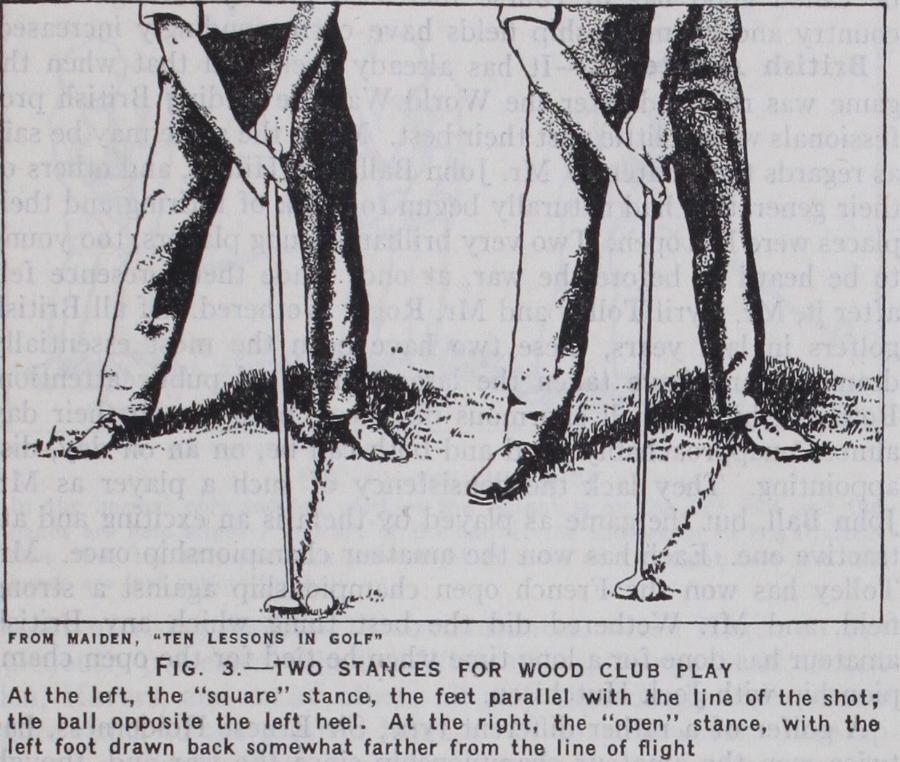
A considerable modification had been effected on the implements of the game. The tendency of the modern wooden clubs is to be short in the heads as compared with the clubs of, say, 188o or 1885. The advantage claimed for this shape is that it masses the weight behind the point on which the ball is struck. Better ma terial in the wood of the club is a consequence of the increased demand for these articles and the increased competition among their makers. Whereas under the old conditions a few workers at the few greens then in existence were enough to supply the golf ing wants, now there is a very large industry in golf club and ball making, which not only employs workers in the local club-makers' shops all the kingdom over, but is an important branch of the commerce of the stores and of the big athletic outfitters both in Great Britain and in the United States. By far the largest modi fication in the game since the change to gutta-percha balls from balls of leather-covering stuffed with feathers, is due to the Ameri can invention of the india-rubber cored balls. Practically it is as an American invention that it is still regarded, although the British law courts decided, after a lengthy trial (19o5), that there had been "prior users" of the principle of the balls' manufacture, and therefore that the patent of Mr. Haskell, by whose name the first balls of the kind were called, was not good. The rubber cored ball, which is now everywhere in use, is a hard core of gutta percha or some other substance, round which is wound, by ma chinery, india-rubber thread or strips at a high tension, and over all is an outer coat of gutta-percha. Some makers have tried to dispense with the kernel of hard substance, or to substitute for it kernels of some fluid or gelatinous substance, but in general the above is a sufficient, though rough, description of the mode of making these balls. Their superiority over the solid gutta-percha lies in their superior resiliency. The effect is that they go much more lightly off the club. They also go remarkably well off the iron clubs, and thus make the game easier by placing the player within an iron shot of the hole at a distance at which he would have to use a wooden club if he were playing with a solid gutta-percha ball. They also tend to make the game more easy by the fact that if they are at all mishit they go much better than a gutta-percha ball similarly inaccurately struck. As a slight set-off against these qualities, the ball, because of the greater liveliness, is not quite so good for the short game as the solid ball ; but on the whole its advantages distinctly overbalance its disadvantages.
When these balls were first put on the market they were sold at 2S. each and even, when the supply was quite unequal to the demand, at a great deal higher price, rising to as much as a guinea a ball. But the normal price, until about a year after the decision in the British courts of law affirming that there was no patent in the balls, was always 2s. for the best quality of ball. Subsequently there was a reduction to Is. for the balls made by many of the manufacturing companies, though in 1 g 1 o the rise in the price of rubber sent up the cost. The rubber-cored ball does not go out of shape so quickly as the gutta-percha solid ball and does not show other marks of ill-usage with the club so obviously. It has had the effect of making the game a good deal easier for the sec ond and third class players, favouring especially those who were short drivers with the old gutta-percha ball. To the best players it has made the least difference, nevertheless those who were best with the old ball are also best with the new ; its effect has merely been to bring the best closer to each other.
The expenditure of clubs on their courses has increased and tends to increase. Demands are more insistent than they used to be for a well kept course, for perfectly mown greens, renewed teeing grounds and so on, and probably the modern golfer is a good deal more luxurious in his clubhouse wants than his father used to be. This means a big staff of servants and workers on the green, and to meet this a rather heavy subscription is required. Such a subscription as five guineas added to a ten or 15-guinea entrance fee is not uncommon, and even this is very moderate compared with the subscriptions to some of the clubs in the United States, where $150 to $250 a year is not unusual and admission costs in some cases amount to $2,500. But on the whole, golf is very economical, as compared with almost any other sport which engages the attention of Britons, and it is a pastime for all the year round and for all the life of a man or woman.