
GOLFING STROKES The Swing—General.—The swing may be of three types : (I) The flat swing, in which the club, if carried back as far as pos sible, would strike the player across the shoulders. (2) The up right swing, which would reach the back of the player's neck. (3) The medium swing, between the two, and best for players of approximately normal physique. The flat swing is suited to short, stout players; the upright to tall and slender ones.
The Arms.—For all strokes greater than the putt and chip shot, the left arm is maintained approximately straight throughout the back swing and until after the ball has been struck. Some experts ease the back swing by a slight bend in the left elbow. but the bent elbow must be straightened early in the downward stroke. The right elbow is not permitted to move far away from the right side in the back swing; it travels around the body. In beginning all strokes the arms should make an obtuse angle with the club-shaft ; never a straight line with it.
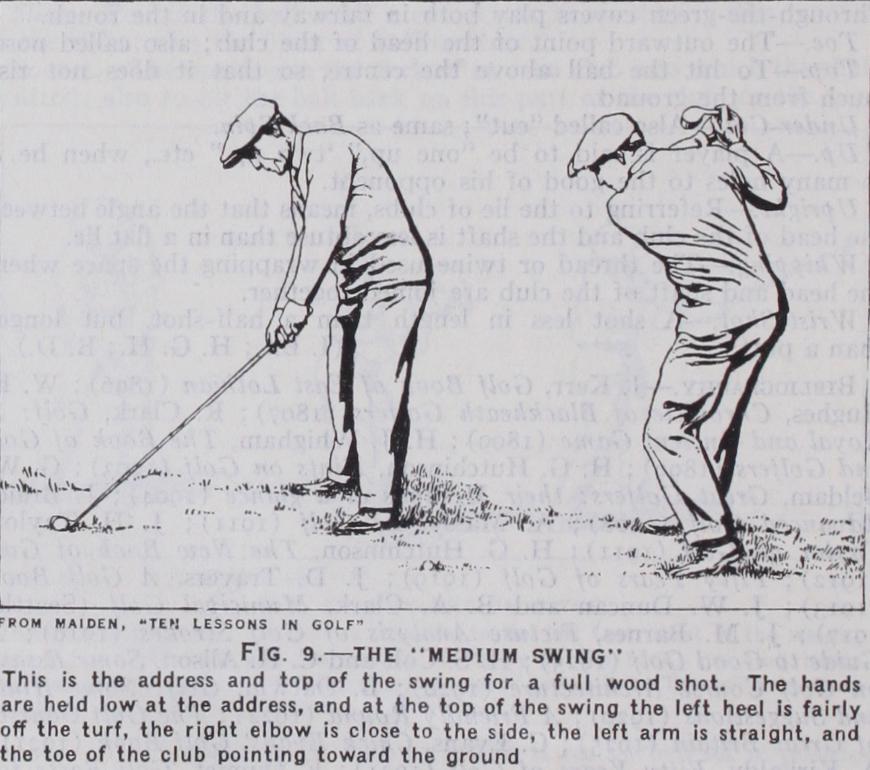
The Wrists.—At the "address," or preparation to strike the ball, the wrists are above the shaft, and at the top of a full stroke are directly beneath the shaft, so that the head of the club is pointed toward the ground. This is the "winding" action of the wrists which provides much of the power in the stroke, the wrists unwinding as the club-head approaches impact.
The Stance.—The stance, or manner in which the player's feet are disposed with relation to the ball, is of three kinds. In the "open" stance the left foot is farther from the line of play than the right, so that he faces very slightly toward the objective. In the "square" stance the feet are parallel with the line of play. In the "closed" stance the right foot is a few inches to the rear of the line of the left. The "square" stance is best tried at the outset, and altered, if need be, as the player gets on in the game. The ball normally is placed in line with the left heel or slightly inside it. The distance at which to stand from the ball may be gauged by placing the club-head against the ball, the end of the shaft reaching to the left knee.
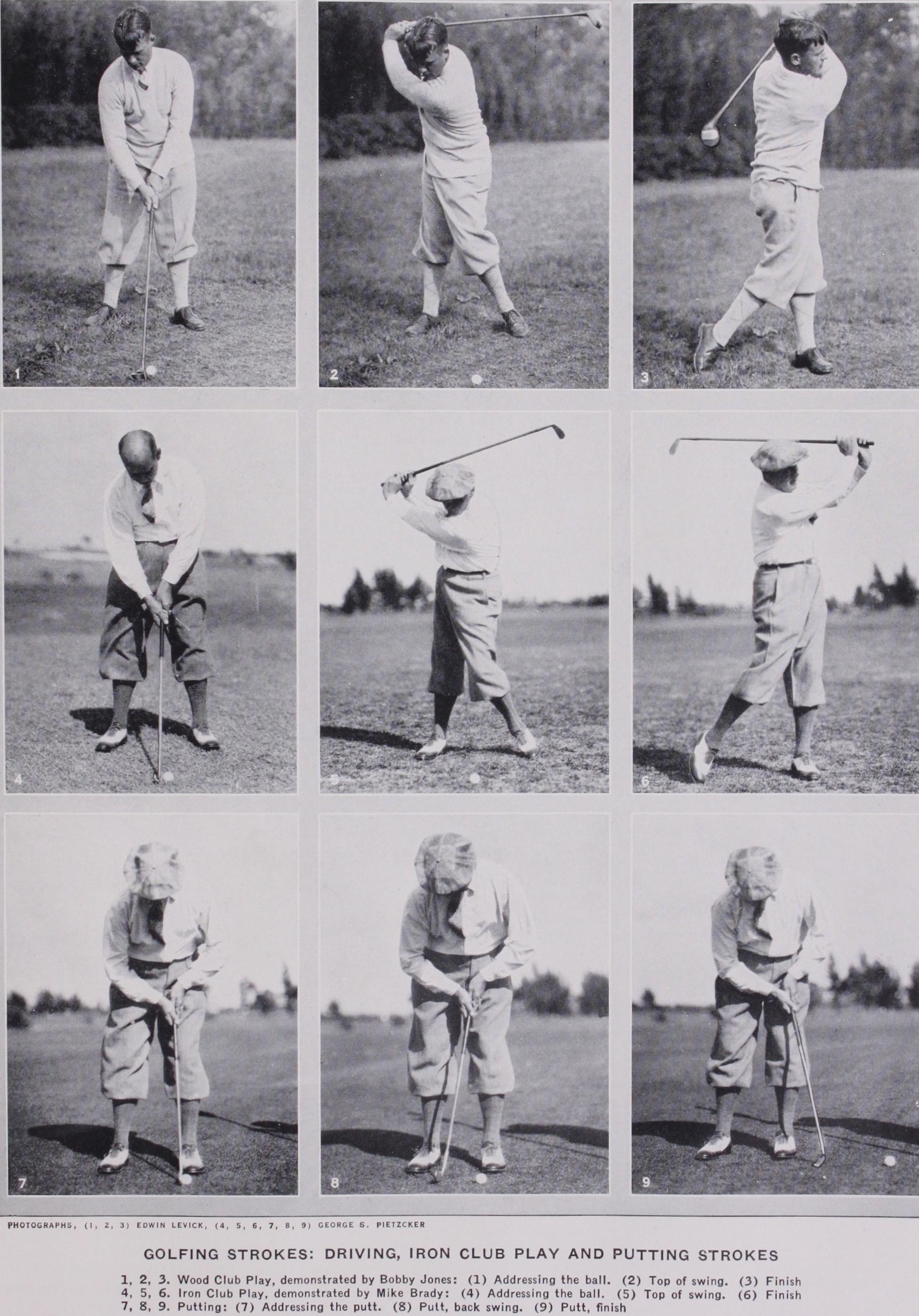
Pivoting or Body-turn.—The back swing is achieved properly with a liberal action of the body, the hips rotating or pivoting away from the ball, and the shoulders turning with them, as the club is taken back. The left hip inaugurates both the backward and the forward motion of the club ; and the principal force or "hit" in the stroke is applied only after the hips have moved toward the objective. The weight is supposed to move slightly on to the right leg in the back swing and be transferred freely to the left as the stroke moves toward impact, finishing well on the left leg.
The Chip-shot.—This tiny stroke, played with a lofted club from just off the putting surface, ordinarily is executed from the usual stance but with the feet closer together, as little power is required. The wrists are firm and the hands are swung decisively, the ball being struck crisply in the back with sufficient force to carry it over intervening grass or hazards to the closely clipped putting surface, where it finishes with a relatively long roll.
The Pitch.—There are two main types of pitch shot. Normally, the ball is played nearly opposite the left heel, with the mashie, mashie-niblick, spade or niblick, the natural loft of the club pro ducing the high trajectory or "pitch." When it is required to stop the ball promptly on touching the turf, backspin or reverse English is applied by playing the ball on a line midway between the feet or even back toward the right, the stroke thus being more down ward, as the chop-stroke in tennis. In all pitch shots and in iron play the "divot" or chip of turf is taken after the ball has left the club's face, from a location immediately in front of where the ball rested.
Iron Play.—There are two leading divisions in iron play. In one, the ball is placed just back of the line of the left heel and is struck quite fairly in the back just before the club-head has reached the lowest point in its arc. This permits considerable roll at the end of the shot, and when it is necessary to achieve a more sudden stop the ball is played farther back toward the line of the right foot, a more downward stroke is employed, and the back spin thus applied results in a lower flight and a shorter roll. This sometimes is called the "push shot." Wood Club Play.—With the wood clubs the player stands far ther from his ball, since the clubs are longer, and should find the normal position of the ball about opposite his left heel. The swing with the wood club is more free than with the irons, but it is best not to permit the club at the top of the swing to drop below the horizontal. A straight left arm tends to check the back swing within reasonable limits. More emphatically than with the irons or pitching clubs, the ball is struck with the woods fairly in the back.
Bunker and Rough—The "explosion shot" from sand is ac complished with the niblick, the blade being sent full force into the sand about an inch behind the ball, which literally is blasted upward and forward without the club touching it. This is the usual recovery from a bunker near the green, though if the ball be lying on top of the sand it may be chipped or pitched. In the rough, or heavy grass, the general method is to strike the ball with an ascending club-head, so as to extricate it from the clinging obstruction with as little opposition as possible. (0. B. K.)