
GLUCOSIDES, NATURAL. The term glucoside is applied to a large number of substances present in plants, which on hydrolysis by acids furnish a sugar and a second product. The sugar is usually dextrose, alone or mixed with other sugars such as rhamnose. The second product may be anything which can occur in a plant, from methyl alcohol to a complex alkaloid, so long as it contains a hydroxyl group capable of forming an ether linkage (see CHEMISTRY : Organic) with either a simple or a complex sugar. The complex sugars (polysaccharides) may them selves be regarded as glucosides since they consist of ethers formed from two or more simple sugars.
It is probable that the formation of glucosides provides the plant with a means of storing in a harmless form, materials such as prussic acid and reactive aldehydes, required for future use and capable by means of enzymes of liberation in small quanti ties as required. Further, glucosides are usually at least sparingly soluble in water, and since only soluble substances are trans portable in a plant, by movements of sap, it is at least a useful working hypothesis to assume that the plant converts into gluco sides (a) harmful or useless substances, which must be transported to the barks, fruit rinds, seed coats, etc., where they can do no harm and will eventually be shed; (b) necessary but harmful substances, which may be useful later on; (c) decorative sub stances, such as floral pigments, formed in the leaves and trans ported at the proper season to the flowers, fruits, etc.
This hypothesis at least accounts for the extraordinary variety of the second, non-saccharine, hydrolytic products of glucosides. Among them are to be found a large number of phenolic gluco sides, such as arbutin and phloridzin, yielding on hydrolysis the phenols, hydroquinone and phloretin; aromatic alcohol glucosides, like salicin, a much-valued analgesic in medicine, which on hydrol ysis furnishes dextrose and saligenin (o-hydroxybenzyl alcohol) ; an interesting group of acid-glucosides represented by gaultherin, the form in which winter-green oil (methyl salicylate) is stored in the plant from which this popular American flavouring agent was formerly drawn, though now largely replaced by synthetic methyl salicylate. Less popular, but probably more useful are convolvulin and jalapin, the active principles of the purgative drugs, scammony and jalap (q.v.). These on hydrolysis yield acids somewhat similar to those found in castor oil, where they are combined with glycerine instead of dextrose. Mention must also be made of the saponins, an extensive and widely distributed series of glucosides, which subserve the purposes of man in such diverse ways as providing beer with a good "head" when it is not of the quality to acquire one naturally, forming the basis of detergent materials for delicate fabrics, assisting the suspen sion of oily fluids so that they become "miscible" with water, as in many well-known disinfectants, and finally in the manufac ture of "foaming" fire extinguishers. Another class of glucosides, the mustard-oil group, found in something like a thousand genera of the natural order cruciferae, supply Englishmen with their national condiment, mustard (q.v.). Nor can the highly toxic glucosides, digitoxin, digitalin, strophanthin and ouabain, which with other similar substances form the group of "cardiac gluco sides," be omitted, since they are indispensable in medicine whether used as such, or as the drugs digitalis (q.v.), strophanthus (q.v.) or acokanthera. The two latter also retain a certain amount of anthropological interest, being still popular as arrow poisons in some of the more remote parts of Africa. Glucosides also minister to man's aesthetic needs, since most of the yellow, red, and blue floral and other pigments occur in plants in the form of "flavonol" and "anthocyan" glucosides ; thus the beauti ful blue tint of the pansy is due to a rhamnoside of the pigment delphinidin, and the red of the scarlet geranium to a diglucoside of the pigment pelargonidin. (See ANTHOCYANINS AND ANTHOX ANTHINS.) Much light has been thrown on the structure of natural gluco sides by the study of the synthetic a and (3-methyl glucosides, that is, the monomethyl ethers of dextrose (see CHEMISTRY Organic and SUGARS) particularly in their specific relationship to enzymes (q.v.) ; and it is now known that most natural gluco sides can be regarded as (3-glucosides, and that the enzymes, such as emulsin, which accompany them in plants and are capable of either decomposing or recomposing the glucosides, depending upon the conditions obtaining at the moment, are i3-enzymes. This reversible activity of the enzymes towards glucosides con sists in the addition or withdrawal of the elements of water at vulnerable points. Thus, using the conventional signs and symbols of the chemist, the decomposition of amygdalin, one of the oldest and best known of the glucosides, can be represented thus :— I. Unregulated decomposition of amygdalin by acids or emulsin.
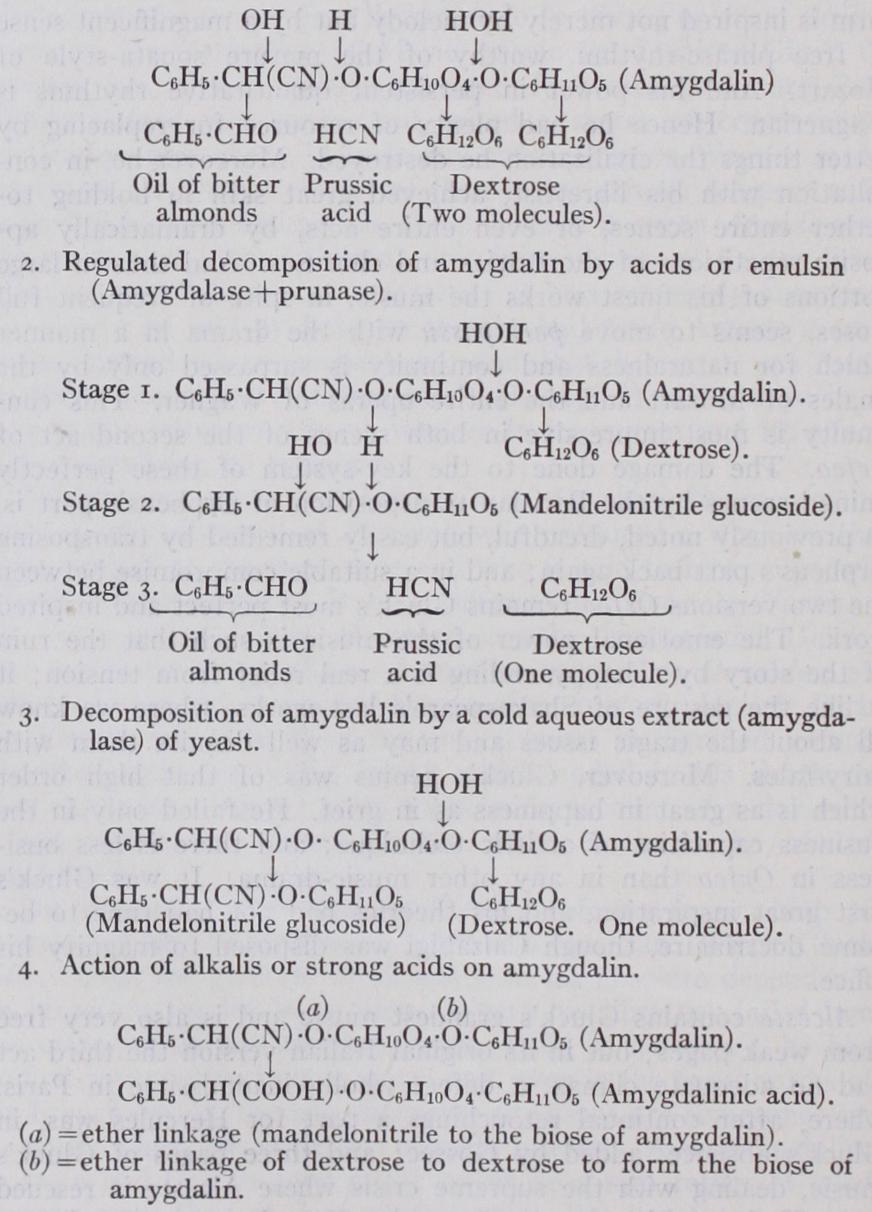
In this diagram, line i represents the complex unregulated action of acids or emulsin upon amygdalin, the latter being de composed into one molecule each of benzaldehyde and prussic acid, which together constitute oil of bitter almonds, and two molecules of dextrose.
Line 2 shows that the apparently. simple reaction represented by line really consists of two reactions, the complex sugar (biose) of amygdalin being split up first, yielding one molecule each of dextrose and a new and simpler substance, dextromandelonitrile glucoside, found in the form of prunasin in the wild cherry bark (Prunus serotina) and in Cerasus padus. In the second stage, dextromandelonitrile glucoside is decomposed into one molecule each of dextrose, benzaldehyde and prussic acid. The demonstra tion of these two stages is possible because the two reactions progress at different rates and by stopping at a certain point d mandelonitrile glucoside can be isolated. So far as the action of enzymes is concerned, the first stage alone is brought about by a cold water extract of yeast, which contains amygdalase, and the second by an enzyme, prunase, which appropriately occurs with prunasin. Prunase has no action on amygdalin itself. This demon stration also shows that emulsin must be a mixture of at least two enzymes, amygdalase and prunase. Line 3 is the first stage of line 2 repeated to represent the action of amygdalase alone. Line 4 is interesting as showing what happens when amygdalin is treated with alkalis or strong acids ; the molecule remains intact and only the nitrile group (CN) is hydrolysed producing a carboxyl group (.COOH) and liberating ammonia, in accordance with the general behaviour of such groups. (See CHEMISTRY : Organic.) The laevorotatory isomeride of mandelonitrile glucoside, and the racemic isomeride, also occur in nature in the form of the gluco sides sambunigrin in the young branches of the elder, and prulaura sin in the leaves of the cherry laurel. These are all called "cyano genetic glucosides" because on hydrolysis they yield prussic acid; other examples are dhurrin from the tropical grass, which yields the food-grain, called "dhurra," and linamarin or phaseolunatin, which yields acetone, prussic acid and dextrose on hydrolysis and is widely distributed in nature. Both these have on several occa sions been the cause of poisoning cases in man or animals.
BIBLIOGRAPHY.—J. J. L. van Rijn, Die Glykoside (1900) ; E. F. Bibliography.—J. J. L. van Rijn, Die Glykoside (1900) ; E. F. Armstrong, The Simple Carbohydrates and the Glucosides (1924). The second of these books contains an excellent bibliography.
(T. A. H.)