
SWABIAN LEAGUE) .
Towards the close of the century the discontent felt at the in competent and absent German king took a decided form. The movement was led by the four Rhenish electors, and after some preliminary proceedings these princes met in Aug. 1400; having declared Wenzel dethroned they chose one of their number, the elector palatine Rupert III., in his stead. Rupert was an excellent elector, and under more favourable circumstances would have made a good king, but so serious were the jealousies and divisions in the kingdom that he found little scope for his energies outside the Palatinate. Having secured a certain amount of recognition in the south and west of Germany, the new king turned aside from the pressing problems of government and in 140I made a futile attempt to reach Rome. After his return to Germany he had to face the hostility of many of the princes, and this contest, together with vain attempts to restore order, occupied him until his death in May 1410.
Sigismund.—His successor, Sigismund, king of Hungary, is the most interesting figure among the emperors of the later middle ages. He played a part in all the movements of his time—the crusade against the Turks, the reform of the Church, the creation of territorial principalities in Germany. The religious rising in Bohemia which developed into the Hussite war (see HussITEs) distracted Sigismund's attention from Germany, into which the war often extended. It was an unfortunate distraction, for Sigis mund had many of the qualities of a radical reformer, and under other circumstances would have done much to adapt the imperial constitution to the conditions of his time. As it was, the part which he played in the history of the council of Constance gave to the empire a prestige which had not belonged to it since the interregnum. In all his plans for the well-being of the empire Sigismund relied on the support of Frederick of Hohenzollern, burgrave of Nuremberg, and made a permanent impression on German history by establishing his ally in the mark of Branden burg (1415) . But the persistent opposition within Germany to any schemes of imperial centralization compelled Sigismund to concentrate on his territorial interests, and his historical impor tance lies in the fact that he is the real creator of the dominion which when inherited by the house of Habsburg, gave a new significance to the imperial title.
The importance of Frederick's reign lies in the steady disinte gration of Germany. In the west, the dukes of Burgundy were steadily consolidating their dominion at the expense of the empire, and the Swiss were achieving virtual independence. In the east the Teutonic order was losing ground against the Poles, and in the north Schleswig and Holstein fell under Danish rule. In Germany itself the greater families such as the Hohenzollerns and Wittels bachs were turning their possessions into territorial principalities and Frederick himself followed their example. Despite all dis couragements, he foresaw the great destiny which lay before his house, and he did much to turn his dreams into reality by secur ing the marriage of his son Maximilian with the heiress of the Burgundian dukes. To this obscure emperor the later Habsburgs owed the territories on the western border of Germany which gave them for centuries a unique influence in European politics.
Maximilian I,—Maximilian, Frederick's son, came to the throne in 1486 with exceptional advantages. He was heir to the extensive Austrian lands, and as the widowed husband of Charles the Bold's daughter Mary he administered the Netherlands. Al though he soon gave up these provinces to his son Philip, the fact that they were in the possession of his family added to his in fluence, and this was further increased when Philip married Joanna, the heiress of the Spanish kingdoms. From Maximilian's accession the empire exercised in the affairs of Europe an author ity which had not belonged to it for centuries.
The reign of Maximilian I. is important in many ways. The emperor himself is an interesting figure, erratic and ambitious, but intelligent, and fully aware of the contrast between his im perial position and his actual resources. His reign coincides with a strong movement among the princes for constitutional reform, led from within the electoral college by Bertold, archbishop of Mainz. Maximilian, in fact, was the first emperor to be confronted with a constitutional programme. Naturally he had no sympathy with the limitation of imperial authority implied by the plan pro posed by Bertold and his adherents. Nevertheless the changes which were made in his time had great influence on the later imperial constitution (see EMPIRE; DIET; IMPERIAL CHAMBER) and in a sense the modern history of the empire begins with him. In the history of Germany his importance lies in his resistance to the French claim to the provinces which had formed part of the Burgundian dominion. In this he was only carrying out his father's dynastic policy, and he had little support from other German princes. Few at the time realized that the integrity of Germany was at stake in the struggle which Maximilian main tained with very slender resources.
In many respects the reign of Maximilian must be regarded as the end of the middle ages. The feudal relation between the king and the princes and between the princes and their vassals had become purely nominal. No real control was exerted by the Crown over the heads of the various States, and, now that war was car ried on mainly by mercenary troops, the mediate nobles did not hold their lands on condition of military service. The princes were sovereigns, not merely feudal lords; and by the institution of local diets in their territories an approach was made to modern conceptions of government. The age of war was far indeed from being over, but men were at least beginning to see that unnecessary bloodshed is an evil, and that the true outlet for the mass of human energies is not conflict but industry. By the growth of the cities in social, if not in political, importance the products of labour were more and more widely diffused; and it was easier than at any previous time for the nation to be moved by common ideas and impulses. Many causes contributed to effect a radical change in the point of view from which the world was regarded, and the strongest of all mediaeval relations, that of the nation to the Church, was about to pass through the fiery trial of the Reformation. This vast movement in the later years of Max imilian definitely severed the mediaeval from the modern world.
The Reformation.—The seeds of the Reformation were laid during the time of the great conflict between the papacy and the empire. During the struggle of Louis IV. with the popes of his day the feeling revived with fresh intensity. At the same time the spiritual teaching of the mystics awakened in many minds an aspiration which the Church, in its corrupt state, could not satisfy, and which was in any case unfavourable to an external authority. The Hussite movement further weakened the spell of the Church. Still more powerful, because touching other elements of human nature and affecting a more important class, was the influence of the Renaissance, which, towards the end of the 15th century, passed from Italy to the universities of Germany. The men of the new learning did not sever themselves from Christianity, but they became indifferent to it ; its conceptions seemed to them dim and faded, while there was a constantly increasing charm in literature, in philosophy and in art. No kind of effort was made by the Church to prepare for the storm. At last Leo X., by his incessant demands for money and his unscrupulous methods of obtaining it, awakened universal hostility.
The popular feeling for the first time found expression when Luther, on All Saints' day 1517, nailed to a church door in Witten berg the theses in which he contested the doctrine which lay at the root of the scandalous traffic in indulgences carried on in the pope's name by Tetzel and his like. This episode, derided at first at Rome as the act of an obscure Augustinian friar intent on scor ing a point in a scholastic disputation, was in reality an event of vast significance, for it brought to the front, as the exponent of the national sentiment, one of the mightiest spirits whom Germany has produced. Under the influence of Luther's strong personality the most active and progressive elements of the nation were soon in more or less open antagonism to the papacy.
At his election Charles had been required to accept a Wahlka pitulation (electoral agreement) embodying the conditions on which he was to receive the crown—a precedent followed at sub sequent elections. This was confirmed by the diet. Charles, re garded as a foreigner by the princes, undertook to respect the freedom of Germany, use the German language and convene the diets on German soil. He was not to bring foreign troops into Germany or place German troops under foreign command. An administrative council, the Reichsregiment (State board of con trol) was to be set up, and after some debate between Charles and the princes it was settled that it should consist of 2 2 mem bers with a president nominated by the sovereign. It was to gov ern Germany in his absence ; at other times its functions would be only advisory. There was an undertaking to aid the emperor by raising and paying an army. In April, 1521, Charles invested his brother F erdinand (afterwards emperor) with the Austrian archduchies and then left Germany to deal with disturbances in Spain and renew his struggle with Francis I.
A more serious revolt was the rising in south and central Ger many known as the Peasants' War (Bauernkrieg). The small farmers and peasants had real grievances, partly the outcome of changing economic conditions, but largely of the grasping policy of the princes and great landowners. Like the knights, they had lost many of their traditional feudal privileges by the introduc tion of the new system of Roman law. In many districts there were obstacles to migration and re-settlement which led to their small holdings being subdivided till, with an increasing popula tion, they became too small to support a peasant family. Since 1461 there had been a recurrence of minor local outbreaks. The first movements of a rising on a wide scale took place in 1522 while the revolt of the knights was still in progress. As in former movements the standard of revolt was the Bundschuh, a peasant's clog upon a pole. As the rising spread many knights and adven turers joined the peasants, and they found friends among the poorer workers of the towns. A new feature of the revolt was that the rebels put forward a religious as well as a social programme, one of their claims. being that each village should elect its pastor. There were appeals also to scriptural prophecies interpreted to predict the coming of a new era of freedom and prosperity. Some of the lords granted the more moderate claims of the peasants, amongst these peace-makers being the elector palatine, the bishops of Bamberg and Speyer and the abbots of Fulda and Hersfeld. Luther wrote a pamphlet warning the princes that their oppres sion had caused the rising, and that the reasonable claims of the peasants should be granted, but telling the latter that their griev ances did not justify their violence, and they should negotiate for peace. Meanwhile the rising spread along the Rhine and across the Main into Thuringia. It was not till the summer of 1525 that the war ended, and ended in disaster for the rebels. After their first successes they had indulged in reckless outrages on life and property, and the princes, when their forces got the upper hand, wreaked a ferocious vengeance on them. Luther en couraged these reprisals in a pamphlet "On the Murderous Peasant Hordes," urging that the rebels deserved no mercy.
In the diet that met at Speyer in June 1526 the reformers were the stronger party. A message from Charles in Spain, call ing on the diet to forbid innovations and enforce the edict of Worms, was rejected, on the ground that when the emperor wrote it, three months earlier, he and the pope were at peace, but were now at war. The diet decreed that pending a national council each prince should regulate the religious affairs of his own dominions. After this wherever the reformers were in power—notably in Saxony, Brandenburg, Hesse and the Palatinate, and in Strass burg, Nurnberg, Ulm and Augsburg—the religious changes went forward. But when the diet met again three years later at Speyer under the presidency of the archduke Ferdinand, the Catholic party was stronger, and a message from Charles required the repeal of the decree of 1526. But the Catholics were anxious for a truce, and with the approval of Melanchthon, who was also striving for peace, secured the adoption of a decree that until a Council met the reformers should abstain from further changes, but that in their states the Catholic minority should have freedom to prac tise their religion. Philip of Hesse with four other princes and the delegates of several cities protested against any limitation of their powers, and declared their resolve to disobey the decree. Melanch thon wrote of this rejection of the modus vivendi as "a terrible affair." The protest was the origin of the new name of "Protes tant," soon applied to and accepted by the reformers.
Charles V., having this year made peace with the Pope and Francis I., was crowned by Clement VII., at Bologna in Feb. 1530, and then went to Germany to make a personal effort to settle its troubles. The Protestant forces were now divided by the conflict between the Lutherans and the followers of the Swiss reformer Zwingli, whose influence extended to the south German cities. In June, 1530, the diet was convoked at Augsburg. By the emperor's invitation, as a basis for discussing a religious peace, the Lutherans presented a statement of their position, drawn up by Melanchthon, its articles accentuating points of agreement with the Catholics and dealing cautiously, and even vaguely, with points of controversy. It is known as the "Confession of Augs burg," and forms still the confession of faith of the Lutheran Evangelical Church. It led to long debates which ended, as was to be expected, in failure to effect an agreement. Four of the Zwinglian cities at once protested against it. Numbers of the Lutherans themselves denounced its guarded statements. A con ference between Catholic and Lutheran theologians only accentu ated points of vital difference. Several of the Lutheran princes and their friends left Augsburg. In November the diet ended with a decree issued by Charles giving the Lutherans till the following April, to reconsider their position, calling for submission to a settlement, and leaving it to the imperial courts to insist on the restoration of confiscated Church property, and referring to the hope of a final peace being effected by a General Council.
In Jan. 1531 at Cologne Charles secured the election of his brother, the archduke Ferdinand, to the dignity of king of the Romans, which implied succession to the empire. Meanwhile Ferdinand would act as his representative in Germany instead of the discredited Reichsregiment. In April the Lutheran leaders formed at Schmalkalden in Hesse the defensive alliance known as the "League of Smalkald," which was joined by nine princes and eleven cities. It entered into relations with Denmark, the Zwinglians of Switzerland and the emperor's rival Francis I. Tension with France and the Turkish peril made the emperor hesitate to go to extremes. The latter danger was serious. The Turks had conquered Serbia and overrun Hungary, and only an outbreak of pestilence in their army had saved Vienna. Early in 1532 the emperor convoked a diet at Regensburg. The Lutherans absented themselves, and though the Catholics voted supplies for the Turkish war they opposed the emperor's policy of concessions to their opponents. Charles then entered into direct negotiations with the Protestant princes, which resulted in July in "the peace of Nuremberg," granting temporary toleration to the Lutherans, which was renewed in the following years. His reward was im mediate and substantial. His subjects vied with each other in hurrying soldiers to his standard and the advancing Turkish army was soon in full retreat.
In 1542 Charles was again involved in war with both France and Turkey, and the League of Smalkald took advantage of his troubles to expel its opponent Henry, duke of Brunswick-Wolfen bUttel, from his duchy and establish Protestantism therein. The citizens of Regensburg declared for Lutheranism, and Hermann von Wied, prince archbishop of Cologne, and William, duke of Gelderland, announced their secession from Rome. The Protes tants were now at the height of their power, but their ascendancy was soon to be destroyed more by their own division and the folly and imprudence of their leaders than by the skill and valour of their foes. The unity and power of the League of Smalkald was undermined by dissensions between John Frederick, the ruler of electoral Saxony, and Maurice, who had succeeded Henry in ducal Saxony, and the bigamy of Philip of Hesse, car ried through under a dispensation signed by Luther and several of his colleagues, made him many enemies and endangered his legal status, so that in June 1541 he saved himself by coming to terms with the emperor. Thus the League lost its most impor tant leader. In 1543 it looked on helplessly while Charles crushed Duke William of Gelderland and added his duchies to the lands of the Habsburgs. Charles, however, hesitated to make a general attack on the Protestants, and in accordance with the promises made in 1539 at Frankfurt, arranged conferences between the two religious parties, which, however, gave no result. The diets held at Regensburg and Nuremberg failed to give any solution of the religious question, and made grudging votes for the war ; but at the diet of Speyer in 1544 lavish promises to the Protes tants obtained supplies with which a new army was placed in the field. In September of that year Charles concluded the treaty of Crepy with Francis I. and had his hands free to deal with the affairs of Germany.
Maurice was rewarded by the Saxon electorate being added to his duchy; more than one of the Lutheran princes hastened to court the conqueror's good will ; and Charles met the diet at Augsburg in Sept. 1547 confident in his power to remodel German affairs.
But his over-confidence led to mistakes of policy. The princes evaded his chief demands by prolonged debate, and were soon encouraged by news that he was quarrelling with the pope over the proposed removal of the Council from Trent (in the empire) to Bologna (in the Papal States). Charles imagined he could set tle the religious question himself. He proposed the acceptance of a compromise set forth in a decree known as the "Interim," as it was to be in force till the decisions of the Council were known. His critics, both Protestant and Catholic, spoke of it as "the Interim religion." Only a minority of both parties were ready to accept it. He did not satisfy either earnest Lutherans or orthodox Catholics, by slurring over points of difference in vague formulae.
Maurice then went to help Ferdinand against the Turks, but his ally, Henry II. of France, continued the war against Ger many. He had seized Metz, and Charles failed in an attempt to recover it. Another of Maurice's allies, Albert of Brandenburg, after "living on the country" in Franconia, was for awhile with the emperor's army against France, and then resumed his bandit raids, which became such a terror that a league of the princes, formed by Maurice, united in driving him out of Germany Maurice lost his life in this campaign.
The treaty was published in Sept. 15 5 5 Charles had left the settlement entirely to his brother. His health was failing, he was tired of the troubled affairs of Germany, and anxious chiefly to consolidate his Spanish dominions in the hands of his son Philip (now the husband of Mary Tudor). He abdicated, in January 1556, entrusting Spain, the Netherlands and his oversea empire to Philip, while Ferdinand took over the conduct of German affairs, though it was not until after the death of Charles (1 S 58) that he was formally installed as emperor.
Ferdinand's son and successor, Maximilian II. (1564-1576), was a man of tolerant views, had even been at one time suspected of an inclination to Lutheranism. He secured his election by a declaration of fidelity to the old faith, but for awhile cherished optimistic but misleading dreams of effecting a peaceful religious reunion in Germany. His first diet at Augsburg in 1566 gave no encouragement to these hopes. The Catholics stood firmly for the decrees of Trent, and the Protestants gave new proof of their divisions by an attempt to exclude the Calvinist prince palatine, Frederick II. from the advantages of the peace of Augsburg. This led to Frederick and the Calvinists entering into closer relations with France and the Dutch Netherlands, while the Lutherans, now led by Augustus of Saxony, courted the friendship of the emperor. But even they were divided, while the Catholics were still gaining ground. Albert of Bavaria boasted that without force or strife most of his people had been won to the Catholic cause. The emperor now abandoned his reunion projects and was for awhile occupied with a Turkish campaign. The new diet at Speyer in 15 7o was chiefly engaged in debates on the abuses resulting from the enlistment of Germans by foreign agents as merce naries, but nothing practical was done. It is to Maximilian's credit that he tried to mediate between his cousin Philip II. and the revolted Netherlands. He was engaged in negotiations with a Polish party, which wished to elect him as King of Poland, when he died in October 1576.
After the death of Augustus of Saxony there was another brief alliance of the Protestant princes, under the leadership of his suc cessor Christian I. and of John Casimir. An opposition party was organised in the diet, but with little practical result, and the deaths of the two leaders in 1591-92 put an end to the alliance between Lutherans and Calvinists for a time. But in the diets held at Regensburg in 1593 the Protestant princes drew together. Under the leadership of Christian prince of Anhalt they put forward de mands for new concessions and in the latter assembly tried to hinder or delay the payment of subsidies for a new war with Tur key. In 1598 they advanced a theory that in the diet the decisions of a majority did not bind the minority, and in the diet of 1603 they asserted the same position, protested against various decisions of the Reichshofrat and finally withdrew from the diet in a body. The war with Turkey lasted from 1593 to 1606, when peace was negotiated not by the emperor but by his brother Matthias, who, on account of Rudolph suffering from attacks of mental failure, had been declared head of the house of Habsburg. Rudolph re sented this indignity and his relations with his brother were strained till his death in January 1612.
During the latter years of his reign the leader of the Catholic party in Germany was Maximilian, the duke of Bavaria. In 1607 he was given an imperial mandate to deal with a religious riot in the free city of Donauworth, and after suppressing it retained the city under his government. Alarmed by this arbitrary act, the Protestant princes formed, in i6o8, the Evangelical Union, and in response the Catholics, led by Maximilian, united in a similar confederation, afterwards known as the Catholic League. As the Union was headed by the Calvinist elector palatine, Frederick IV., many of the Lutherans were slack in supporting it, but it became very important by an alliance with Henry IV. of France, who was ready to profit by German quarrels and was interfering in a dis puted accession to the duchies of Cleves and Jiilich. War be tween the two confederations on this question seemed imminent, but after the murder of Henry IV. in May 161o, the Union did not venture to fight.
The war blazed up again on a larger scale in 1625. The em peror's successes and the rising power of Maximilian of Bavaria alarmed the Lutheran princes, and a new Protestant combination was formed, of which the leading member was King Christian IV. of Denmark, who as duke of Holstein was a prince of the empire. Two confederate armies were soon in the field, the princes accept ing for them the leadership of King Christian and Count Mans feld. Unwilling to depend entirely on Maximilian and the League, and unable to raise a large force of his own, Ferdinand accepted the offer of the celebrated Wallenstein to raise, equip and maintain in the field at his own cost an army of 20,000 men, mostly veteran troops, on condition that he should command them and have a free hand. He was a wealthy Czech noble, who had seen service in the Turkish wars, and had a real military genius with the mental ity of a soldier of fortune. A Catholic, at least by profession, and serving the Catholic emperor, his levies were made up of a mixture of Catholics, Protestants and all kinds of adventurers ready to fight under any successful leader. He meant to pay and supply his army by levying contributions on the country in which it operated. As the war went on many of the armies in the field were not unlike Wallenstein's. In April 1626 with his hard fighting mercenaries he defeated Mansfeld at Dessau, and in August Tilly with the army of the League defeated Christian of Denmark at Lutter. The victors united their armies and invaded Denmark. Wallenstein now formed in union with the Spaniards an ambitious scheme for cutting off the supplies of the Netherlands and con trolling those of North Germany by seizing the North sea and Baltic ports. He was only partly successful, and after five months' siege had to abandon the attempt to seize Stralsund. But Den mark was at the mercy of the imperialists, and in May 1629 had to conclude the peace of Lubeck.
Intoxicated by success, Ferdinand had only two months before issued the ill-advised "edict of restitution," ordering the restora tion of all ecclesiastical lands taken over by the Protestants since the peace of Passau in 1552. This stirred up widespread opposition. While it was still being debated, Maximilian and his colleagues of the Catholic League united in demanding the dismissal of Wallen stein, now duke of Friedland, governor of the conquered terri tories of Mecklenburg and Pomerania, and rightly suspected of dangerous personal ambitions. Ferdinand had to yield just when new dangers were arising. In the summer of 163o Gustavus Adolphus of Sweden declared himself the champion of the Protes tant cause in Germany, and established himself with a strong force in Pomerania. How political rather than religious motives were now influencing events is shown by the fact that he had the promise of subsidies for the support of the war from the France of Cardinal Richelieu.
Gustavus, probably the ablest soldier of his day, had already extended the Swedish power to several of the Baltic lands, and at first the Protestant princes were slow in uniting with him, sus pecting his real object was further Swedish conquests on the Baltic shores. But they soon welcomed his aid. He pushed forward to the Elbe gathering strength with success. He captured Frankfort on-Oder, added the Saxon army to his own and defeated Tilly and the main army of the League at Breitenfeld near Leipzig in Sep tember 1631. Then while the Saxons won Silesia and invaded Bohemia, Gustavus marched triumphantly through Central Ger many and established his headquarters at Mainz. In April 1632 he invaded Bavaria ; Tilly was killed in a lost battle on the Lech; and Gustavus occupied Augsburg and Munich. Ferdinand now appealed to Wallenstein to take command again. Wallenstein only consented on being given control of all the imperial forces and the right of making treaties and granting pardons. He then drove the Saxons out of Bohemia, repulsed an attack made by Gustavus on the entrenched camp near Nuremberg, but was de feated by the Swedes at Lutzen (November 16, 1632). It was for them a costly victory, for Gustavus was killed leading a cavalry charge. The crown passed to his daughter Christina, but, under the government of the Chancellor Oxenstjerna, the Swedes con tinued the war.
In April, 1633, at Heilbronn the Swedes and their German allies agreed to arrangements for the conduct of the war. The military command was divided between Bernhard, duke of Saxe-Weimar and the Swedish general Horn. France was still supplying money to the allies. The war went on in the Rhine and Danube valleys, the Swedes entering Alsace and Bernhard capturing Regensburg. Wallenstein showed no longer his former vigorous leadership. There was enough reason for dissatisfaction to evoke a movement for his dismissal. Ferdinand yielded and in January 1634 declared Wallenstein deposed from command. He tried, however, to retain control of his army, but next month, as a result of a conspiracy among his officers, he was assassinated.
Commanded now by the archduke Ferdinand, king of Hungary (later the emperor Ferdinand III.), the Imperialists began a suc cessful campaign by recapturing Regensburg and Donauworth and then, aided by Spanish troops, winning a complete victory over the Swedes and their allies at Nordlingen (Sept., 1634). The fortunes of the confederates were at a low ebb, but France presently came to their aid. Richelieu signed an alliance with Sweden at Com piegne in April, 1635, and next month France declared war and put her armies in motion. But by this time there was a move ment for peace in Germany. Men of all classes were tired of the long conflict, in which they saw their country wasted and ruined as the cockpit for contending armies which levied contributions on city, town and countryside, and whether they were friends or foes left a trail of misery in their track. John George, the Lutheran elector of Saxony, took the lead in the movement, and despite Swedish opposition signed in May, 1635, the Treaty of Prague with the emperor. The vexed question of Restitutions was settled by fixing November, 1627, as the date up to which their possession would be recognised and even later occupations were to stand for 4o years to come, during which amicable arrangements might be made. The elector agreed to assist the emperor to recover territories occupied by the Swedes, and to place the Saxon army at his disposal, receiving in return a small increase of his own dominions. The elector of Brandenburg, the duke of Wiirt temberg and several of the cities soon adhered to the treaty.
In this last phase the war became a struggle between the Bour bon and the Habsburg interests. The Swedes won some successes in north Germany but in these campaigns after France came in the important field of operations was in the west and south. The French armies on one side drove the Spaniards back in Flanders, and on the other crossed the Rhine, and under Conde and Turenne, with some help from Bernhard and the Swedish general Wrangel penetrated far into south Germany. (On Bern hard's death in 1639 his army was taken over and paid by the French.) The Treaty of Westphalia.—While these operations were in progress preliminary negotiations for a general peace had already begun at Hamburg and Cologne, before the death of the emperor Ferdinand II. it 1637. But it was not till Dec., 1641, that under his successor, I erdinand III., a treaty was signed at Hamburg, by which it was agreed that peace conferences should meet at Munster and Osnabruck in March, 1642, the emperor treating with France at the former and with Sweden at the latter. The Catholic princes of the empire were to be represented at Munster and the Protestants at Osnabruck. The conferences did not actu ally begin till 1645, when the elector of Brandenburg had made, and the elector of Saxony was about to make, a truce with Sweden. In three years many controversial questions were settled, with much diplomatic playing for advantages, but at last in Oct. 1648 the treaty of Westphalia was signed, ending the Thirty Years' War.
France gained possession of the "three bishoprics"—Metz, Ver dun and Toul, with the Austrian territory in Alsace. Sweden was granted Western Pomerania, Stettin, Verden and Bremen, and in virtue of this cession became a member of the empire. Hanover, Brandenburg and Saxony received some increase of territory, and the Rhenish palatinate was divided between the electoral house and Bavaria. Switzerland and Holland, long actually independent, were formally recognized as independent nations. The German states of the empire were accorded a measure of independence by the recognition of the right to make alliances even with foreign powers, with the nominal proviso that these should not be injuri ous to the emperor or the empire. The princes were to regulate the religious affairs of their territories, and though there was a stipulation for individual religious freedom, practically for long after in many states those who did not belong to the officially established religion were under some disabilities. To the imperial diet was left the settlement of treaties and laws affecting all Germany. By a compromise 1524 was fixed as the date for settling the question of the ecclesiastical lands. This left to the Catholics recent gains in the Habsburg territories. The general effect of the treaty was to relax the connection between the Habs burg and the other German lands. The empire survived, but there was a foreshadowing of the future change when the Habsburg emperor at Vienna would be no longer emperor of a "Holy Roman Empire," but emperor of Austria. But for another century and a half he was to represent the dignified tradition of some of the greatest memories of European history. (A. H. A.) The condition of Germany after the conclusion of the Peace of Westphalia was indeed tragic. The population had decreased in the course of the Thirty Years War from about 3o millions to 20 millions; the greatest decrease was shown in the rural popu lation on whom the hardships of the war fell heaviest, causing them to migrate in large numbers to the cities. Many villages were totally deserted, and the old conditions were not completely restored until the middle of the 18th century.
Agriculture was almost at a standstill; large numbers of the land workers had been killed, or enrolled as mercenaries in the armies; stock had been destroyed, and houses burnt to the ground. Without capital and credit, the peasants were reduced to utter dependence upon the great nobles and land-owners who only furnished them with the money to rebuild their houses and replenish their stock on extremely hard terms. Everywhere their dues were increased and their rights of tenure diminished. A peasant without capital could not hope to improve the state of his holding. In consequence of the depopulation of the land the demand for agricultural produce had decreased, prices of live stock and grain had fallen and the area of land under cultivation had steadily diminished.
Nor did the great landowners fare any better. They suffered in like manner with the peasants, and in order to maintain their estates were forced to raise mortgages on their properties at a high rate of interest. If, in spite of these conditions the nobility succeeded for the most part in maintaining their properties, it was chiefly due to the administrations of the different States, who came to their help by declaring moratoriums or by the remission of interest. By the establishment of a Fidei-kommiss the aristo cracy sought to preserve their landed property to their families' estates; the same object prompted the prohibition of the sale of noble estates to townsmen which survived in many cases until the beginning of the i9th century. The great landlords were also seldom in a position to carry out any agricultural development, and it was only gradually that a certain number of them, at the instigation of the ruling princes, began to cultivate the potato, which had been newly imported from America, and other food crops and to plant fruit trees and tobacco.
Industry and commerce had been equally ruined by the wars. The disorganization of industry had favoured the import of foreign goods; the lack of purchasing power and skilled labour made recovery difficult. The country was flooded with French and English goods through the agency of the Dutch merchants. The once flourishing German trade in products of industrial art had almost entirely ceased; the South German linen and cloth industry decreased and the quality too, deteriorated. Official regulations were of little avail, and it was only the immigration of the French Huguenots in the second half of the 17th century that gave new life to German industry. The ancient organizations of the handi craft workers, the gilds, had become rigidly occupational associa tions ; bad trading conditions and want of capital hindered the introduction of the factory system which was already developing widely throughout western Europe. German trade suffered specially from the fact that the mouths of the great German rivers were in foreign hands ; the Dutch held the mouth of the Rhine; the Swedes and Danes the Weser, Elbe and Oder and the Poles the Vistula. German participation in world commerce was very restricted; German merchants were confined to internal trade and were often only agents for foreign investors.
Germany had been a wealthy country in the second half of the 16th century, but now money was scarce and furniture, art treasures and other valuables had been looted in large quantities by foreign armies. The crushing levies which the towns had to pay to preserve themselves from the hand of the invader had brought them to the verge of ruin. The mineral wealth, which had formerly been a main contributory source of German prosperity, especially the silver mines, was partly exhausted and partly diminished in value through the growing imports of precious metal from America. This loss of national wealth could only be replaced in the course of centuries.
Intellectual life had also suffered severely. Hard conditions had made material interests and the struggle for daily bread predominant. The striving after wealth and material comfort obsessed the nation, impoverished and demoralized by war. The sense of nationality was at a low ebb and the generation that had grown to manhood during the war had no other conception than that Germany was predestined to be ill-used by her neighbours. Confidence in the national strength had vanished and even patriotic pride and the culture that springs from it had been sorely diminished. A vast number of Spanish and French words had been introduced into the German language, while court life and ceremony, fashion, and all social intercourse came more and more under French influence. This foreign culture descended from the court and the city patricians into the ranks of the middle classes until the peasant class alone remained untouched by it.
Apart from the Reichstag, there existed a further general im perial organization, the Reichskammergericht, the supreme judicial body of the empire. It met first at Speyer and later at Wetzlar, and was financed by the estates. Its effectiveness was seriously impaired, however, because the greater principalities were exempt by special imperial privileges from its jurisdiction. In addition the emperor maintained a separate Reichs/io f gericht at Vienna which was in perpetual conflict over questions of competence with the Reichskammergericht. Moreover, as the procedure was very complicated the hearing of processes was almost incredibly prolix, and at times a decision was never reached. An enquiry held in 1772 revealed that no less than 61,233 suits were still awaiting judgment by the Reichskammergericht.
The empire was unable either to take precautions to safeguard its territory, or to preserve law and order among its citizens and protect the interests and lives of its subjects abroad. There existed no regular taxation, and the empire possessed no army or police force. The necessary duties were collected on the basis of a register in which each constituent estate of the empire was assessed at a definite rate. These amounts, however, were regularly diminished in consequence of the protest of the different estates that their ability to pay was rated too highly ; and payment into the imperial treasury was very irregular. When the empire went to war each estate had to furnish a stated quantity of troops and ordnance also recorded in a register. When the numerous small contingents did assemble at the oppointed date and place, which very rarely happened, the troops were variously armed and for the most part were made up of raw levies. The organization of larger forces was very difficult because no estate would permit its soldiers to be placed under foreign command. When it is also remembered that the troops were never trained together, it is easy to understand that an imperial army composed in such a manner rarely possessed any real military effectiveness.
It can therefore be said with truth that since the Peace of Westphalia there had never been a common political life in Germany. For administrative measures were carried out not by the empire but by the individual territories that had grown up within it and had practically attained to the status of independent States. The number of these States was extraordinarily large, and has been estimated at some i 800 including some amazing examples. The smallest territories were the dominions of the knights of the empire, numbering some 1,475. These were nearly all situated in south-west Germany and their joint population amounted to about 500,000. Each individual territory averaged about 30o inhabitants. These territories therefore, were no more than properties which, since their owners were free knights of the empire, were not under the dominion of a prince, but directly dependent on the emperor and the empire. In this instance the capacities of land owner and sovereign lord were united in the same person, who administered the law and exercised police-rights over his little territory. These knights of the empire were unrepresented in the Reichstag.
Then there were 51 free imperial cities with a total population estimated at about 750,00o, and, included in their number, were certain of the more important ancient commercial towns such as Hamburg, Bremen, Nuremberg, Augsburg, Ulm, Strasbourg and Frankfurt-am-Main; but the vast majority were small and insignif icant country towns of 2-3,00o inhabitants in south-west Germany who had had the good fortune, like the knights, to be protected by their ancient privileges from coming under the rule of a prince. For the most part these towns and cities were governed by a small number of patrician families who monopolized all positions of influence and profit and often gained a reputation for devoting the revenue of the town more to their own special interests than to those of the citizens at large. With certain exceptions, these towns were little animated by civic spirit and the desire for eco nomic progress. Moreover they were overshadowed by the capitals rising round the residences of the princes—although these had not the advantages enjoyed by the free cities.
The 63 ecclesiastical principalities (archbishoprics, bishoprics, abbacies) with their population of some three millions, had special characteristics. Here the supreme lord was a bishop or abbot elected by the cathedral chapter with whom he shared the adminis tration of the district. The chapter was almost entirely composed of the nobility of the neighbourhood, since these religious founda tions and orders afforded the nobles a convenient opportunity of providing for their younger sons in a manner befitting their rank. For the most part the administration was bad, and it was not until the i8th century that a few of the ecclesiastical princes were sufficiently enlightened to introduce important reforms. Many bishops used their high position to further the interests of their families by making over to them ecclesiastical estates and by fill ing the chapters with their relatives.
The temporal principalities and countships numbered between 17o to 200; the number varied because the estates were often divided among different lines of the same family, or many prin cipalities united by inheritance under one prince. A patriarchal form of government characterized the smaller principalities, in which the prince was personally acquainted with the majority of his subjects, concerned himself in their family affairs, and ex pected them to take a similar lively interest in the joys and sorrows of his own family. Nearly all these lesser princes main tained a magnificent court and employed a number of officials out of all proportion to the size of their principalities ; they were especially inventive in introducing fresh methods of taxation by which they sought to obtain the money for the upkeep of their courts. A true political life was naturally impossible in all these miniature states, and was only to be found in the few larger prin cipalities. Of these, the greatest was in the possession of the house of Habsburg which ruled over a vast territory in south east Germany composed of the kingdoms of Bohemia, Austria. Styria, Carinthia, Carniola and Tirol with, in addition, a number of scattered possessions in southern Suabia stretching to the banks of the Rhine. These territories could not be regarded as constitut ing a single State, for from time to time they were divided among various branches of the ruling house, and it was only in 1665, after the failure of the Tirolese line, that Leopold I. finally united all the possessions of the Habsburgs. The individual States, how ever, retained their own administration and diets and the central authority for the whole territory, which Maximilian I. had begun to establish, was still very unwieldy and exercised little control. Next in importance came the territories of the house of Hohen zollern. The margrave of Brandenburg had inherited in the i8th century the district of East Prussia which had hitherto owed allegiance to Poland. At the same time he inherited from the last duke of Jiilich the district of Cleves in western Germany together with the countship of Mark and Ravensberg in Westphalia. After the death of the last Pomeranian duke, the Treaty of Westphalia gave to the Hohenzollerns Lower Pomerania and, as compensation for Upper Pomerania, ceded to Sweden the former bishoprics of Magdeburg, Halberstadt and Minden. The centre of their terri tory extended from the Elbe and the Hartz mountains almost to the bank of the Vistula : while East Prussia, which was cut off from the central territory by Polish West Prussia, and their terri tories on the Rhine and in Westphalia, formed districts loosely joined to the main body. The individual districts maintained sub stantial independence and did not look upon themselves as form ing part of a single united territory, but rather as districts that had by chance come into the hands of the same ruler. After the Habs burgs and Hohenzollerns, came the house of Wettin which was divided into so many branches that the head of the house, the elector of Saxony, only ruled personally over a portion of its territories. The same was true of the house of Wittelsbach of which the most powerful member was the elector of Bavaria, ruling over the largest and most compact territory, whereas the widely-scattered lands in the Palatine were divided among num erous cadet branches of the family. In north-western Germany the leading role fell to the house of Guelf, whose lands in Han over and Brunswick were shared among innumerable members of the family. If account be taken of the duchy of Wurttemberg and the margravate of Baden in the south, and the lands of the house of Hesse in central Germany, all the more important territories then existing will have been considered. In these greater states there existed estates in which the land-owning aristocracy exerted the predominant influence, but in which the civil population of the towns was also represented. These diets claimed that no new legislation could be enacted, no fresh taxation introduced, and no burden of loans laid upon the State without their consent having first been obtained. While the princes endeavoured to reduce the old established power of the estates, they did not dare to suppress it outright. With the assistance of their paid officials, and sup ported by the standing armies which had been maintained in all the greater States since the Thirty Years' War, the princes succeeded in the course of the i 7th and i8th centuries in permanently aug menting their power, until in fact they became absolute rulers; while the rights of the estates dwindled away more and more.
Administration and justice were far better in these greater States than in the smaller territories, and by developing the police system the princes ensured peace and order within their States. Political life in Germany was confined to these larger States. The only question was whether they would not gradually become wholly independent, and thus destroy the last traces of that na tional alliance of all the Germanic peoples that still existed in the old Imperial State Union (Reichsverband). In that event, Ger many would have been divided into a number of independent States, each of which would have pursued its own special interest, and one could then have spoken of a German nation in so far as the inhabitants of the different States possessed in common a similar language and certain common elements of intellectual culture. Such a collapse of the empire could only be avoided either by strengthening the power of the empire to such a degree that the central authority could bring the individual territories into sub mission, or by one of these territories becoming so strong that the remainder would be forced to submit to its leadership.
The sovereign princes of the German States were not sufficiently gifted to construct a real Government in the midst of the difficul ties then prevailing in Germany. Ferdinand III. (I 63 7) had been brought up in a strictly religious atmosphere and was domi nated by his confessors. He had never given evidence of any special qualities. His eldest son, Ferdinand, who during his father's lifetime had been chosen as his successor by the imperial electors, died before him in 1654, and, notwithstanding all his endeavours, the emperor was unable before his death to bring about the elec tion of his younger son, Leopold, as king of the Romans. Hence when Ferdinand died in 1657 an interregnum ensued that lasted for almost a year, until finally the electoral princes united to elect Leopold (Aug. 18, 1658) who, however, was compelled to sign a capitulation by which the imperial rights were still further re duced.
In the first decade after the Peace of Westphalia, the primary concern of all the estates was the maintenance of peace. As the war between France and Spain lasted until 1659, and as grave issues were arising in north and east, Germany could easily have been involved again in a general war. As no one believed in the ability of the emperor to safeguard the empire from this danger, there grew up a network of alliances between the different estates for mutual defence. The elector Johann Philipp of Mainz suc ceeded in uniting the most important Catholic and Protestant princes in a great defensive alliance. The Confederation of the Rhine was signed on August 16, 1658 for three years, and had for its object the full execution of the Peace of Westphalia, the prevention of foreign wars and the defence of its own territories. But, in fact this alliance, which the emperor regarded as directed against his authority, very soon became largely dependent on France. It was frequently renewed and lasted until 1667.
During the first northern war (i 656-6o), the emperor in the Catholic interests supported the Catholic king of Poland ; whilst the elector of Brandenburg, who at the outset supported Sweden, later entered into an understanding with Poland and the emperor. These wars, however, were waged for the most part outside the ter ritory of the empire, and Germany was far more deeply disturbed by the course of events on her western frontier.
But Leopold still hesitated to take any action against Louis XIV. In view of the anticipated extinction of the Spanish branch of the Habsburgs, his main policy was to unite the Spanish mon archy with his own territories. This policy depended for its suc cess upon the acquiescence of the French king, and since Louis was clever enough to dangle before the emperor the hope that he would help him to fulfil his desires, Leopold did not feel himself at liberty to oppose Louis in his schemes. Hence the Dutch found their sole support in the elector of Brandenburg, who had grown up in Holland and whose first wife had been a princess of Orange. By cutting the dykes and flooding the country, the Dutch were able with great difficulty to avert the French attack in 1672. At the urgent request of the estates, Leopold determined to send an army under General Montecucoli for the defence of the im perial frontier on the Rhine, but with instructions to maintain the defensive. The empire declared war on France at the same time as Spain. The war was chiefly waged in Belgium and on the Rhine. Louis XIV. allied himself with Sweden, who, at his re quest, invaded Brandenburg from Pomerania in order to restore the elector Frederick William, who was participating in person in the war against France. At the same time, Louis XIV. entered into relations with Poland, Turkey and Hungary which was discon tented with the Habsburg rule. The emperor then found him self threatened in the rear. By his victory at Fehrbellin on June 28, 1675, the elector of Brandenburg drove the Swedes out of his territory and occupied nearly the whole of Swedish Pomerania. The French, on the other hand, were for the most part victorious in Belgium and on the Rhine. As the war dragged on without any definite decision being reached Louis was able to induce first Holland and then Spain to conclude a separate peace. When the emperor saw that he could no longer hope to obtain any suc cess by carrying on hostilities, he concluded the peace of Nijm wegen with France in Feb. 1679. The greater part of Alsace and Lorraine, as well as the former Austrian territory of Breisgau, remained in French possession. The elector of Brandenburg, who was required by the peace to give up all his acquisitions in Pomer ania, was unwilling to subscribe to such terms and for a short time carried on alone a forlorn fight. In the following year, how ever, he too was compelled to conclude peace.
In consequence of these events, Louis XIV. became convinced that the weakness of the empire was such that he could encroach upon its territory with impunity. He established in the French law courts in Metz, Breisach and Besancon, so-called chambers of reunion (Reunionskammern) for the purpose of determining what lands had at any former time belonged to the districts which had now been ceded to him. As the result of these investi gations, he declared that the countship of Mompelgard, the whole of Alsace and certain districts in the Palatine and Trier, belonged by right to France; and he sent his armies to occupy these dis tricts. The imperial city of Strasbourg, which was included in these districts, was on Sept. 28, 1681, forcibly seized and at once erected into a powerful French fortress. The emperor and the Reichstag contented themselves with ineffectual protests against these acts of violence.
That the emperor did nothing to safeguard the integrity of the empire at this crisis is partly accounted for by the fact that his own immediate territories were menaced by many grave dan gers. The Turks in Hungary were planning a desperate attack on Austria, and in the spring of 1683 appeared with a powerful army before the walls of Vienna. But the valiant Count Rudiger von Starhemberg managed to defend the city until the arrival of an army under the king of Poland and the electors of Bavaria and Saxony, which defeated the Turks and freed Vienna.
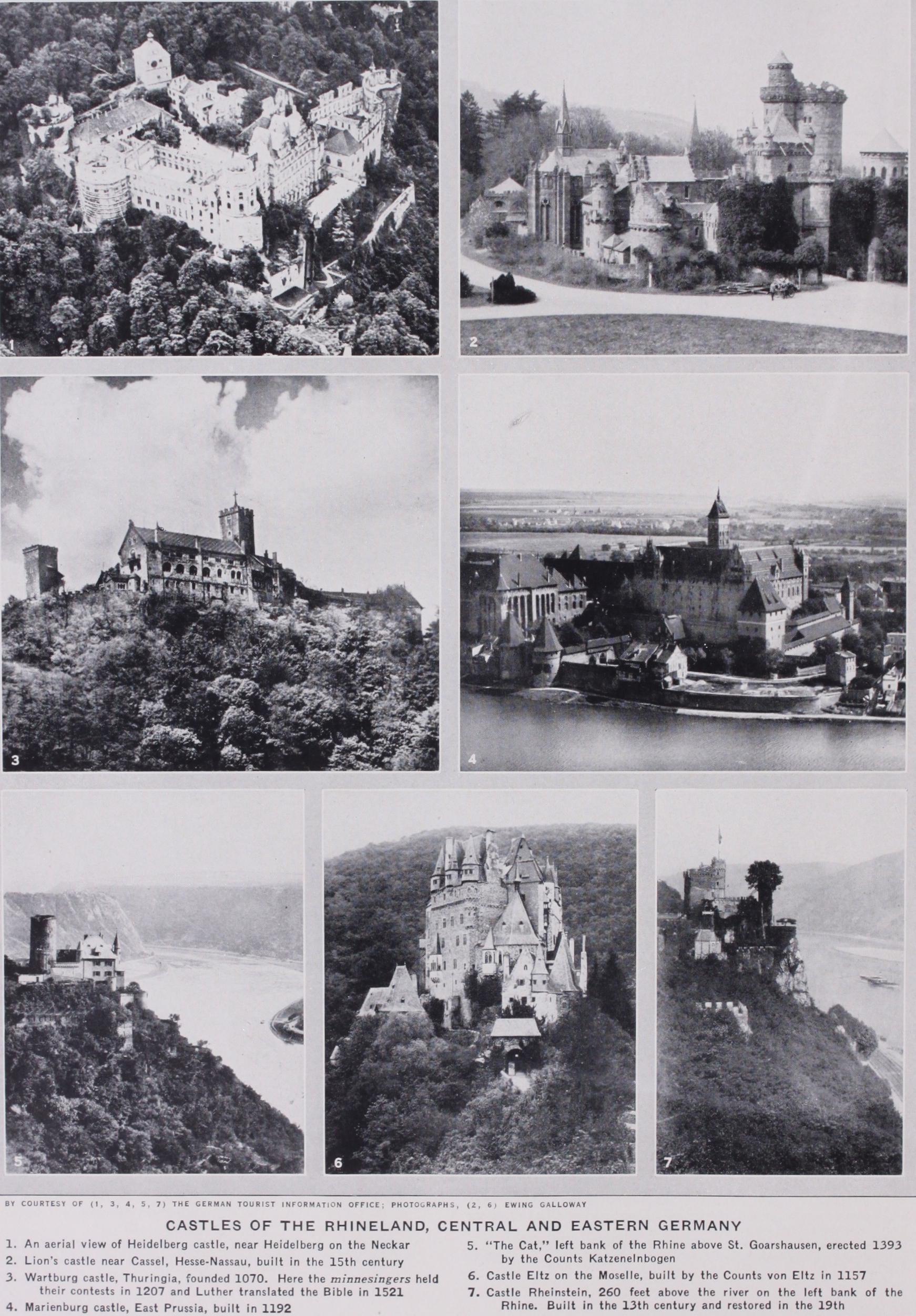
When Louis XIV., on grounds that had no legal justification whatever, sought to bring the Palatinate within his grasp, claim ing it as the inheritance of Elizabeth Charlotte, the wife of his younger brother, war once more broke out in the west. The French armies invaded the Palatinate, and ravaged it with fire and sword. The magnificent palace of the elector Palatine at Heidelberg was destroyed and in face of this outrage the emperor felt impelled to resume the war in alliance with Holland and Eng land. This new war lasted for nine years, inflicted severe losses on the French, but did not result in any decisive victory. Once more Louis was able to sow dissension among his enemies and to isolate Germany, and the emperor was forced to conclude the Peace of Ryswick in 1697, with but small gain to himself. Louis abandoned his claim to the Palatinate, and the districts outside Alsace that had been declared to have once formed part of it. Further he had to restore his duchy to the duke of Lorraine, but he retained the whole of Alsace and also Strasbourg.
Meanwhile the war between the emperor and the Turks con tinued in the east ; two-thirds of Hungary remained in Turkish hands. Prince Eugene of Savoy, one of the greatest generals of the age was appointed to command the Austrian army and de feated the Turks in a decisive victory at Zenta (Aug. 29, 1697) . Prince Eugene invaded Serbia and Bosnia, and forced the Turks to conclude the Peace of Carlowitz on Jan. 26, 1699, by which the entire kingdom of Hungary, with the exception of the Banat of Temesvar, was restored to the emperor. It was the conquest of Hungary that paved the way to the later Habsburg monarchy and its position as a great Power.
Meanwhile a fleet of the maritime Powers attacked Spain. The younger brother of the emperor Joseph, the archduke Charles, who was the imperial claimant to the Spanish throne, accompanied this fleet which seized Gibraltar, sailed along the east coast of Spain and effected a landing at Barcelona. Catalonia rose in support of the archduke, and by the summer of 1706 he was able to enter Madrid. In that year Marlborough gained a great vic tory over the French at the battle of Ramillies (May 23), and occupied almost the whole of Belgium. Eugene took command of the allied forces in Italy, and by his victory at Turin (Sept. 7) relieved the army of the duke of Savoy, which had been sur rounded and drove the French out of Italy. A year later he oc cupied the kingdom of Naples.
The French, after failing in a renewed attempt to cross the Rhine into Suabia, concentrated their main military strength in the Netherlands. Eugene hastened thither with the imperial troops and again joined forces with Marlborough. After their victory at Oudenarde (June II, 1708), the Allies captured Lille. Louis XIV. expressed his readiness to renounce, on behalf of his grandson, all claims to the Spanish throne and to agree to a restoration of the Franco-German frontier to the line laid down in the Peace of Westphalia in 1648. This entailed the restoration of Strasbourg. The Allies, however, thought that he was only playing for time, and demanded that he should place his troops at their disposal to aid in the expulsion of his grandson from Spain. When he re fused to do this, they broke off negotiations.
Once more the Allies were victorious at Malplaquet (Sept. II, 1709), and captured the fortress of Mons. Louis again sued for peace, and now declared his willingness to concede to Germany the frontier of 1521, that is to say to relinquish Alsace, Metz, Toul and Verdun. He further offered to pay a sum of money to be used in driving his grandson out of Spain. Intoxicated by vic tory the Allies stood firmly by their former demands, and nego tiations once more broke down.
A change now occurred in the general political situation which threatened to rob the allies of all the fruits of their victories. In England the Tories, who had long considered that the interests of England did not demand a continuance of the war came into power and entered into negotiations with France for a separate peace. The other allies, too, were disturbed when on April 17, 1711, the Emperor Joseph I. died, and, as he left no son his younger brother Charles was elected emperor. If Spain, Austria and the empire were all to be united under one ruler there was danger that such a disproportionate concentration of power in the house of Habsburg would threaten the European balance of power more seriously than the establishment of a second French dynasty in Spain. Neither England nor Holland nor Savoy felt disposed to prosecute the war for such an object. Hostilities were sus pended and the peace congress assembled at Utrecht in 1712, resulted in the Peace of Utrecht (April II, 1713). The emperor was awarded only a portion of Lombardy and the Neapolitan mainland : no mention was made of a restoration of the old Franco-German frontier. The emperor and the Reichstag prose cuted the war for some time longer. When Landau and Freiburg im-Breisgau, however, had been captured by the French, they were forced, in the treaties of Rastatt and Baden (March 7 and Sept. 7, 1714), to assent to the terms of the Peace of Utrecht. The frontiers of the German empire remained as laid down in the Treaty of Ryswick (1697). The prospect of winning back the old German territories in the south-west, which a few years before had seemed so near realization now completely disappeared. More over the emperor was forced to agree to the restoration of his territories to the elector of Bavaria. Thus the War of the Spanish Succession had overthrown the supremacy enjoyed by France in Europe in the early years of Louis XIV.'s reign without yielding any profit to Germany. (See also SPANISH SUCCESSION, WAR OF THE ; UTRECHT, TREATY OF, etc.) The Northern War.—At the same time another long-standing quarrel came to a head in the North and the East. The accession to the Swedish throne of the young king Charles XII. (1697) afforded an opportunity for Sweden's enemies to unite in an attempt to oust her from the position of power in which she had been placed during the Thirty Years' War by Gustavus Adolphus. In 1697 the elector Frederick Augustus of Saxony, after his conversion to Catholicism, was elected king of Poland. In alliance with Denmark and the Russian tsar, Peter, he began a war in the summer of 1700 which was to last for almost 20 years. By the spring of 1706, Charles was in possession of the greater part of Poland and the capital, Warsaw, and, in agreement with a section of the Polish nobility, had set up Stanislaus Leszczynski as king in opposition to Frederick Augustus. But Charles con ceived the plan of overthrowing his chief enemy by seizing his German lands, and so rendering it impossible for him to receive money and reinforcements from Germany. To effect his purpose, he marched through Silesia towards Saxony, occupied a great part of the elector's domains, and established his headquarters during the winter of 1706-07 in Altranstadt, near Leipzig. But the peace which he compelled Augustus to sign, and in which the latter renounced his claim to the Polish throne, did not long remain in force. In the meanwhile Peter the Great had organized an effi cient army with which he threatened to occupy Poland. Charles marched to oppose him and was completely defeated at Pultawa (1709) and forced to take refuge in Turkish territory. The Swedes were driven from Poland, and their allied enemies in vaded Swedish territory on all sides. The elector of Branden burg, who, with the Emperor's consent, had assumed the title of king of Prussia in 1701, also took part in this attack upon his old enemy. The Swedish possessions in Germany, Upper Pome rania, Bremen and Verden were seized, and when Charles returned from Turkey he found himself powerless to give a more favourable turn to the war.
After Charles had been shot at Frederikshall on the Norwegian frontier, the conclusion of peace was possible. Sweden was forced to surrender Bremen and Verden to Hanover, and Upper Pome rania south of the Peene to Prussia. Of greater importance as regards the future relations of Germany and Russia was that Estonia, Livonia and Ingermanland fell into the hands of the tsar: for Russia gained a firm foothold on the shores of the Baltic and thereby acquired a position that became more and more threaten ing to Germany. The Northern War made an end to Sweden as a Great Power, although she retained the German districts of New Pomerania and Riigen until they were joined to Prussia in 1815.
Charles VI.—From his earliest youth, the Emperor Charles VI. had been regarded as the future king of Spain and had been brought up in the spirit of Spanish Jesuitism. Throughout his life his dearest wish was to secure as large a share as possible of the Spanish possessions for the house of Habsburg, and Austrian policy became more and more obviously inspired by the desire to govern Italy and extend the Habsburg rule to the lower reaches of the Danube. The emperor had little in sympathy with the interests of the rest of Germany which lay, above all, in safe guarding her western and north-eastern frontiers. He exercised but limited influence in the empire and the individual States were practically independent. There was no common political history in Germany at this period. On the other hand Germany's destiny was deeply influenced in the following decades by international affairs.
While prince Eugene was leading the imperial troops to fresh victories in the course of a new war against Turkey (1715-18), and by the Peace of Passarowitz (1718) compelled the Sultan to cede the Banat and the greater part of Serbia and Wallachia, complications arose in Italy mainly caused by the dynastic ambi tions of the Spanish queen. The lack of a male heir was the source of much anxiety to the emperor. He devoted his energies to assuring the succession to his eldest daughter, Maria Theresa, and as his action was contrary to the provisions of earlier compacts between the members of the house of Habsburg, which gave the precedence to the daughters of his eldest brother, he spared no trouble to ensure that, after his death, his wishes respecting the succession would be carried out. These wishes he embodied in a special law, the "Pragmatic Sanction," for which he secured the approval of the diets in all the territories of his empire. As Charles did not consider this was sufficient security in itself against the probable attempts on the part of the other heirs to secure the throne, he sought to have it guaranteed by the great Powers and approved by the Reichstag. The approval of the Reichstag was especially difficult to obtain, because two of the most powerful princes in Germany, the electors of Bavaria and Saxony, had married his brother's daughters and so had an immediate personal interest in frustrating the execution of the emperor's wishes. In these circumstances, the emperor was particularly anxious to secure the consent of the king of Prussia to his plan. King Freder ick William was quite willing to fall in with the emperor's wishes but demanded in return his assistance in prosecuting his claim to a part of the inheritance of the duties of and Berg in the Lower Rhine. The emperor appeared to assent to his wish and so secured the consent of Prussia to the Pragmatic Sanction by the Treaty of Berlin (Dec. 23, 1728). But since it soon appeared that the emperor had made contrary promises to the rival claim ants the courts of Vienna and Berlin became estranged, and King Frederick William allied himself with the emperor's enemies.
On the death in 1733 of King August the Strong of Poland, who was also elector of Saxony, fresh troubles arose in the east. While Austria and Russia declared themselves in favour of the succes sion of his son August III., a number of Polish nobles, who were in relations with France, chose August the Strong's former op ponent, Stanislaus Leszczynski, whose daughter was married to the young French king, Louis XV. Out of this quarrel arose the War of the Polish Succession (1733-35), which was chiefly fought in Italy and the Upper Rhineland and which ended unfavourably for Austria; the emperor being forced in the Peace of Vienna (1738) definitely to abandon Sicily and Naples, which were placed under the rule of one of the young Spanish princes whilst the duchy of Parma was ceded to Austria. Of special significance to Germany was the consent of the emperor to the cession of Lor raine. This duchy which had long been in the possession of France was made over to Stanislaus Leszczynski, as compensation for his abandonment of all claim to the Polish crown. After his death Lorraine was to be restored to France. The reigning duke of Lorraine, Francis Stephen, who was married to princess Maria Theresa, was compensated for the loss of his ancestral inherit ance by the grand duchy of Tuscany. France, in return, recognized the Pragmatic Sanction with the important reservation that she only did so in so far as it did not conflict with established third party rights.
In the evening of his days the emperor was once more called upon to engage in war with Turkey—a war that ended disastrously for him. By the Peace of Belgrade he was forced to restore a great part of his former conquests, and the frontier in Serbia and Wallachia then laid down remained essentially the same until the outbreak of the World War.
The Silesian Wars.—When the Emperor Charles VI. died on Oct. 24, 1740, his daughter Maria Theresa at once assumed the reins of government in the countries belonging to the house of Habsburg. The electors of Saxony and Bavaria protested against her accession, and were supported by France who de sired to see a partition of the Austrian territories; a still more pressing danger threatened the young princess when the new Prussian king joined her opponents. Frederick William I. of Prussia had died a few months before the emperor and his son Frederick II. thought that by virtue of certain old family corn pacts he could lay claim to a part of Silesia, namely the duchies of Liegnitz, Brieg, Wohlau and Jagerndorf. These claims had never been recognized by Austria, nor had they ever been com pletely settled. At one time, indeed, compensation had been offered but no final agreement was reached on the matter. Fred erick now claimed the cession of a portion of Silesia and in return promised the young archduchess his aid against her enemies. When Maria Theresa rejected his proposal Frederick determined to occupy the disputed lands by force. In Dec. 174o he crossed the Silesian frontier, advanced as far as Breslau, and defeated an advancing Austrian army near Mollwitz on April 1o, 1741. As at the same time, the Bavarians supported by a French army, in vaded Austria, advanced as far as Linz and even seized Prague with the help of the Saxons, Maria Theresa found herself in an extremely critical situation. Finally the German electors, under French and Prussian influence, did not elect as emperor her hus band, duke Francis Stephen, but the elector Charles Albert of Bavaria (Jan. 24, 1742). He assumed the name of Charles VII., but throughout his three years' reign (1742-45) he never received full recognition in Germany nor succeeded in setting up a work ing Government. When Frederick invaded Moravia in 1742, after he had secured possession of all Silesia, and defeated an Austrian army at Chotusitz, Maria Theresa thought it prudent to open negotiations. Her troops had regained Linz, and even invaded Bavaria, but she thought a complete victory over her other ene mies impossible, so long as the Prussian army threatened her flank. Frederick expressed his readiness to conclude a separate peace. England, also at war with France over colonial questions, acted as intermediary and thus the Peace of Breslau ( June 1 1, 1742) was concluded. Austria ceded the greater part of Silesia, along with the countship of Glatz, to Prussia; and received only the principalities of Troppau and Teschen. In return, Frederick promised his neutrality. The first Silesian War, which ended with this peace established the military reputation of Frederick the Great. It was the first armed contest between the two greatest German States which had developed out of the old empire and had long regarded each other with common distrust and jealousy.
After the withdrawal of Prussia, the struggle for the inherit ance of Charles VI. continued until the Austrian army captured Prague, freed Bohemia from the invaders, and even captured Munich, the capital of the Bavarian emperor. England had also despatched an army to the continent, led by George II. in per son, which, after a victory at Dettingen in the summer of advanced from Hanover as far as the Rhine. The Austrians, under the leadership of Prince Charles of Lorraine, were ad vancing from southern Germany with the intention of crossing the Rhine, when Frederick decided to intervene again in the war. He feared that Maria Theresa, after a complete victory over her other enemies (as now seemed possible) would attempt to wrest Silesia back from him. Having signed a new alliance with France, Frederick invaded Bohemia and advanced by forced marches by way of Prague to Budweis. But as the expected simul taneous advance of the French army did not take place, Fred erick found himself forced to retire to Silesia before the on coming Austrians. During the winter the Emperor Charles VII. died (Jan. 20, 1745), and his son, the Elector Max Joseph, at once made peace with Maria Theresa. He received back his an cestral domains in return for the renunciation of all his claims to the Austrian throne as grandson of the Emperor Joseph I. As the elector of Saxony had already abandoned his claims and made peace with Austria, and as the French were fully occupied with the campaign in Belgium, Frederick found himself alone opposed to the main force of Austria. Strengthened by Saxon troops, the Austrians attacked Silesia in the summer of 1745, but were de feated near Hohenfriedberg on June 4. Once more Frederick was able to invade Bohemia, and by the end of the year a great part of Saxony was in his possession. On Dec. 15 his chief general, Leopold von Dessau, won a fresh victory over the Austrians and Saxons at Kesselsdorf, near Dresden.
The majority of the electors had in the meantime at Frankfurt on-Main, elected Francis Stephen of Lorraine as emperor. As Francis I. he was the nominal head of the German empire from 1745 to 1765. Maria Theresa, who perceived from the events of the last few years that it would not be so easy to retake Silesia, and who laid great stress on the recognition of her husband as emperor by Frederick, signified her willingness to reopen negotia tions. On Dec. the Second Silesian War was brought to a close by the Peace of Dresden, by which Frederick retained Silesia and recognized Francis I. as emperor.
The War of the Austrian Succession (q.v.) lasted for yet an other three years, and was chiefly fought in Belgium. Because the French victories on land were more than offset by the English victories at sea, each of the contestants began to doubt the possi bility of a decisive victory, and the dispute was finally settled by the Peace of Aix-la-Chapelle (Nov. 13, 174E) which recognized Maria Theresa as sole heiress of her father, gave certain frontier districts in Lombardy to Savoy, and the duchy of Parma to prince Philip of Spain.
While Kaunitz, with the zealous support of Russia, set to work in Paris to turn this defensive alliance into an offensive alliance, and to secure the consent of France to the complete destruction and partition of Prussia, Frederick the Great learnt of the con clusion of the Versailles Treaty. As at the same moment he re ceived intelligence that Russia was arming on his eastern frontier and from intercepted letters perceived that an attack on Prussia by Austria, Russia and France was being planned for the coming spring, Frederick determined to anticipate the plans of his enemies before their negotiations had been completed. Austria having collected a great military force in Bohemia, Frederick en quired of Maria Theresa whether her military preparations were directed against Prussia, and whether she would be 'ready to give him her assurance that in this and the following year no attack would be made upon him. On receiving an evasive answer Fred erick gave the order to his troops to cross the Saxon frontier.
During the autumn of 1756 Frederick occupied Saxony, and after he had first defeated a relieving Austrian army at Lobositz, compelled the Saxon army to surrender at Pirna. In the following year he invaded Bohemia, defeated the Austrians near Prague, and invested the Bohemian capital. When, however, he sought to turn back the advancing Austrian army under General Daun, he was himself heavily defeated at Kolin on June 18, 17 5 7, and forced to withdraw from Bohemia. At the same time the Russian troops invaded East Prussia, the French attacked Hanover, and the English army that was stationed there to protect the country was put out of action. Hanover was occupied by the French. A second French army, in conjunction with an imperial army advanced from Thuringia upon Berlin. Frederick immediately attacked this army and won a brilliant victory at Rossbach on Nov. 5. As the Aus trians had in the meantime invaded Silesia and seized Breslau, Frederick hastened thither and recaptured by his victory at Leuthen (Dec. 5) the capital of Silesia.
The following year saw a dangerous attack on the part of the Russians, who occupied Konigsberg. The Austrians advanced to the south-west to join the Russians and besieged Kiistrin. Frederick, who had again attempted an attack on Moravia, was forced by this to return in order to avert this pressing danger and to prevent a junction of the enemy armies. He defeated the Russians at Zorndorf on Aug. 25, although himself sustaining very heavy losses. The Russian forces now retreated into Pomer ania and besieged Kolberg. The Austrians, however, had entered Lusatia and, in an attempt to expel them, Frederick was defeated by Daun at Hochkirch, near Bautzen, on Oct. 14. Notwithstand ing this defeat Frederick was able, on the whole, to maintain himself in Silesia and Saxony, while in the west, duke Ferdinand of Brunswick, who commanded the English and Prussian forces held the line of the Rhine.
The year 1759 brought Frederick to the verge of irretrievable disaster. Whilst the French advanced in the west as far as the Weser, Frederick, who this time had been unable to prevent a junction of the Austrian and Russian armies, was heavily de feated by them at Kunersdorf on Aug. 12. His army seemed to be well-nigh exterminated. Frederick himself almost despaired and it was only the bad use made of their victory by his oppo nents that gave him time to collect his troops again. He was in deed, unable to prevent the imperial army from entering Dresden and occupying a part of Saxony. But, since in this year, they had not succeeded in completely overpowering Frederick, his ene mies began to weaken in their attack. The illness of the tsarina Elizabeth hindered the operations of the Russians, since it was a matter of common knowledge that the sympathies of the heir apparent were with Frederick. Although a Russian advance guard did on one occasion (Oct. 1760) reach Berlin, Frederick was able more or less to retain possession of his kingdom. But, in 1761, the Austrians captured Schweidnitz and the Russians Kolberg and it became daily more and more difficult for Frederick to obtain reinforcements and money with which to pursue the war. Eng lish financial support was no longer forthcoming after the fall of Pitt's ministry, when the new Government began to negotiate for peace with France. No decisive change in the situation took place until the death of the Tsarina Elizabeth of Russia on Jan. 5, 1762. The new tsar, Peter III., immediately made peace with Frederick and entered into an alliance with him. Although he was murdered a few months later, his successor Catherine II. was also of the opinion that neither a strengthening of Austria nor the destruction of Prussia would serve the true interests of Russia. She with drew her military support from Frederick although she did not renew the alliance with Austria. Since the conclusion of peace with England, France had lost all interest in the war with Prussia and had withdrawn her troops across the Rhine. Hence Maria Theresa found herself deprived of all hope of a decisive victory and compelled to enter into negotiations for peace. Peace was signed at Hubertusburg on Feb. 15, 1763. Frederick evacuated Saxony but retained Silesia. Both parties renounced all claims to a war-indemnity.
The importance of the Seven Years' War in the history of Ger many lies in the failure of Austria's attempt to destroy Prussia before the power of the latter was consolidated. But the hostility between the two greatest German States continued to exist and to influence powerfully the whole future political development of Germany.
The Emperor Francis I. died (1765) very soon after the con clusion of peace, and was succeeded by his son Joseph II. (1765 90) who was appointed by Maria Theresa co-ruler in the Austrian possessions. As long as his mother was alive, however, he exer cised a very limited influence upon Austrian policy. His am bition therefore led him to invest the imperial position with new significance to reform the Reichs/io f rat and the Reichskamrner geric/it, and to restore many imperial rights that had fallen into disuse. He was a man of quick perception, and steeped in the ideas of the Aufklarung, and endeavoured to introduce them into public life. A doctrinaire rather than a man of action, Joseph was too ready to seek to enforce his ideas without regard to existing circumstances. Frederick the Great said of him that he invariably took the second step before he had taken the first ; and from the very first his projects aroused the deep distrust of the German princes. Another principal concern of the emperor Joseph was the wish to extend the frontiers of his empire on all sides. This was first evident when Polish affairs called for interference on the part of the neighbouring Powers.
His action led to the first partition of Poland by the Treaty of Aug. 5, 1772. Russia received all the land lying to the east of the Dvina and Dnieper; Austria received Eastern Galicia; while Prussia was given the former Polish province of West Prussia, with the exception of Danzig and Thorn, the bishopric of Erm land, and the district of the Netze. Though Prussia's share was the smallest, it was of the greatest importance for Prussia in that it restored the territorial unity between East Prussia and the main body of the kingdom. West Prussia had formerly belonged to the Teutonic knights, and was for the most part inhabited by German peasants and townsmen. When the rule of the Teutonic knights came to an end in the 15th century, their lands were lost to Poland.
The German League of Princes was an important forerunner of the subsequent development, since this was the first occasion on which an alliance of the majority of the German States under the leadership of Prussia and in opposition to Austria, had been successfully concluded, yet it was not regarded by Frederick the Great and the majority of its members as a permanent institution. It was called into being by the menace of Joseph II.'s projects for adding to his possessions and lost its significance with the com plete abandonment of those projects by Joseph's successors. Of all its members, only Duke Charles August of Saxe-Weimar sought to give it a more far-reaching character. He thought to endow the League with a permanent constitution and to estab lish a common legal, financial and customs administration, sup ported by a joint army. The League would then have taken the place in German political life of the old empire now crumbling into ruins. His plans, however, awakened no response in the other members of the League.
The establishment of the League of Princes was the last political act of Frederick the Great. He died at Sans Souci on Aug. 17, 1786, lonely as he had lived, feared and admired by his contemporaries but not loved. The Emperor Joseph II. in the last years of his reign threw himself into vast undertakings in the East. The war against Turkey into which he entered in alliance with Russia, ended disastrously for Austria and threatened to involve the empire in a European war, when Joseph II. died on Feb. 20, 179o. As his successor, the Electors chose his younger brother, Leopold II., grandduke of Tuscany, who ruled for only two years. A peaceable, prudent and farsighted man, Leopold at once sought to restore peace in the East ; to bring about friendly relations with Prussia ; to overcome the mistrust aroused in the German princes by the adventurous schemes of his brother; and to quiet the disorder that had arisen within his dominions in consequence of the hasty reforms introduced by Joseph II.