
THE GERMAN GLASSES Germany.—Germany is undoubtedly the European country in which the art of glass-making has received its widest applica tion, and in which the decoration employed has covered the most varied and artistic range. From the Rhine, where ancient Roman traditions were never wholly extinguished, glass-making spread quickly eastward in the later middle ages to many well wooded hilly districts which favoured the industry. It was carried on most actively in Hesse and the surrounding forest regions, and in Bohemia and the neighbouring territories of Bavaria, Thur ingia, Saxony and Silesia. As early as about 1400 all the glass workers in the Hessian factories formed a close corporation.
The late mediaeval German glasses are almost all made of the green "forest" glass; the principal forms are simple cup shaped beakers with bosses or spiral fluting on the sides (Maige lein) (Plate VI., No. I), and beakers about the size of the fist, with knobs or prunts, which were called "cabbage-stalks" (Kraut strunk) because they resembled a cabbage-head with the leaves stripped off (Plate VI., No. 5). By the side of these there de veloped taller and larger glasses, with or without prunt decoration, almost always green, but in an extraordinarily wide range of shades. Slender wine-glasses were given a squared pattern or dec orated with glass threads welded around the sides. Out of the knobbed beaker there developed in the first half of the i6th cen tury the "rummer" (Romer) (Plate VI., No. 4), the beautiful classic form of the German green wine-glass, which has maintained its popularity to the present day. In the i6th and i 7th centuries there was a great demand for the Kuttrolf or Angster—a comic shape consisting of a bulbous vessel with from two to five thin tubes like windpipes intertwined and uniting in an enlarged bowl like a mouth (Plate VI., No. 2). Other comic glasses are in the shapes of animals (bears, pigs, birds, etc.), boots, pistols and so forth. The principal drinking-vessel of these centuries, however, was the cylindrical tankard, often of huge dimensions, which is also called the "welcome" (Willkomm). The second half of the i6th century saw the introduction into Germany of painting with opaque enamels on hollow-glass, and for about i oo years this remained the most favoured type of glass-decoration. The idea came from Venice (q.v.), but soon spread to all the German glass-works, and ware of this kind was produced in vast quantities. The most beautiful enamelled glasses, from the point of view of colour, come from the Bohemian works (see Plate V., No. 7). Multicoloured dotted borders on a ground of gold leaf close the design below the lip of the glass ; the design itself may be of many different types—coats-of-arms, the imperial eagle with the electors, dukes, counts, cities, farmers, etc., according to the "quaternion" system on the wings ; the electors with the emperor, political allegories, apostles, biblical scenes, allegories of the virtues, ages of life, hunting scenes, genre pictures, playing cards, views of churches, cities and many other pictures, often full of figures. The Schaper glasses, named after their inventor, Johann Schaper (d. 167o at Nuremberg), were a particular specialty; they were small beakers and goblets painted generally with black lead, sometimes with other transparent enamels, in very charming designs (Plate VI., No. 3). Lacquer-painting and scratching with the diamond were also used here and there (e.g., in Nuremberg, Silesia and Saxony) for decorating glass with telling effect.

About 1600, Caspar Lehmann, court jewel-cutter to the Em peror Rudolf II. at Prague, applied the process of cutting jewels and crystals to glass. This was the decisive step towards the form of glass-decoration that has ever since held the first place —glass-cutting. We know of only a few goblets and dishes cut by Lehmann himself (d. 1622) ; his pupil and successor in office, Georg Schwanhardt, took the technique with him to Nuremberg, which kept the lead in fashion till towards the end of the 17th century. The specialty of this town was the tall Nuremberg goblet, composed of hollow pillars, and adorned with distinguished landscapes and portraits by masters of the art (Georg Schwan hardt and his sons Heinrich and Georg the Younger, Hermann Schwinger, H. W. Schmidt, G. F. Killinger and others) (Plate VI., No. 7) ; similar work was done by one or two glass-cutters of the Hess Lamily at Frankfort-on-the-Main. About 1700, how ever, the Bohemian and Silesian glass-cutters came into the first rank. In those districts cut-glass of unprecedented technical per fection and artistic delicacy was produced in numerous work shops, almost always in intaglio, but sometimes—especially on the Silesian side of the Riesengebirge—in brilliantly-handled relief. Every phase in the development of style, from the Baroque through the Regency (foliate and fillet patterns—Laub- and Bandelwerk) and the Rococo to the Louis XVI. style, can be followed in these gracefully-shaped glasses and goblets, which have also been blown since about 1675 in the faultless crystal glass (chalk-glass) of Bohemia. Of the countless variations of Silesian and Bohemian glass, a few examples are given in Plate VI., Nos. 9 and io. Thuringia, Hesse, Saxony, Brunswick and other districts have produced special types of glass and special forms of decoration; next to Silesia and Bohemia, a distinguished place is taken by Brandenburg, where the celebrated alchemist and master glass-maker Johann Kunckel invented the magnifi cent gold ruby-glass about 168o at the Potsdam works. These works, established by the Great Elector and removed to Zechlin about 1736, produced magnificent, and incidentally very large, goblets, mainly by command of the court. The greatest glass cutters were Martin Winter (d. 1702) and Gottfried Spiller (d. after 1721), both of whom worked in Berlin. The latter in par ticular exercised astonishing technical ingenuity and artistic power in producing veritable masterpieces in relief and intaglio (Plate VI., No. 8) . His only equal—artistically perhaps even his superior—was Franz Gundelach (see Plate VI., No. 6), who worked in Cassel as glass-cutter to the Hessian court.
A special technique, practised only in the i8th century in Bo hemia, was that of the "gold sandwich" glasses (Zwischengold glaser), in which two glass beakers are made to fit exactly to gether and one is slipped over the other, the outer glass thus serving as a cover and protection for a highly decorative gold etching design on the outer surface of the inner glass (Plate VI., No. 12). This technique was practised in monastic workshops, and found a late imitator in J. J. Mildner of Guttenbrunn (Lower Austria), who, from about 1785 to 1808, produced deli cate glasses on which "gold sandwich" medallions and fillets are frequently combined with diamond engraving.
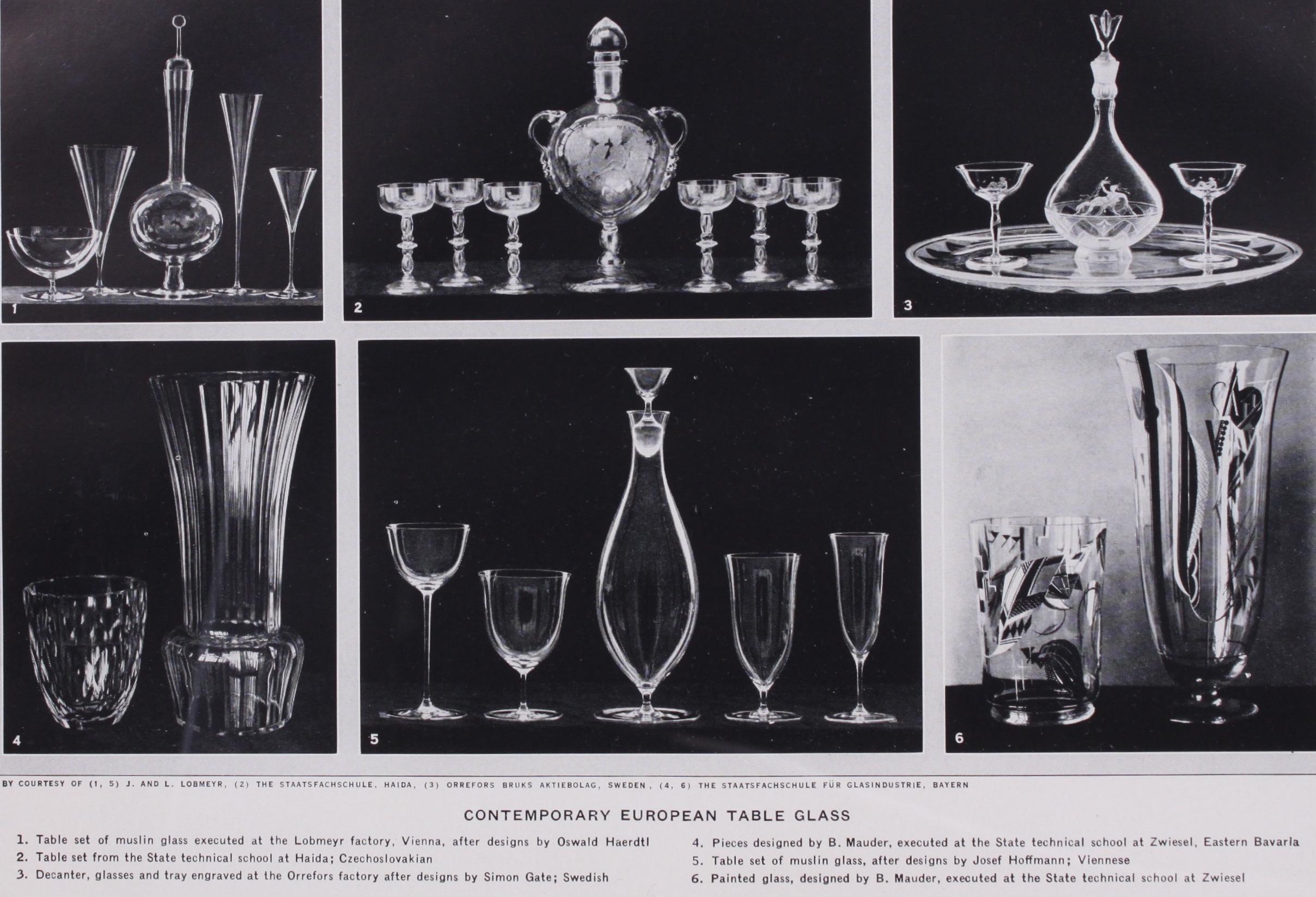
In the first half of the i9th century, German, and particularly Bohemian, glass-making enjoyed another considerable rise in importance. Besides cutting and engraving, painting with trans parent enamel colours was in great favour (Samuel Mohn, d. 1815; Gottlob Samuel Mohn, d. 182 5 ; Anton Kothgasser, d. 1851). Tinted glasses of all kinds, coloured in the metal, flashed and etched, were produced, as well as the popular lithyalin (an imitation of agate and other semi-precious stones), spun glass and "millefiori" in imitation of the old Venetian inventions, and many other types. Technically, the Biedermeier period reached an absolutely amazing height; but artistically it could not equal the best productions of other ages, particularly the i8th century. Subsequently, about 186o, a new movement set in under the leadership of the Viennese glass-manufacturer Ludwig Lobmeyr (1829-1902) ; inspired by the cut crystal work of the Renais sance, it ushered in a new renaissance in the art of glass-cutting, the modern development of which is explained below.