
THE RENAISSANCE (1600-1740) The 17th century in Germany presents a complete contrast to its predecessor; the fact that it was the century of the Thirty Years' War, which devastated the country, crippled the prosperity of the towns, and threw back by many generations the social de velopment of the people, explains much, but it can hardly be held entirely responsible for their intellectual apathy and slavery to foreign customs and foreign ideas.
There were, however, some branches of German poetry which escaped this foreign influence. The Church hymn, continuing the great Lutheran traditions, shows extraordinary richness both in quality and quantity. Paul Gerhardt (1607-76), the greatest German hymn-writer, was only one of many Lutheran pastors who in this age contributed to the German hymnal. On the Cath olic side, Angelus Silesius (Johann Scheffler, 1624-77) showed what a wealth of poetry lay in the mystic speculations of Jakob Boehme, the gifted shoemaker of Gorlitz (1575-1624), while Friedrich von Spee (1591-1635), another leading Catholic poet of the century, cultivated the pastoral allegory of the Renaissance. The revival of mysticism associated with Boehme gradually spread through the whole religious life of the 17th century. Besides the hymn, the Volkslied, which amidst the struggles and confusion of the great war bore witness to a steadily growing sense of patri otism, developed in its own way. But all else—if we except cer tain forms of fiction—stood completely under the influence of the Baroque.
The first focus of the Renaissance literature was Heidelberg, where, under the leadership of J. W. Zincgref (1591-1635), a number of scholars carried into practice that interest in the ver nacular which had been shown a little earlier by the German trans lator of Marot, Paul Schede or Melissus (1539-16o2). G. R. Weckherlin (1584-1653), a native of Wurttemberg who had spent the best part of his life in England, wrote Oden and Gesange (1618-19) of great promise. But the greatest, or at least the most influential writer of this group was Martin Opitz 1639). He was a native of Silesia and, as a student in Heidelberg, came into touch with Zincgref's circle ; subsequently, in the course of a visit to Holland, a more definite trend was given to his ideas by the example of the Dutch poet and scholar, Daniel Heinsius. As a poet, Opitz experimented with every form of Renaissance poetry, and with his Buck von der deutschen Poe terey (1624) he gave the German Renaissance its theoretical text book. In this tract, in which Opitz reproduced in German the doctrines of Scaliger and Ronsard, he not merely justified his own mechanical verse-making, but also gave Germany a law-book which regulated her literature for loo years.
The work of Opitz as a reformer was furthered by another institution of foreign origin, namely, literary societies modelled on the Accademia della Crusca in Florence. These societies, of which the chief were the Fruchtbringende Gesellschaf t or Pal menorden (founded 1617), the Elbschwanenorden in Hamburg and the Gekronter Blumenorden an der Pegnitz or Gesellschaf t der Pegnitzschafer in Nuremberg, were the centres of literary ac tivity during the unsettled years of the war. Although they pro duced much that was trivial, these societies also did German letters an invaluable service by their attention to the language, one of their chief objects being to purify it from foreign and un-German ingredients. J. G. Schottelius (1612-76) wrote his important grammatical works to further the objects of the Frucht bringende Gesellscha f t. Meanwhile the poetic centre of gravity in Germany had shifted from Heidelberg to Konigsberg, where a group of academic poets gave practical expression to the Opitz ian theory. Chief among them were Simon Dach , a gentle, elegiac writer on whom the laws of the Buch von der deutschen Poeterey did not lie too heavily, and the more manly and vigorous Paul Fleming (1609-4o) .
Satire was cultivated by two Low German poets, J. Laurem berg (159o-1658) and J. Rachel (1618-69), of whom at least the latter was accepted by the Opitzian school ; but there is satire, too, in the powerful and scathing sermons of J. B. Schupp (1610 61), an outspoken Hamburg preacher, and in the scurrilous wit of the Viennese monk Abraham a Sancta Clara (1644-1709), who had inherited something of his predecessor Murner's gift. Most gifted of all the Silesian group of writers is Friedrich von Logau 0604-55), Germany's greatest epigrammatist. Logau's 3,00o epigrams (Deutsche Sinngedichte, 1654) reflect admirably the intellectual temper of their age.
The cinef dramatist of the Renaissance movement is Andreas Gryphius (1616-64). Like Opitz, Gryphius was a Silesian, and a poet of no mean ability, as is to be seen from his lyric poetry; but his tragedies, modelled on the stiff Senecan pattern, suf fered from his ignorance of the more highly developed drama of France, not to speak of England; his models were Dutch. In the field of comedy, he was less hampered ; and his Horribili cribri f ax and Herr Peter Squentz—the latter an adaptation, prob ably through a Dutch intermediary, of the comic scenes of the Midsummer Night's Dream—are the best German plays of the I 7th century.
The German novel of the 17th century was largely a product of foreign influence, Spanish and French. Don Quixote had been partly translated early in the century and the picaresque romance had found its way to Germany still earlier; while H. M. Mosche rosch (1601-69) in his Gesichte Philanders von Sittewald (1642 43) made the Suenos of Quevedo the basis for vivid pictures of the life of the time, interspersed with satire. The best German novel of the 17th century, Der abenteurliche Simplicissimus (1669) by H. J. Christoffel von Grimmelshausen (c. 1625-76), is picaresque, but it owed little more than its form to the Spaniards. It is in great measure the autobiography of its author, and de scribes with uncompromising realism the social disintegration and the horrors of the Thirty Years' War. But this remarkable book stands alone. Christian Weise (1642-1708), rector of the Zittau gymnasium, wrote a few satirical novels, but his realism and satire are too obviously didactic. He is seen to better advantage in his dramas, of which he wrote more than 5o for performance by his scholars.
The real successor of Siinplicissimus in Germany was the Eng lish Robinson Crusoe, a novel which, on its appearance, was im mediately translated into German (172r); it called forth hundreds of imitations, the vogue of which is even still kept alive by Der schweizerische Robinson of J. R. Wyss (1812 seq.). With the exception of J. G. Schnabel's Insel Felsenburg (1731-43), the lit erary value of these imitations is slight ; but they represented a healthier and more natural development than the "gallant" novels of French provenance, written by writers like Philipp von Zesen (1619-89), Duke Anton Ulrich of Brunswick (1633-1714), A. H. Buchholtz (1607-71), H. A. von Ziegler (1653-97)—author of the famous Asiatische Banise (i688)—and D. C. von Lohenstein (1635-83). The last mentioned and Christian Hofmann von Hof mannswaldau (1617-79) are regarded as the leaders of a "sec ond Silesian school," opposed to the first school of Opitz. They cultivated the bombastic and Euphuistic style of the Italians Guarini and Marini, and of the Spanish writer Gongora.
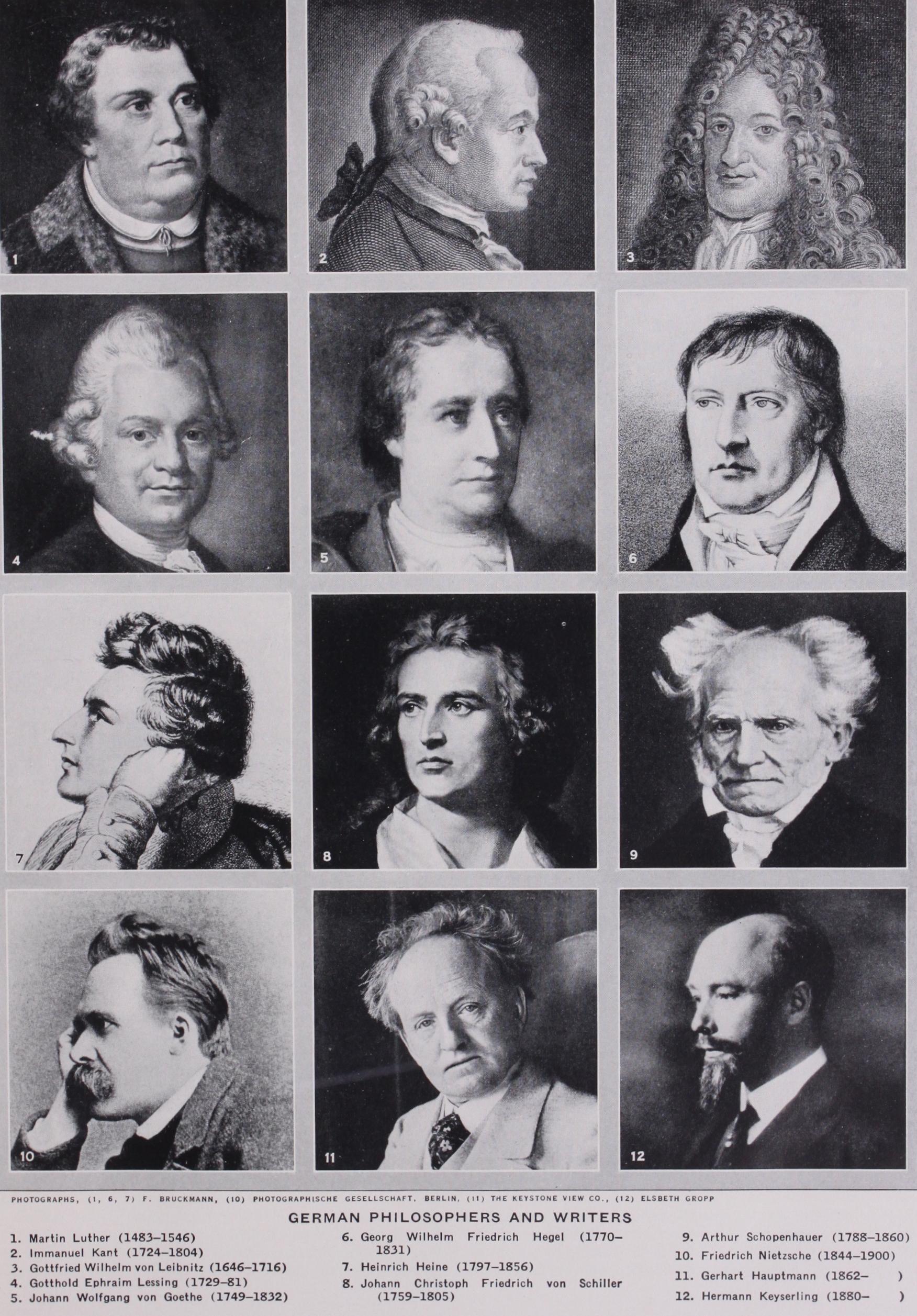
But this aberration of taste was of short duration. Although socially the recovery of the German people from the desolation of the war was slow and laborious, the intellectual life of Germany was rapidly recuperating. Samuel Pufendorf (1632-94), Chris tian Thomasius (1655-1728), Christian von Wolff and, above all, Gottfried Wilhelm Leibnitz (1646-1716), the first of the great German philosophers, laid the foundations of rationalism ; while German religious life was strengthened and enriched by a revival of pietism, under mystic thinkers like Philipp Jakob Spener (1635-1705), a revival which left its traces on re ligious poetry. The so-called "court poets"—Rudolf von Canitz , Johann von Besser (1654-1729) and Benjamin Neukirch (1665-1729)—substituted the "good taste" of Boileau for the extravagance of Marini ; and from their midst sprang one lyric poet, Johann Christian Gunther (1695-1723), of high gifts. In Hamburg, where the Italian opera kept the decadent Renais sance poetry alive, the incisive epigrams of Christian Wernigke (1661-1725) provided an effective antidote; and Barthold Hein rich Brockes (1680-1747), who had been deeply impressed by English nature-poetry, gave the artificiality of the Silesians its death-blow. Translations and imitations of the English Spectator, Tatler and Guardian—the so-called Moralische Wochenschriften —helped to regenerate literary taste, and implant healthy moral ideas in the German middle classes. Between 1724 and 1740 Johann Christoph Gottsched (17oo-66) succeeded in establishing in Leipzig, then the metropolis of German taste, literary reforms in accord with French 17th-century classicism. He purified the stage by abolishing irrelevant buffoonery, and provided it with a repertory largely of French origin ; and in his Kritische Dicht kunst (173o) he laid down the principles according to which good literature was to be produced and judged. With Gottsched the period of German Renaissance literature reaches its culmination and at the same time its close.