
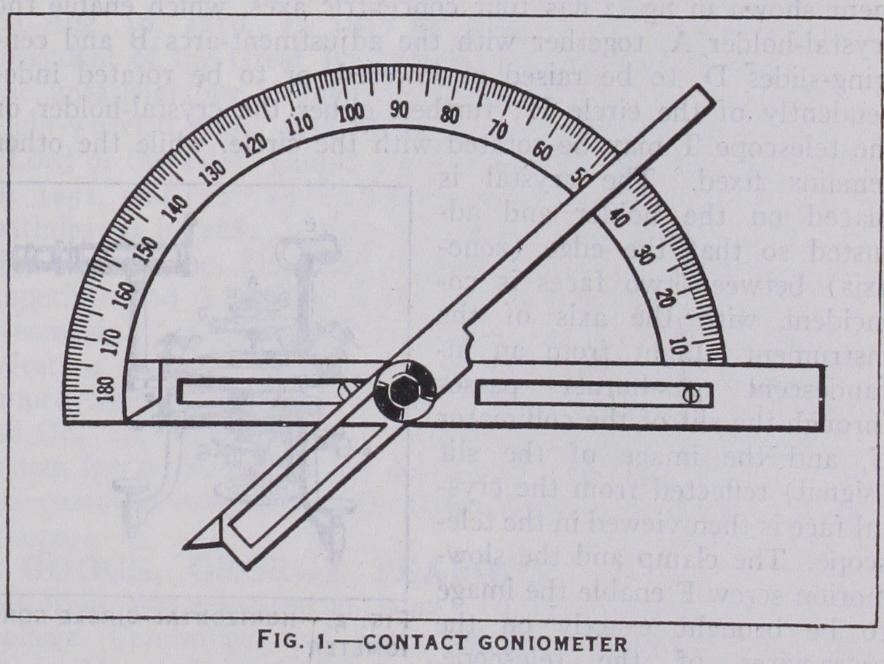
GONIOMETER, an instrument for measuring the angles of crystals ; there are two kinds—the contact goniometer and the re flecting goniometer.
Several forms of instruments depending on this principle have been devised. One consists of a graduated circle reading degrees and minutes, which turns with a milled head about a horizontal axis. The crystal is attached with a mixture of beeswax and pitch to a holder and by means of pivoted arcs is adjusted so that the edge between two faces (a zone-axis) is parallel to, and coincident with, the axis of the instrument. The crystal-holder and adjustment-arcs, together with the milled head are carried on an axis which passes through the hollow axis of the graduated circle, and may thus be rotated independently of the circle. In use, the goniometer is placed directly opposite to a window, with its axis parallel to the horizontal window-bars, and as far distant as possible. The eye is placed quite close to the crystal, and the image of a slit in a dark screen as seen in the crystal-face is made to coincide with a chalk mark on the floor as seen directly; this is done by turning the milled head, the reading of the gradu ated circle having previously been observed. Without moving the eye, the crystal is then rotated until the image from a second face is brought into the same position ; the difference between the first and second readings of the graduated circle will then give the angle between the normals of the two faces.
Several improvements have been made on this goniometer. The adjustment-arcs have been modified; a mirror of black glass fixed to the stand beneath the crystal gives a reflected image of the signal, with which the reflection from the crystal can be more conveniently made to coincide; a telescope provided with cross-wires gives greater precision to the direction of the reflected rays of light ; and with the telescope a collimator has sometimes been used. A still greater improvement was effected by placing the graduated circle in a horizontal position. Many forms of the horizontal-circle goniometer have been constructed; they are pro vided with a telescope and collimator, and in construction are essentially the same as a spectrometer, with the addition of ar rangements for adjusting and centring the crystal. The instru ment shown in fig. 2 has four concentric axes, which enable the crystal-holder A, together with the adjustment-arcs B and cen tring-slides D, to be raised or lowered, or to be rotated inde pendently of the circle H; further, either the crystal-holder or the telescope T may be rotated with the circle, while the other remains fixed. The crystal is placed on the holder and ad justed so that the edge (zone axis) between two faces is co incident with the axis of the instrument. Light from an in candescent gas-burner passes through the slit of the collimator C, and the image of the slit (signal) reflected from the crys tal face is then viewed in the tele scope. The clamp and the slow motion screw F enable the image to be brought exactly on the cross-wires of the telescope, and the position of the circle with respect to the vernier is read through the lens. The crystal and the circle are then rotated to gether until the image from a second face is brought on the cross wires of the telescope, and the angle through which they have been turned is the angle between the normals to the two faces. While measuring the angles between the faces of crystals the telescope remains fixed by the clamp (3, but when this is released the instru ment may be used as a spectrometer or refractometer for deter mining, by the method of minimum deviation, the indices of refraction of an artificially cut prism or of a transparent crystal when the faces are suitably inclined to one another.
With a one-circle goniometer, such as is described above, it is necessary to mount and re-adjust the crystal afresh for the meas urement of each zone of faces (i.e., each set of faces intersecting in parallel edges) ; with very small crystals this operation takes a considerable time, and the minute faces are not readily identified again. Further, in certain cases, it is not possible to measure the angles between zones, nor to determine the position of small faces which do not lie in prominent zones on the crystal. These diffi culties have been overcome by the use of a two-circle goniometer or theodolite-goniometer, which is a combination of a vertical circle goniometer. In these instruments the crystal is set up and adjusted with the axis of a prominent zone parallel to the axis of either the horizontal or the vertical circle. As a rule, only in this zone can the angles between the faces be measured directly ; the positions of all the other faces, which need be observed only once, are fixed by the simultaneous readings of the two circles. These readings, corresponding to the polar distance and azimuth, or latitude and longitude readings of astronomical telescopes, must be plotted on a projection before the symmetry of the crystal is apparent ; and laborious calculations are necessary in order to determine the indices of the faces and the angles between them, and the other constants of the crystal ; or to test whether any three faces are accurately in a zone.
These disadvantages are overcome by adding still another grad uated circle to the instrument, with its axis perpendicular to the axis of the vertical circle, thus forming a three-circle goniometer. With such an instrument measurements may be made in any zone or between any two faces without re-adjusting the crystal; further the troublesome calculations are avoided, and, indeed, the instru ment may be used for solving spherical triangles.
Goniometers of special construction have been devised for measuring crystals during their growth in the mother-liquid; for cutting section-plates and prisms from crystals (precious stones) accurately in any desired direction. The instrument commonly employed for measuring the optic axial angle of biaxial crystals is really a combination of a goniometer with a polariscope. For the optical investigation of minute crystals under the microscope, various forms of stage-goniometer with one, two or three gradu ated circles have been constructed. An ordinary microscope fitted with cross-wires and a rotating graduated stage serves the purpose of a goniometer for measuring the plane angles of a crystal face or section, being the same in principle as the contact goniometer.
For fuller descriptions of goniometers see text-books of Crys tallography and Mineralogy, especially P. H. Groth, Physikalische Krystallographie (4th ed., Leipzig, . See also C. Leiss, Die optischen Instrumente der Firma R. Fuess, deren Beschreibung, Justierung and Anwendung (Leipzig, 1899). (L. J. S.)