
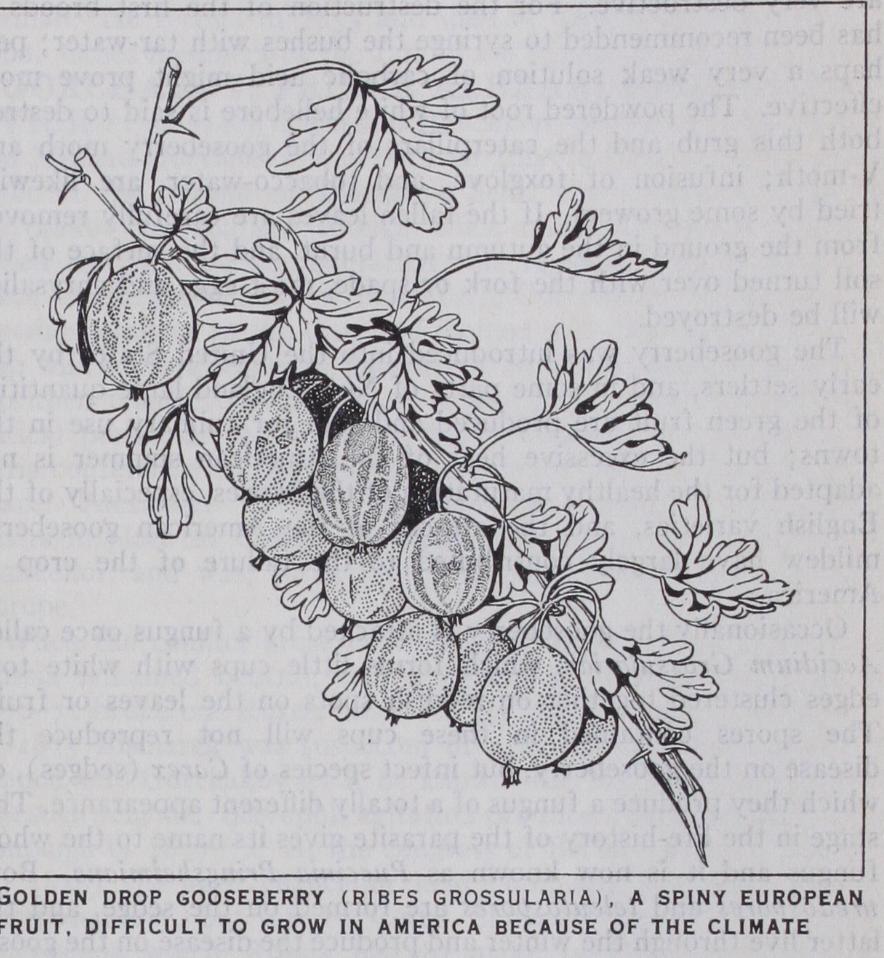
GOOSEBERRY, Ribes Grossularia, a well-known fruit-bush of northern and central Europe, placed in the same genus of the family Saxifragaceae as the closely allied currants. It forms a dis tinct section Grossularia, the members of which differ from the true currants chiefly in their spinous stems, and in their flowers growing on short foot-stalks, solitary, or two or three together, instead of in racemes.
The wild gooseberry is a small, straggling bush, nearly resem bling the cultivated plant,—the branches being thickly set with sharp spines, standing out singly or in diverging tufts of two or three from the bases of the short spurs or lateral leaf shoots, on which the bell-shaped flowers are produced, singly or in pairs, from the groups of rounded, deeply-crenated 3- or 5-lobed leaves. The fruit is smaller than in the garden kinds, but is often of good flavour; it is generally hairy, but in one variety smooth; the colour is usually green, but plants are occasionally met with having deep purple berries. The gooseberry is indigenous in Europe and western Asia, growing naturally in alpine thickets and rocky woods in the lower country, from France eastward, perhaps as far as the Himalayas. In Britain it is often found in copses and hedge rows and about old ruins, but has been so long a plant of cultiva tion that it is difficult to decide upon its claim to a place in the native flora of the island. Of the many hundred sorts enumerated in horticultural works, few equal in flavour some of the older deni zens of the fruit-garden, such as the "old rough red" and "hairy amber." The climate of the British Isles seems peculiarly adapted to bring the gooseberry to perfection, and it may be grown successfully even in the most northern parts of Scotland; indeed, the flavour of the fruit is said to improve with increasing latitude. In Norway the bush flourishes in gardens on the west coast nearly up to the Arctic Circle, and it is found wild as far north as 63°. The dry summers of the French and German plains are less suited to it, though it is grown in some hilly districts with tolerable suc cess. It will succeed in almost any soil, but prefers a rich loam or black alluvium, and, though naturally a plant of rather dry places, will do well in moist land, if drained.
The varieties are easily propagated by cuttings planted in the autumn, which root rapidly, and in a few years form good fruit bearing bushes. Much difference of opinion prevails regarding the mode of pruning this valuable shrub ; it is probable that in differ ent situations it may require varying treatment. The fruit being borne on the lateral spurs, and on the shoots of the last year, it is the usual practice to shorten the side branches in the winter, before the buds begin to expand. When large fruit is desired, plenty of manure should be supplied to the roots, and the greater portion of the berries picked off while still small. If standards are desired, the gooseberry may be grafted or budded with advantage on stocks of some other species of Ribes, R. aureum, the orna mental golden currant of the flower garden, answering well for the purpose. The bushes at times suffer much from the ravages of the caterpillars of the gooseberry or magpie moth, Abraxas grossu lariata, which often strips the branches of leaves in the early sum mer, if not destroyed before the mischief is accomplished. The most effectual way of getting rid of this destructive insect is to look over each bush carefully, and pick off the larvae by hand. Equally annoying in some years is the smaller larva of the V moth, Halias vanaria, which often appears in great numbers, and is not so readily removed. The gooseberry is sometimes attacked by the grub of the gooseberry sawfly, Nematus ribesii, of which several broods appear in the course of the spring and summer, and are very destructive. For the destruction of the first broods it has been recommended to syringe the bushes with tar-water; per haps a very weak solution of carbolic acid might prove more effective. The powdered root of white hellebore is said to destroy both this grub and the caterpillars of the gooseberry moth and V-moth ; infusion of foxglove, and tobacco-water, are likewise tried by some growers. If the fallen leaves are carefully removed from the ground in the autumn and burnt, and the surface of the soil turned over with the fork or spade, most eggs and chrysalids will be destroyed.
The gooseberry was introduced into the United States by the early settlers, and in some parts of New England large quantities of the green fruit are produced and sold for culinary use in the towns; but the excessive heat of the American summer is not adapted for the healthy maturation of the berries, especially of the English varieties, and the attacks of the American gooseberry mildew have largely contributed to the failure of the crop in America.
Occasionally the gooseberry is attacked by a fungus once called Aecidiura Grossulariae, which forms little cups with white torn edges clustered together on reddish spots on the leaves or fruits The spores contained in these cups will not reproduce the disease on the gooseberry, but infect species of Carex (sedges), on which they produce a fungus of a totally different appearance. This stage in the life-history of the parasite gives its name to the whole fungus and it is now known as Puccinia Pringsheimiana. Both uredospores and teleutospores are formed on the sedge, and the latter live through the winter and produce the disease on the goose berry in the succeeding year.
A much more prevalent disease is that caused by Microsphaeria Grossulariae. This is a mildew growing on the surface of the leaf and sending suckers into the epidermis. The white mycelium gives the leaves of the plant the appearance of having been whitewashed. There are numerous white spores produced in the summer which are able to germinate immediately, and later small blackish fruits (perithecia) are produced that pass uninjured through the winter liberating the spores they contain in the spring, which infect the young developing leaves of the bush. In bad cases the plants are greatly injured but frequently little harm is done.
An allied fungus, Sphaerot)ieca mors-uvae, of much greater vir ulence, causes the disease known as "American gooseberry mil dew." For the most part the mode of attack is similar to that of the last-mentioned, but not only are the leaves attacked, but the tips of the young shoots and the fruits become covered by the cobweb-like mycelium, the attack frequently resulting in the death of the shoots and the destruction of the fruits. After a time the mycelium becomes rusty brown and produces the winter form of the fungus. Through the winter the shoots are covered thickly with the brown mycelium and in the spring the spores contained in the perithecia germinate and start the infection anew, as in the case of the European mildew.
The gooseberry, when ripe, yields a wine by the fermentation of the juice with water and sugar, the resulting sparkling liquor re taining much of the flavour of the fruit. By similarly treating the juice of the green fruit, picked just before it ripens, an efferves cing wine is produced, nearly resembling some kinds of cham pagne, and, when skilfully prepared, far superior to much of the liquor sold under that name. Brandy has been made from ripe gooseberries by distillation; by exposing the juice with sugar to the acetic fermentation, a good vinegar may be obtained. The gooseberry, when perfectly ripe, contains a large quantity of sugar, most abundant in the red and amber varieties ; in the former it amounts to from 6 to upwards of 8%. The acidity of the fruit is chiefly due to malic acid.
Several other species of the sub-genus produce edible fruit, though none have been brought under economic culture. Among them may be noticed R. oxyacanthoides and R. Cynosbati, abun dant in Canada and the northern United States, and R. gracile, common along the Allegheny range. The group is widely dis tributed in the north temperate zone,—one species is found in Europe extending to the Caucasus and North Africa (Atlas Mountains), five occur in Asia and nineteen in North America, the range extending southwards to the republics of Mexico and Guatemala.