
GOTHIC ARCHITECTURE IN ENGLAND Although pointed arches occur spasmodically in England in various buildings dating from the last half of the 12th century, English Gothic first appears in a complete form in the choir of Canterbury cathedral, built by the French architect William of Sens (1175-78). This was designed according to a predominantly French scheme, with a six-part vault, a developed chevet and crocketed capitals. Nevertheless, certain English characteristics appear in the generally low proportions and the amount of wall surface. Similarly, in Westminster Abbey (begun 1245), although the high vault and some of the tracery details are French in type, the ornament and arch shapes are purely English. Two main in fluences caused the difference between English and French work. The first was that in England no break or rivalry between the regular and secular clergy occurred such as that which had taken place in France. The monasteries were everywhere powerful. Especially important architecturally was the influence of the Cistercian order, with its insistence upon simplicity and restraint, to which was due, in no small part, the English abandonment of the chevet plan in favour of the square east end, as well as the development of the moulded capital without foliage, and the English skill in the invention of varied moulding profiles. The tradition of Norman church building strengthened the English Gothic love of simple wall and textured surface in place of the rigid French articulation. Thus the English never sought the soaring heights of the French churches, or the lavish use of carved ornament and sculpture.

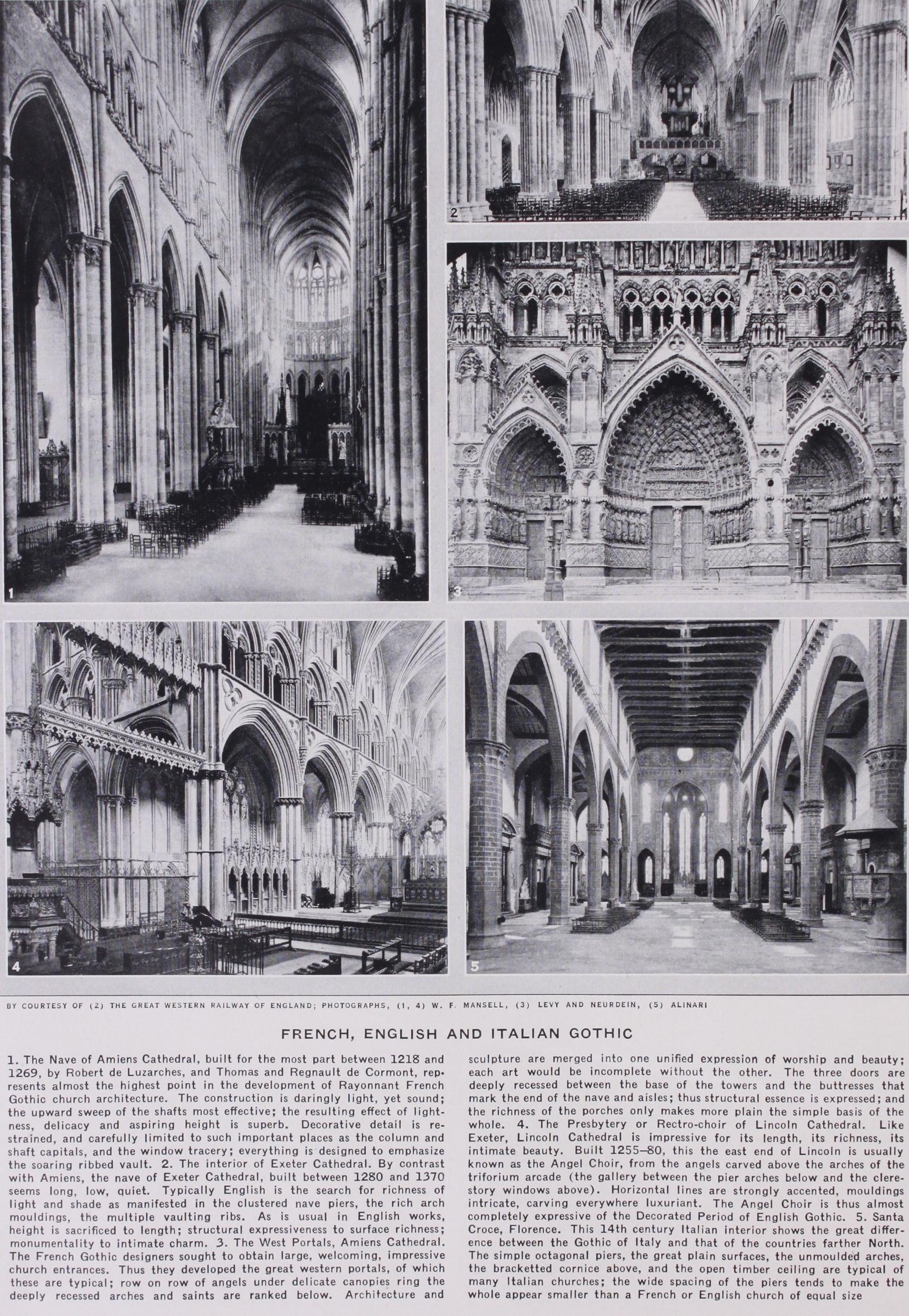
Yet even such decorative enrichment as that of the Angel Choir of Lincoln did not give sufficient scope for the English imagina tion, and about the beginning of the 14th century the introduc tion of reversed curves and flowing lines in tracery brought about the second phase of English decorated Gothic, known as cur vilinear. Although at first merely developing varieties of geo metric forms, like the reticulated windows in which, as in the early i4th century church of New Romney, the whole arched head is filled with a regularly arranged network of flowing bars, in later examples, the geometric basis was forgotten, and the tracery patterns often simulate leaf, tree or branch forms. The great west window of York cathedral (1338), and the rose win dow of Lincoln, known as the "bishop's eye" (1350), show beau tifully this freer type of curvilinear work. There was too, an immense development of vaulting by the introduction of many tiercerons, and a growing enrichment of carving throughout. Moulding profiles are, however, simplified. The effect can best be seen in the cathedral at Exeter, which was built in the cur vilinear style (129o-1367). Here the ranked colonnettes of the clustered piers, the richly simple pier arches, the vaulting shafts resting on carved corbels, the tiny triforium and the forest of branching vaulting ribs combine to produce an effect of warmth, richness, invitation and mystery. The choir, Lady Chapel and octagon of Ely cathedral (1321-49), form another combination with the same characteristics, and the octagon, with its wooden vault, is remarkable as an example of the inventiveness of the curvilinear architects, in this case Alan of Walsingham. There was an accompanying lavishness in all types of church furniture and minor work, such as tombs, chantries, screens and choir stalls. In these, the richest use was made of gablets, false gables, finials, foliated cusping, crockets and foliage. The choir stalls at Ely, the choir screen of Southwell minster and the Percy tomb at Beverly (1365) are examples.
The decorated period also saw the development of the charac teristic English simple, slim, stone spires. That of Salisbury 0329-75), rising in simple lines 406 ft. high, is only one of many instances which show how felicitously the English combined the octagonal spire with a square tower.
Perpendicular.—Meanwhile, a new style, the perpendicular, was developing. It started at Gloucester abbey where, between 1327 and 1377, the entire Norman choir interior was altered, re faced and vaulted. In this alteration curvilinear lines are for gotten. Wall surfaces are covered with rectangular, arched headed panels, and the lines of the tracery carried vertically down to the floor. In the south transept window (1337), the main divisions are vertical, although reminiscences of curvilinear tracery exist, but in the great east window (13 7 7) the fully developed perpen dicular scheme is apparent, with its light and heavy mullions, its horizontal ranges of arched lights capped by a cornice, and the smaller subdivisions of the upper portion. Moreover, in the vault (q.v.), the additions of liernes (small connecting ribs between the tiercerons), and the elaboration of carved bosses, produced a veritable network of lacy richness. At the same time, mould ings were flattened and carved ornament reduced. At Winchester, between 1345 and 1394, a similar alteration using the same forms was made in a Norman fabric. Furthermore, the use of the f our centred arch appeared in pier arches. At Gloucester, in the clois ter (begun 1351), fan vaulting appeared in an entirely de veloped form. Thus the final step in the decorative development of vaulting was achieved ; ribs, at first structural, had become so numerous and complicated, that their decorative function over balanced the structural, and in fan vaulting they are only decora tive, being carved in the form of tracery on the lower side of a completely cut stone vault. The climax of fan vaulting develop ment was reached in Kings college chapel at Cambridge and the Henry II. chapel at Westminster abbey. (See FAN VAULT.) The perpendicular period is also notable for the tremendous number of lavish parish churches, such as St. Mary Redcliffe, Bristol and Lavenham church in Suffolk. Many of these are extremely rich on the outside and distinguished by the use of polychrome masonry of flint and free-stone and the exquisite square towers which are so characteristic of the period and were so frequently added to earlier churches. In decorative detail the same love of rectangularity seen in the tracery finds complete expression. The four-centred arch is almost universal. When used for doors and windows it is enclosed within a rectangular frame and the spandrils filled with tracery or carving. Battle mented parapets, frequently pierced with tracery, are found, sometimes even on interior work. The capital almost disappears and takes the form of the simple band of mouldings with occa sional rudimentary foliage. Moulding profiles are flat, delicate rather than strong, and sometimes decorated with rosettes re peated at intervals. This style was reaching its highest develop ment just when Renaissance architecture (q.v.) was being grad ually introduced, and its influence was strong.