
GRANITE, in petrology, the group name for a family of plutonic or deep-seated acidic igneous rocks characterized essen tially by the presence of the minerals, quartz, felspar (orthoclase, microcline, perthite, anorthoclase [rarely], acid plagioclase) and some ferromagnesian mineral (mica, amphibole or pyroxene). Granites are wholly crystalline and possess a typical hypidio morphic or irregular granular (granitoid) texture—whence the name from Lat. "granum," a grain. When, however, they are porphyritic, the phenocrysts may possess well defined crystal lographic outlines. In popular usage the term granite is applied to almost any crystalline rock, irrespective of its composition or origin.
According to their mineralogical composition, the granites may be subdivided broadly into three groups : (a) alkali-granites (b) calc-alkali granites and the intermediate (c) adamellite granites. This subdivision is based on the nature and quantitative proportions of the contained felspar; alkali granites possess a predominance of alkali felspar, calc-alkali granites a predominance of lime-bearing plagioclase, and the adamellite granites have alkali felspar and lime-bearing plagioclase in approximately equal proportions. The alkali-granites are again subdivided into potash granites (dominant potash felspar) and soda granites (dominant albite felspar) . The chief ferro-magnesian mineral of the former is biotite (lepidomelane, zinnwaldite) and may be accompanied by muscovite. The rarer soda granites have as dark constituents soda-amphiboles (arfvedsonite, hastingsite or riebeckite) or soda pyroxenes (acmite, aegirine or aegerine-augite).
The calc-alkali granites are typically represented by the great group of granodiorites, in which there is a great predominance of lime-plagioclase (oligoclase to andesine). The ferro-magnesian minerals are biotite, green hornblende or an alumina-poor py roxene near diopside in composition. These ferro-magnesian minerals also characterize the adamellite group of granites. Different varieties are usually distinguished by prefixing the name of the dominant ferro-magnesian mineral, e.g., hornblende-granite, aegirine granite, etc.
The distinctive type carrying rhombic pyroxene (hypersthene) is usually referred to under the name charnockite (q.v.). Amphi bole- and pyroxene-bearing granites never carry muscovite, which occurs only in association with biotite or alone, as in muscovite granite. The granites usually carry minor amounts of other minerals, the principal being apatite, zircon (often enclosed in biotite and yielding pleochroic haloes due to their content of uranium or thorium), titanite, magnetite and ilmenite. Less frequently monazite, spessartine-rich garnet orthite, topaz, fluorite and cassiterite occur. Tourmaline may appear as a primary accessory, but it is most of ten of pneumatolytic origin (see PNEUMATOLYSIS). Cordierite and andalusite only occur in those granites which have assimilated the country rock into which they are intruded. These two minerals are well known in the granites of Cornwall and Devon.
In hand specimens granites show a great variety of colour, dependent on the abundance of the dark constituents or the state of preservation of the contained felspar. Many potash granites are pink or red, due to the colour of the orthoclase felspar. Calc-alkali granites are more usually grey or white. Porphyritic granites are common, the phenocrysts being felspars, some of the best known examples being those of Cornwall.
In the field, granite usually occurs in great masses covering wide areas. They form the rocks of many batholiths, laccoliths and stocks, and frequently appear in the core of mountain ranges. Granites are by far the most abundant of the plutonic intrusive rocks visible on the earth's surface, and appear in batholiths of great dimensions as in British Columbia and Patagonia. It is probable that many apparently homogeneous granite laccoliths, etc., are not single intrusive masses but multiple intrusions in the form of sheets successively injected, as is the case for the granite laccolite of Dartmoor.
Evidence of the intrusive character of granite is principally provided by the occurrence of transgressive dikes and veins pro ceeding from it into the surrounding strata, and by the alteration which the granite produces in the country rock through a zone varying from a few yards to a mile or more in breadth around it (see METAMORPHISM). Seen in natural sections, many granites have a rudely columnar appearance. Others weather into large cuboidal blocks which may produce structures resembling cyclo pean masonry. The tors of the west of England are of this nature. These differences depend on the disposition of the joint cracks which traverse the rock and are opened up by the action of frost and weathering.
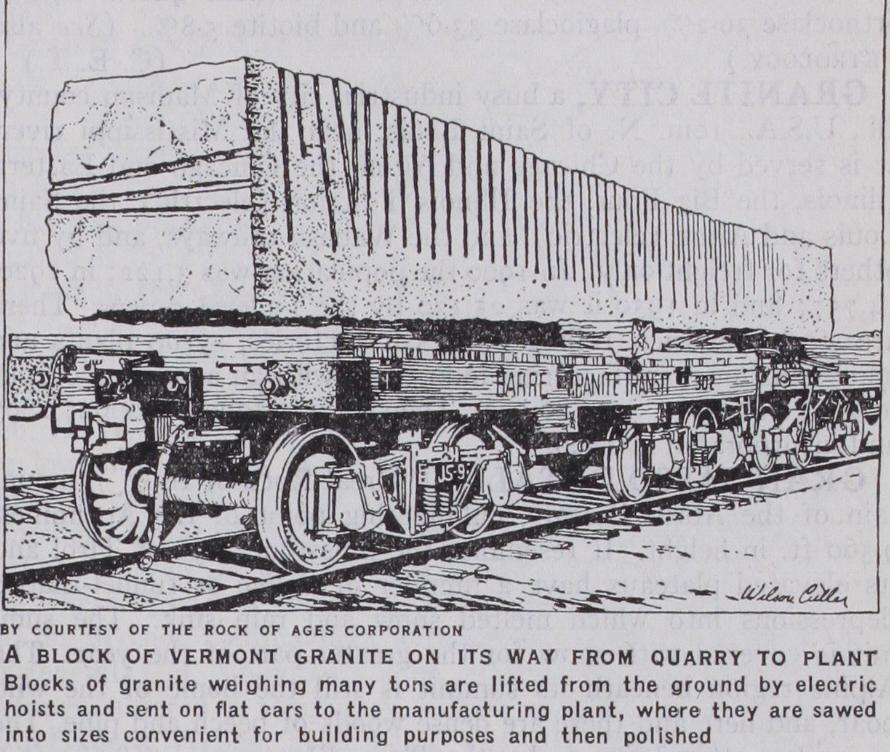
As a group the granites are of very great economic importance. They form the country rock of a vast number of metalliferous deposits in many parts of the world. Gold, tin, tungsten and bismuth may be especially mentioned. The chinastone used in pottery is frequently derived by the pneumatolytic action of residual vapours upon the solidified granite. As a building stone, granite is of great importance, particularly for works of some magnitude.
The chemical composition of a few granites from different parts of the world is given below :— Only the most important constituents are shown in the table, but all granites contain also small amounts of MnO, Zr02, Ba0 and water. These aggregate usually less than i%, except water, which may rise to 2 or more per cent in weathered ocks. From the chemical composition it may be computed that granites contain 2o% to 5o% of quartz, the total silica content varying from 66% to 8o%. The shap granite, e.g. (see analysis 5) by micrometric analysis is shown to contain quartz orthoclase 36.2%, plagioclase 33.6% and biotite 5.8%. (See also PETROLOGY.) (C. E. T.)